
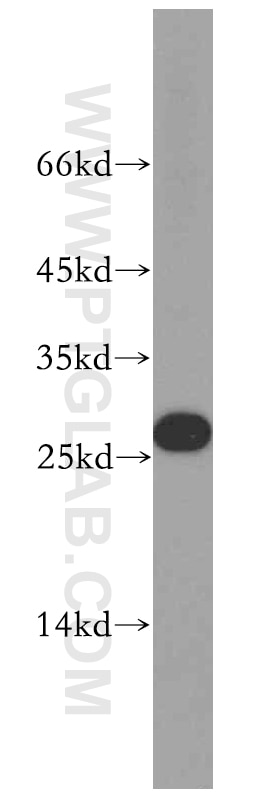
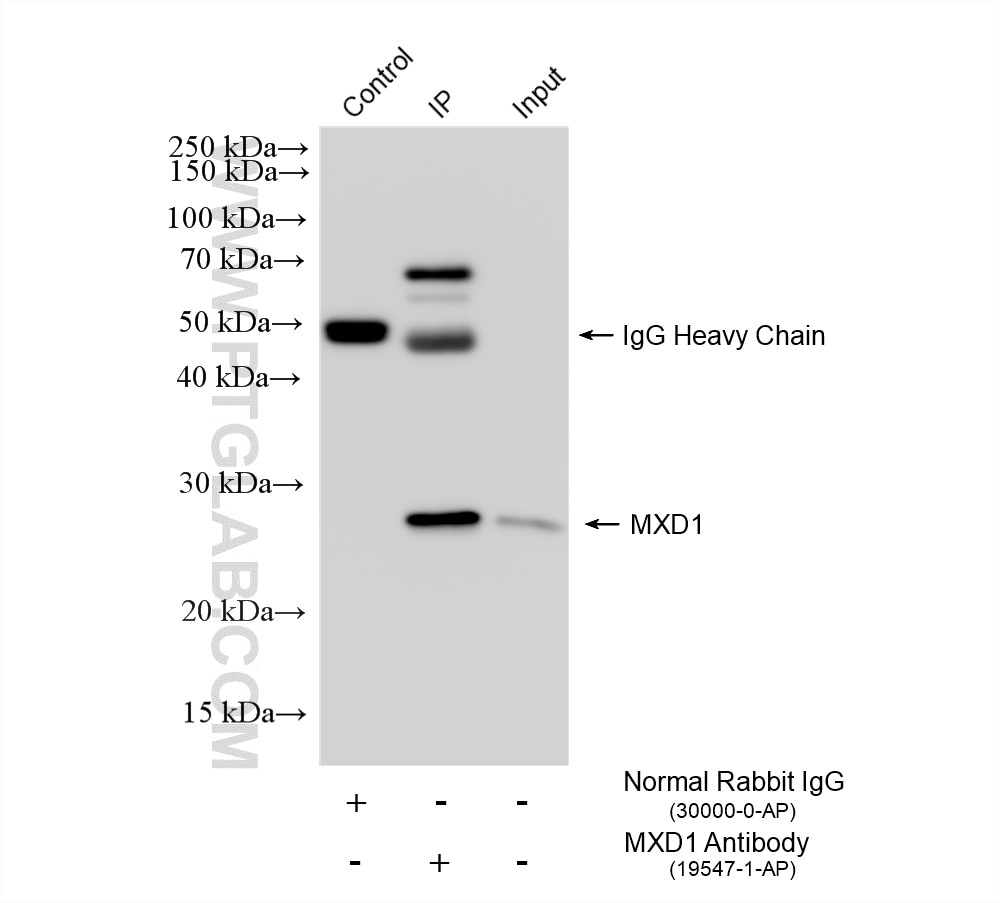

Tested Applications
| Positive WB detected in | HepG2 cells |
| Positive IP detected in | HepG2 cells |
Recommended dilution
| Application | Dilution |
|---|---|
| Western Blot (WB) | WB : 1:500-1:3000 |
| Immunoprecipitation (IP) | IP : 0.5-4.0 ug for 1.0-3.0 mg of total protein lysate |
| It is recommended that this reagent should be titrated in each testing system to obtain optimal results. | |
| Sample-dependent, Check data in validation data gallery. | |
Product Information
19547-1-AP targets MXD1 in WB, IP, chIP, ELISA applications and shows reactivity with human samples.
| Tested Reactivity | human |
| Cited Reactivity | human, mouse |
| Host / Isotype | Rabbit / IgG |
| Class | Polyclonal |
| Type | Antibody |
| Immunogen |
Peptide Predict reactive species |
| Full Name | MAX dimerization protein 1 |
| Calculated Molecular Weight | 25 kDa |
| Observed Molecular Weight | 25 kDa |
| GenBank Accession Number | NM_002357 |
| Gene Symbol | MXD1 |
| Gene ID (NCBI) | 4084 |
| RRID | AB_10641995 |
| Conjugate | Unconjugated |
| Form | Liquid |
| Purification Method | Antigen affinity purification |
| UNIPROT ID | Q05195 |
| Storage Buffer | PBS with 0.02% sodium azide and 50% glycerol, pH 7.3. |
| Storage Conditions | Store at -20°C. Stable for one year after shipment. Aliquoting is unnecessary for -20oC storage. 20ul sizes contain 0.1% BSA. |
Background Information
MXD1, also named as MAD, is a transcriptional repressor. MAD1 binds with MAX to form a sequence-specific DNA-binding protein complex which recognizes the core sequence 5'-CAC[GA]TG-3'. MAD thus antagonizes MYC transcriptional activity by competing for MAX. There're two isoforms of MXD1 protein.
Protocols
| Product Specific Protocols | |
|---|---|
| IP protocol for MXD1 antibody 19547-1-AP | Download protocol |
| WB protocol for MXD1 antibody 19547-1-AP | Download protocol |
| Standard Protocols | |
|---|---|
| Click here to view our Standard Protocols |
Publications
What published studies show
MXD1 Polyclonal antibody (Cat# 19547-1-AP) has 3 total citations published in Theranostics, Journal of Biological Chemistry, and Cell Reports. The associated research fields include m6A RNA modification and retinal neovascularization, glucose metabolism and long noncoding RNA regulation, and CRAC channel signaling in autoimmune inflammation.
| Species | Application | Title |
|---|---|---|
Theranostics BARD1-mediated stabilization of METTL14 promotes retinal neovascularization by m6A-modifying MXD1 mRNA on a YTHDF2-dependent manner | ||
J Biol Chem Role for carbohydrate response element-binding protein (ChREBP) in high glucose-mediated repression of long noncoding RNA Tug1. | ||
Cell Rep Temporal CRAC channel blockade modulates the MYC-MXD axis to attenuate autoimmune inflammation. |



