
Speedy™ Mouse Albumin One-Step ELISA Kit
Cat no : SE60018
Synonyms
Alb, Alb 1, Alb1, albumin
Validation Data Gallery
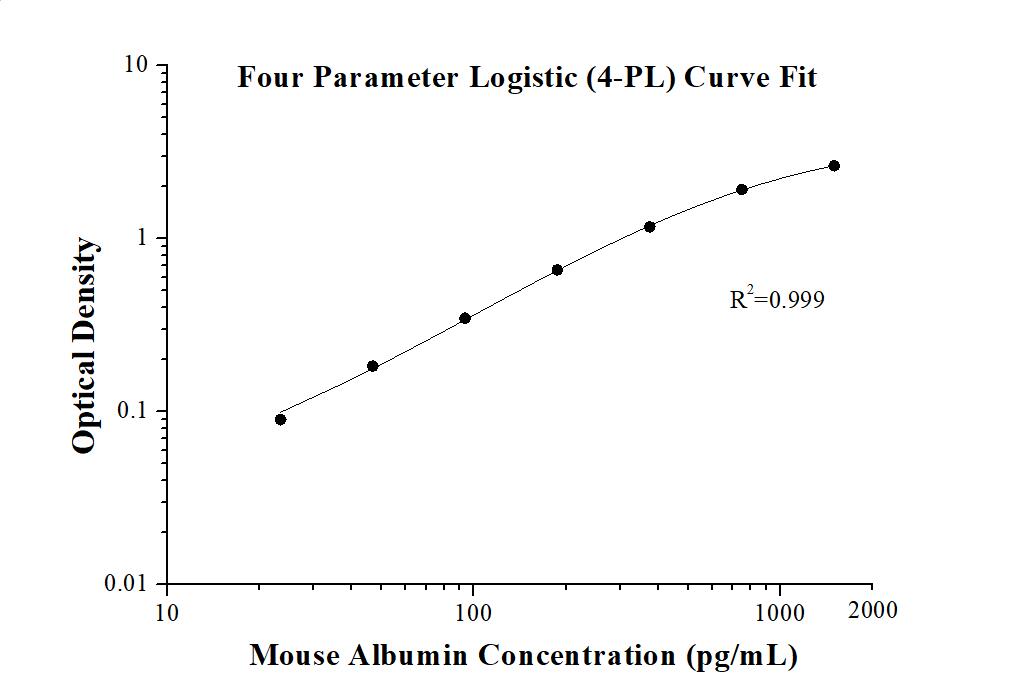
Product Information
| Product name | Speedy™ Mouse Albumin One-Step ELISA Kit |
| Tests | 1 X 96 well plate |
| Sample type | Serum, Plasma, Urine |
| Assay type | Sandwich |
| Sensitivity | 2.9 pg/mL |
| Range | 23.4-1500 pg/mL |
| Reactivity | Mouse |
| Tested applications | Sandwich ELISA |
| Gene ID (NCBI) | 11657 |
Recovery
| Sample Type | Average | Range |
|---|---|---|
| Mouse serum | 93% | 85%-104% |
| Urine | 98% | 85%-118% |
IntraAssay
| Sample | n | mean ( pg/mL) | SD | CV% |
|---|---|---|---|---|
| 1 | 8 | 726.9 | 39.6 | 5.4 |
| 2 | 8 | 178.7 | 10.5 | 5.9 |
| 3 | 8 | 98.8 | 3.9 | 3.9 |
InterAssay
| Sample | n | mean ( pg/mL) | SD | CV% |
|---|---|---|---|---|
| 1 | 16 | 728.4 | 32.9 | 4.5 |
| 2 | 16 | 180.5 | 10.3 | 5.7 |
| 3 | 16 | 98.5 | 4.1 | 4.2 |
Background Information
Albumin is one of the main proteins in animal species, which plays a decisive role in the transport of various ions and in maintaining the colloidal osmotic pressure of the blood. Albumin is able to bind to almost all known drugs, as well as many nutraceuticals and toxic substances, largely determining their pharmaco-and toxicokinetics. Albumin is not only passive, but also an active participant of pharmacokinetic and toxicokinetic processes, possessing a number of enzymatic activities. Numerous experiments have shown esterase or pseudoesterase activity of albumin towards a number of endogeneous and exogeneous esters. Due to the free thiol group of Cys34, albumin can serve as a trap for reactive oxygen and nitrogen species, thus participating in redox processes. Glycated albumin makes a significant contribution to the pathogenesis of diabetes and other diseases. The interaction of albumin with blood cells, blood vessels and tissue cells outside the vascular bed is of great importance. Interactions with endothelial glycocalyx and vascular endothelial cells largely determine the integrative role of albumin.
Properties
| Storage Instructions | All the reagents are stored at 2-8℃ for 6 months or -20℃ for 12 months. Refer to the protocol for further storage instructions. |
| Synonyms | Alb, Alb 1, Alb1, albumin |
FAQ
1、I have limited sample diluent. How should I handle samples requiring high dilution factors?
Answer: We recommend performing a serial dilution. For example, if human serum requires a 1,000,000-fold dilution, you can use a three-step 100× dilution method as follows:
Step 1: Take 2 uL of human serum and add it to 198 uL of sample diluent, mix thoroughly to obtain a 100-fold diluted sample.
Step 2: Take 2 uL of the 100-fold diluted sample and add it to 198 uL of sample diluent, mix thoroughly to obtain a 10,000-fold diluted sample.
Step 3: Take 2 uL of the 10,000-fold diluted sample and add it to 198 uL of sample diluent, mix thoroughly to obtain a 1,000,000-fold diluted sample.
If further dilution is required, additional serial steps can be used. We do not recommend using any other solutions or water for dilution, except for the sample diluent we suggest. If your sample diluent is still insufficient, please contact our customer service for more sample diluent.
2、If thermostatic shaker is not available, will it affect the duration of my experiment and the experimental data?
Answer: If thermostatic shaker is not available, it may take 2.5 hours to complete this experiment. After adding the antibody cocktail, we suggest you incubate the plate at 37℃ for 2 hours. After adding TMB, you only need to incubate the plate at 37℃ for 15 minutes. Through comparative experiments, our R&D personnel have confirmed that you can still obtain valid experimental data, although the signal will be slightly reduced.