
Mouse CXCL1 ELISA Kit
Cat no : KE10019
Synonyms
C-X-C motif chemokine 1, Cxcl1, Fsp, gro, Gro1, GRO-alpha, KC, Mgsa, N51, NAP-3, Scyb1
Validation Data Gallery
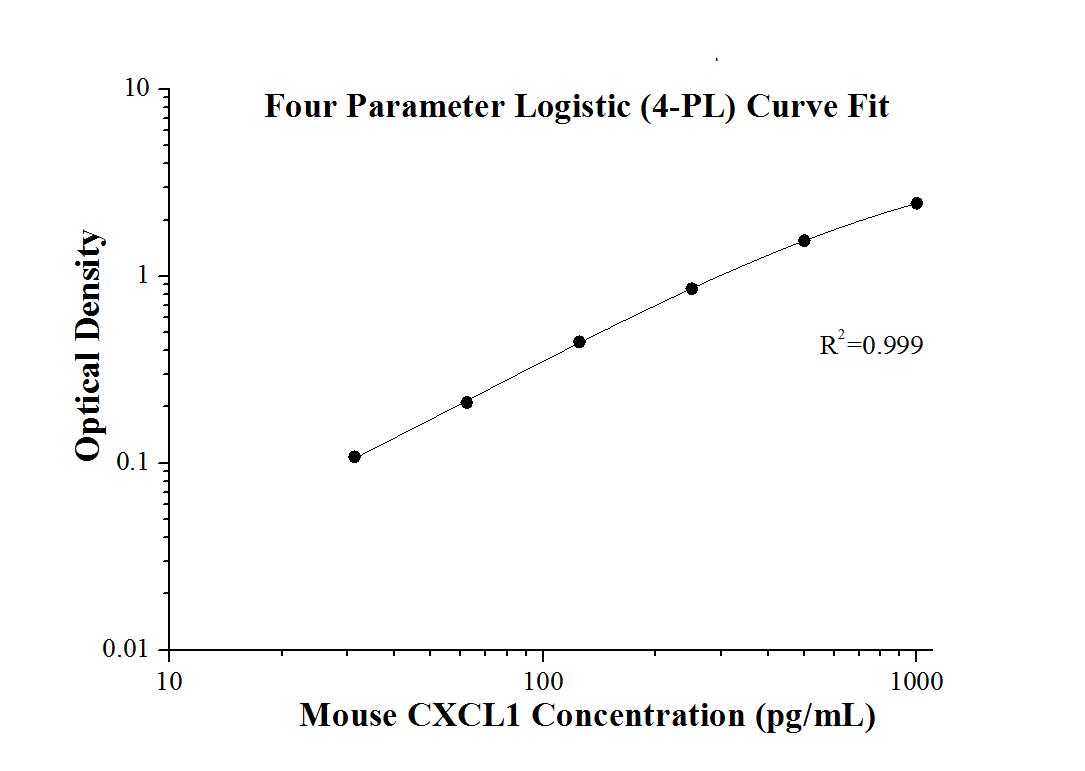
Product Information
KE10019 is a solid phase sandwich Enzyme Linked-Immuno-Sorbent Assay (Sandwich ELISA). The mouse CXCL1 ELISA kit is to be used to detect and quantify protein levels of endogenous mouse CXCL1. The assay recognizes mouse CXCL1. An antibody specific for mouse CXCL1 has been pre-coated onto the microwells. The mouse CXCL1 protein in samples is captured by the coated antibody after incubation. Following extensive washing, another antibody of biotinylated specific for mouse CXCL1 is added to detect the captured mouse CXCL1 protein. For signal development, Streptavidin-HRP is added, followed by Tetramethyl-benzidine (TMB) reagent. Solution containing sulfuric acid is used to stop color development and the color intensity which is proportional to the quantity of bound protein is measurable at 450 nm with the correction wavelength set at 630 nm.
| Product name | Mouse CXCL1 ELISA Kit |
| Tests | 1 X 96 well plate |
| Sample type | Serum, Plasma, Cell culture supernatants |
| Assay type | Sandwich |
| Sensitivity | 6.5 pg/mL |
| Range | 31.25-1000 pg/mL |
| Reactivity | Mouse |
| Tested applications | Sandwich ELISA |
| Gene ID (NCBI) | 14825 |
Recovery
| Sample Type | Average | Range |
|---|---|---|
| Mouse serum | 90% | 71%-118% |
| Cell culture supernatants | 99% | 72%-121% |
IntraAssay
| Sample | n | mean ( pg/mL) | SD | CV% |
|---|---|---|---|---|
| 1 | 20 | 30.1 | 1.0 | 3.3 |
| 2 | 20 | 120.7 | 3.5 | 2.9 |
| 3 | 20 | 481.3 | 18.0 | 3.7 |
InterAssay
| Sample | n | mean ( pg/mL) | SD | CV% |
|---|---|---|---|---|
| 1 | 24 | 31.8 | 1.7 | 5.2 |
| 2 | 24 | 130.1 | 4.9 | 3.8 |
| 3 | 24 | 505.0 | 14.6 | 2.9 |
Background Information
CXCL1 a is a member of CXC family and also known as keratinocyte-derived chemokines (KC) or growth-related oncogene (GRO). CXCL1 is expressed by macrophages, neutrophils and epithelial cells. CXCL1 binding specifically to the CXC chemokine receptor CXCR2, is involved in fibrogenesis and angiogenesis. This protein also plays a role in inflammation and as a chemoattractant for neutrophils. CXCL1 is upregulated in some types of human cancer, including colorectal, bladder, breast, prostate and skin cancers.
Properties
| Storage Instructions | All the reagents are stored at 2-8℃ for 6 months or -20℃ for 12 months. Refer to the protocol for further storage instructions. |
| Synonyms | C-X-C motif chemokine 1, Cxcl1, Fsp, gro, Gro1, GRO-alpha, KC, Mgsa, N51, NAP-3, Scyb1 |
FAQ
1、I have limited sample diluent. How should I handle samples requiring high dilution factors?
Answer: We recommend performing a serial dilution. For example, if human serum requires a 1,000,000-fold dilution, you can use a three-step 100× dilution method as follows:
Step 1: Take 2 uL of human serum and add it to 198 uL of sample diluent, mix thoroughly to obtain a 100-fold diluted sample.
Step 2: Take 2 uL of the 100-fold diluted sample and add it to 198 uL of sample diluent, mix thoroughly to obtain a 10,000-fold diluted sample.
Step 3: Take 2 uL of the 10,000-fold diluted sample and add it to 198 uL of sample diluent, mix thoroughly to obtain a 1,000,000-fold diluted sample.
If further dilution is required, additional serial steps can be used. We do not recommend using any other solutions or water for dilution, except for the sample diluent we suggest. If your sample diluent is still insufficient, please contact our customer service for more sample diluent.
Publications
| Species | Sample Type | Title |
|---|---|---|
Cell Res Inhibiting Hv1 channel in peripheral sensory neurons attenuates chronic inflammatory pain and opioid side effects. | ||
Cell Host Microbe Microbiota-derived urocanic acid triggered bytyrosine kinase inhibitors potentiates cancer immunotherapy efficacy | ||
Nat Commun High body temperature increases gut microbiota-dependent host resistance to influenza A virus and SARS-CoV-2 infection | ||
Cancer Lett Myeloid-derived suppressor cells deficient in cholesterol biosynthesis promote tumor immune evasion | ||
J Hazard Mater m6A-mediated HDAC9 upregulation promotes particulate matter-induced airway inflammation via epigenetic control of DUSP9-MAPK axis and acts as an inhaled nanotherapeutic target |