
Mouse PD-1 ELISA Kit
Cat no : KE10121
Synonyms
CD279,PD1,PD-1,PD 1,Pdc1
Validation Data Gallery
Product Information
KE10121 is a solid phase sandwich Enzyme Linked-Immuno-Sorbent Assay (Sandwich ELISA). The mouse PD-1 ELISA kit is to be used to detect and quantify protein levels of endogenous mouse PD-1. The assay recognizes mouse PD-1. An antibody specific for mouse PD-1 has been pre-coated onto the microwells. The mouse PD-1 protein in samples is captured by the coated antibody after incubation. Following extensive washing, another horseradish peroxidase (HRP)-conjugated antibody specific for mouse PD-1 is added to detect the captured mouse PD-1 protein. For signal development, followed by Tetramethyl-benzidine (TMB) reagent. Solution containing sulfuric acid is used to stop color development and the color intensity which is proportional to the quantity of bound protein is measurable at 450 nm with the correction wavelength set at 630 nm.
| Product name | Mouse PD-1 ELISA Kit |
| Tests | 1 X 96 well plate |
| Sample type | Cell culture supernatant, Cell lysate |
| Assay type | Sandwich |
| Sensitivity | 5.1 pg/mL |
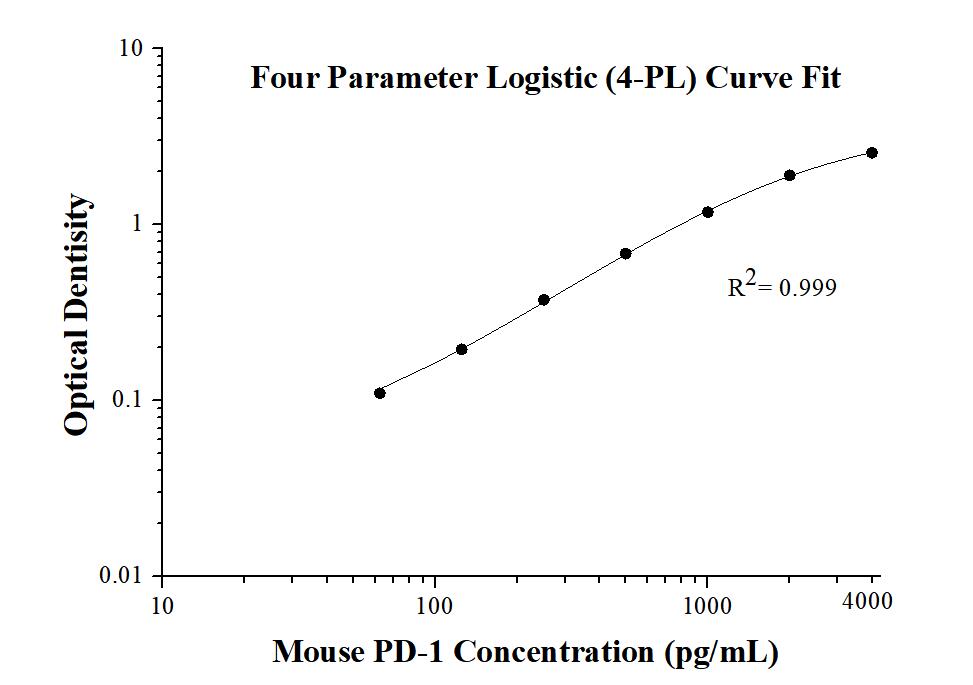
| Range | 62.5-4000 pg/mL |
| Reactivity | Mouse |
| Tested applications | Sandwich ELISA |
| Gene ID (NCBI) | 18566 |
Recovery
| Sample Type | Average | Range |
|---|---|---|
| Cell culture supernatant | 105% | 96%-113% |
| Cell lysate | 104% | 93%-128% |
IntraAssay
| Sample | n | mean ( pg/mL) | SD | CV% |
|---|---|---|---|---|
| 1 | 20 | 1,975.8 | 87.7 | 4.4 |
| 2 | 20 | 458.0 | 22.1 | 4.8 |
| 3 | 20 | 102.3 | 7.8 | 7.6 |
InterAssay
| Sample | n | mean ( pg/mL) | SD | CV% |
|---|---|---|---|---|
| 1 | 24 | 1,937.0 | 90.7 | 4.7 |
| 2 | 24 | 447.3 | 36.1 | 8.1 |
| 3 | 24 | 102.1 | 9.0 | 8.8 |
Background Information
Programmed cell death 1 (PD-1, also known as CD279) is an immunoinhibitory receptor that belongs to the CD28/CTLA-4 subfamily of the Ig superfamily. It is a 288 amino acids type I transmembrane protein composed of a Ig superfamily domain, a stalk, a transmembrane domain, and an intracellular domain containing an immunoreceptor tyrosine-based inhibitory motif (ITIM), as well as an immunoreceptor tyrosine-based switch motif (ITSM). PD-1 can be expressed on activated T cells, B cells, natural killer T cells, monocytes, and dendritic cells (DCs). Engagement of PD-1 by its ligands PD-L1 or PD-L2 transduces a signal that inhibits T-cell proliferation, cytokine production, and cytolytic function. It is critical for the regulation of T cell function during tolerance, autoimmunity and infection. Blockade of PD-1 can overcome immune resistance and also has been shown to have antitumor activity.
Properties
| Storage Instructions | All the reagents are stored at 2-8℃ for 6 months or -20℃ for 12 months. Refer to the protocol for further storage instructions. |
| Synonyms | CD279,PD1,PD-1,PD 1,Pdc1 |
FAQ
1、I have limited sample diluent. How should I handle samples requiring high dilution factors?
Answer: We recommend performing a serial dilution. For example, if human serum requires a 1,000,000-fold dilution, you can use a three-step 100× dilution method as follows:
Step 1: Take 2 uL of human serum and add it to 198 uL of sample diluent, mix thoroughly to obtain a 100-fold diluted sample.
Step 2: Take 2 uL of the 100-fold diluted sample and add it to 198 uL of sample diluent, mix thoroughly to obtain a 10,000-fold diluted sample.
Step 3: Take 2 uL of the 10,000-fold diluted sample and add it to 198 uL of sample diluent, mix thoroughly to obtain a 1,000,000-fold diluted sample.
If further dilution is required, additional serial steps can be used. We do not recommend using any other solutions or water for dilution, except for the sample diluent we suggest. If your sample diluent is still insufficient, please contact our customer service for more sample diluent.