
Mouse/Rat Osteopontin/OPN ELISA Kit
Cat no : KE10097
Synonyms
AA960535, AI790405, Apl 1, BNSP, Bsp, BSPI, Eta, ETA 1, minopontin, OP, Opn, Opnl, Osteopontin, Ric, secreted phosphoprotein 1, Spp 1, Spp1
Validation Data Gallery
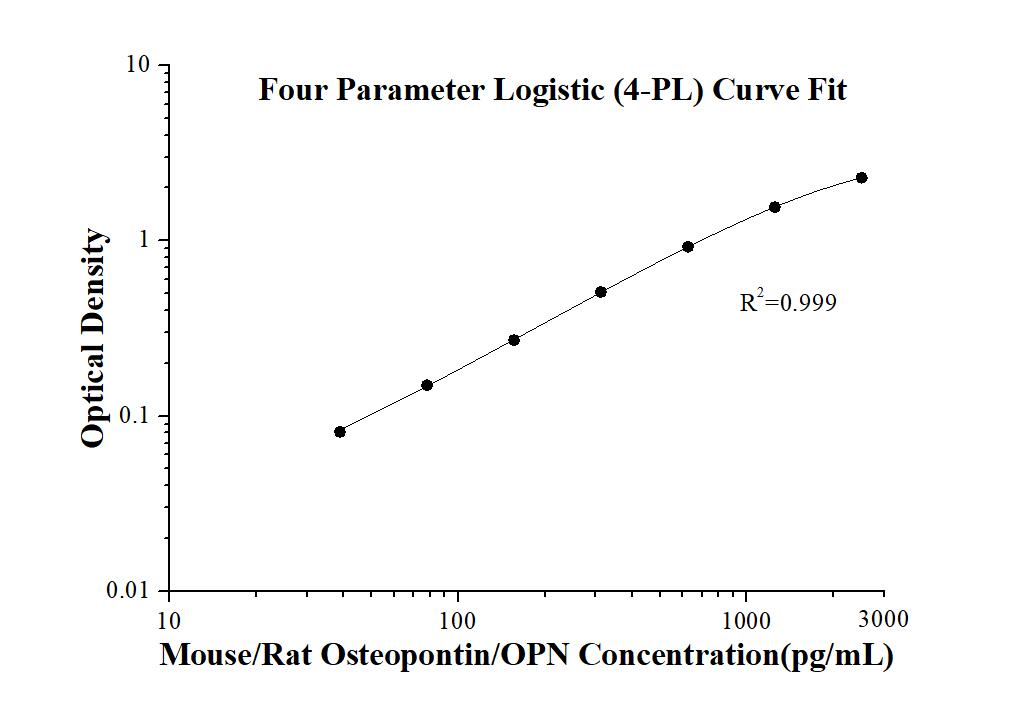
Product Information
KE10097 is a solid phase sandwich Enzyme Linked-Immuno-Sorbent Assay (Sandwich ELISA). The mouse/rat OPN ELISA kit is to be used to detect and quantify protein levels of endogenous OPN. The assay recognizes mouse/rat OPN. An antibody specific for OPN has been pre-coated onto the microwells. The OPN protein in samples is captured by the coated antibody after incubation. Following extensive washing, another horseradish peroxidase (HRP)-conjugated antibody specific for OPN is added to detect the captured OPN protein. For signal development, followed by Tetramethyl-benzidine (TMB) reagent. Solution containing sulfuric acid is used to stop color development and the color intensity which is proportional to the quantity of bound protein is measurable at 450 nm with the correction wavelength set at 630 nm.
| Product name | Mouse/Rat Osteopontin/OPN ELISA Kit |
| Tests | 1 X 96 well plate |
| Sample type | Serum, Plasma, Cell culture supernatant, Urine |
| Assay type | Sandwich |
| Sensitivity | 6.3 pg/mL |
| Range | 39-2500 pg/mL |
| Reactivity | Mouse/Rat |
| Tested applications | Sandwich ELISA |
| Gene ID (NCBI) | 20750 |
Recovery
| Sample Type | Average | Range |
|---|---|---|
| Mouse serum | 97% | 85%-112% |
| Rat serum | 100% | 86%-130% |
| Cell culture supernatant | 106% | 90%-123% |
| Mouse urine | 102% | 91%-111% |
IntraAssay
| Sample | n | mean ( pg/mL) | SD | CV% |
|---|---|---|---|---|
| 1 | 20 | 1,191.6 | 31.8 | 2.7 |
| 2 | 20 | 275.9 | 7.9 | 2.9 |
| 3 | 20 | 65.2 | 5.2 | 8.0 |
InterAssay
| Sample | n | mean ( pg/mL) | SD | CV% |
|---|---|---|---|---|
| 1 | 24 | 1,205.5 | 71.6 | 5.9 |
| 2 | 24 | 283.3 | 7.8 | 2.8 |
| 3 | 24 | 70.5 | 3.2 | 4.5 |
Background Information
Osteopontin (OPN), also known as SPP1, is a secreted glycophosphoprotein that belongs to the small integrin-binding ligand N-linked glycoprotein (SIBLING) family. Originally isolated from bone, OPN has been found in kidney, vascular tissues, biological fluids, and various tumor tissues. OPN can interact with CD44 and integrins and regulate diverse biological processes. It has a multifaceted role in bone development and remodeling and is also involved in the inflammatory and immune response, oncogenesis, and cancer progression.
Properties
| Storage Instructions | All the reagents are stored at 2-8℃ for 6 months or -20℃ for 12 months. Refer to the protocol for further storage instructions. |
| Synonyms | AA960535, AI790405, Apl 1, BNSP, Bsp, BSPI, Eta, ETA 1, minopontin, OP, Opn, Opnl, Osteopontin, Ric, secreted phosphoprotein 1, Spp 1, Spp1 |
FAQ
1、I have limited sample diluent. How should I handle samples requiring high dilution factors?
Answer: We recommend performing a serial dilution. For example, if human serum requires a 1,000,000-fold dilution, you can use a three-step 100× dilution method as follows:
Step 1: Take 2 uL of human serum and add it to 198 uL of sample diluent, mix thoroughly to obtain a 100-fold diluted sample.
Step 2: Take 2 uL of the 100-fold diluted sample and add it to 198 uL of sample diluent, mix thoroughly to obtain a 10,000-fold diluted sample.
Step 3: Take 2 uL of the 10,000-fold diluted sample and add it to 198 uL of sample diluent, mix thoroughly to obtain a 1,000,000-fold diluted sample.
If further dilution is required, additional serial steps can be used. We do not recommend using any other solutions or water for dilution, except for the sample diluent we suggest. If your sample diluent is still insufficient, please contact our customer service for more sample diluent.
Publications
| Species | Sample Type | Title |
|---|---|---|
Biochem Biophys Res Commun Pirfenidone and nintedanib exert additive antifibrotic effects by the SPP1-AKT pathway in macrophages and fibroblasts | ||
In Vitro Cell Dev Biol Anim Liposome-iRGD loaded with astragaloside IV alleviates the functional damage of endothelial progenitor cells via the Hippo-YAP/TAZ signaling pathway. |