
Speedy™ Mouse Resistin One-Step ELISA Kit
Cat no : SE60025
Synonyms
Adipose tissue-specific secretory factor, Adipose-specific cysteine-rich secreted protein A12-alpha, ADSF, Cysteine-rich secreted protein FIZZ3, Fizz3
Validation Data Gallery
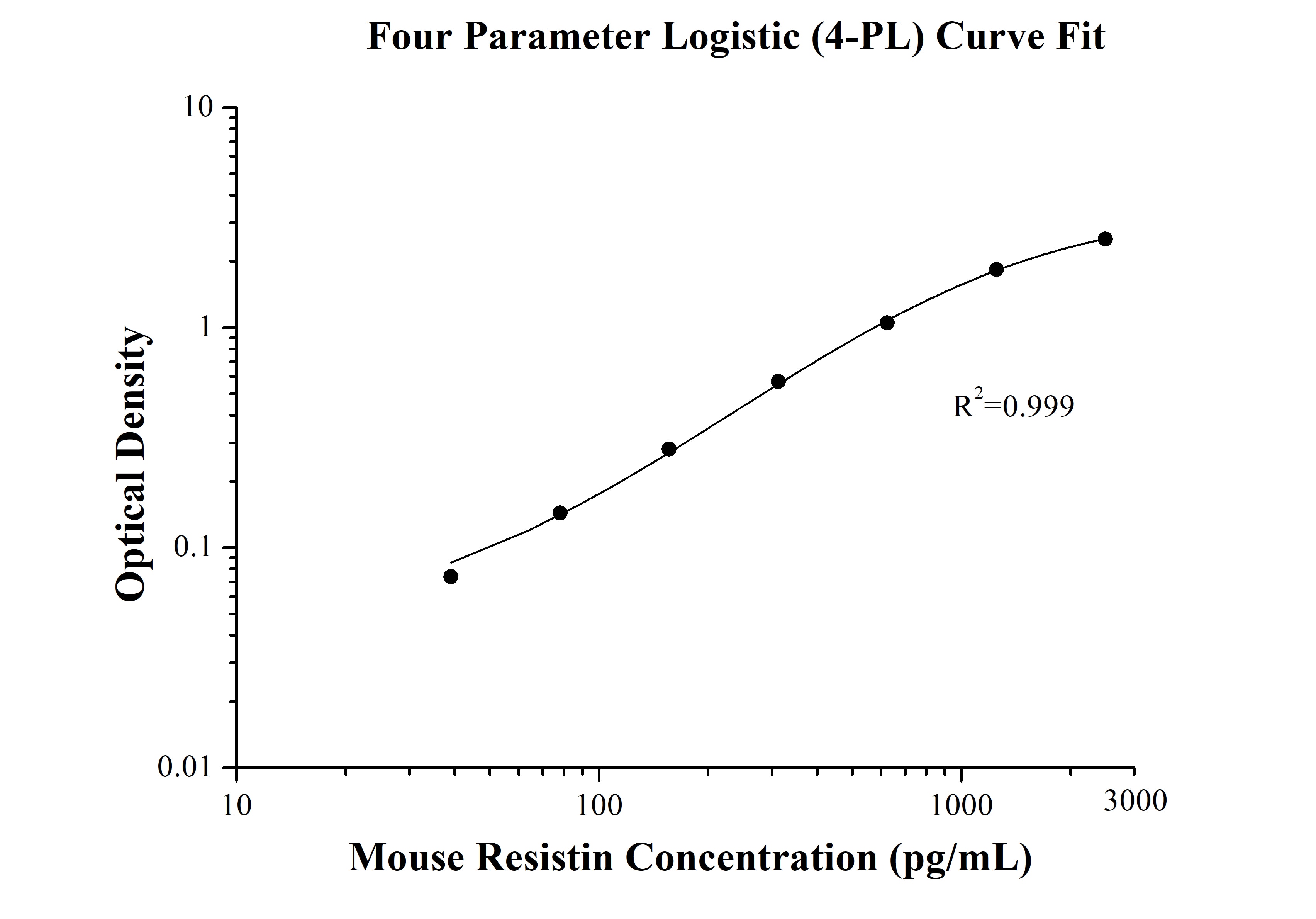
Product Information
| Product name | Speedy™ Mouse Resistin One-Step ELISA Kit |
| Tests | 1 X 96 well plate |
| Sample type | Serum, Plasma, Cell culture supernatant |
| Assay type | Sandwich |
| Sensitivity | 1.7 pg/mL |
| Range | 39-2500 pg/mL |
| Reactivity | Mouse |
| Tested applications | Sandwich ELISA |
| Gene ID (NCBI) | 57264 |
Recovery
| Sample Type | Average | Range |
|---|---|---|
| Mouse plasma | 112% | 106%-121% |
| Cell culture supernatant | 107% | 101%-114% |
IntraAssay
| Sample | n | mean ( pg/mL) | SD | CV% |
|---|---|---|---|---|
| 1 | 8 | 1,145.5 | 36.2 | 3.2 |
| 2 | 8 | 282.6 | 6.6 | 2.3 |
| 3 | 8 | 150.6 | 3.4 | 2.3 |
InterAssay
| Sample | n | mean ( pg/mL) | SD | CV% |
|---|---|---|---|---|
| 1 | 16 | 1,141.7 | 47.2 | 4.1 |
| 2 | 16 | 282.4 | 5.5 | 2.0 |
| 3 | 16 | 153.2 | 4.5 | 2.9 |
Background Information
Resistin (or 'resistance to insulin') was originally discovered in mice in 2001 and named for its ability to resist (interfere with) insulin action; at that time, it was proposed as a link between obesity and diabetes. Mouse resistin is an 11 kDa cysteine-rich polypeptide, and its gene is located on chromosome 8. It is synthesized as a 114 amino acid precursor, with a 20 aa signal sequence and a 94 aa mature segment. Neuroprotective nature of adipokine resistin in the early stages of focal cerebral ischemia in a stroke mouse model suggests that resistin may have a therapeutic potential effect in management of neurodegenerative disease.
Properties
| Storage Instructions | All the reagents are stored at 2-8℃ for 6 months or -20℃ for 12 months. Refer to the protocol for further storage instructions. |
| Synonyms | Adipose tissue-specific secretory factor, Adipose-specific cysteine-rich secreted protein A12-alpha, ADSF, Cysteine-rich secreted protein FIZZ3, Fizz3 |
FAQ
1、I have limited sample diluent. How should I handle samples requiring high dilution factors?
Answer: We recommend performing a serial dilution. For example, if human serum requires a 1,000,000-fold dilution, you can use a three-step 100× dilution method as follows:
Step 1: Take 2 uL of human serum and add it to 198 uL of sample diluent, mix thoroughly to obtain a 100-fold diluted sample.
Step 2: Take 2 uL of the 100-fold diluted sample and add it to 198 uL of sample diluent, mix thoroughly to obtain a 10,000-fold diluted sample.
Step 3: Take 2 uL of the 10,000-fold diluted sample and add it to 198 uL of sample diluent, mix thoroughly to obtain a 1,000,000-fold diluted sample.
If further dilution is required, additional serial steps can be used. We do not recommend using any other solutions or water for dilution, except for the sample diluent we suggest. If your sample diluent is still insufficient, please contact our customer service for more sample diluent.
2、If thermostatic shaker is not available, will it affect the duration of my experiment and the experimental data?
Answer: If thermostatic shaker is not available, it may take 2.5 hours to complete this experiment. After adding the antibody cocktail, we suggest you incubate the plate at 37℃ for 2 hours. After adding TMB, you only need to incubate the plate at 37℃ for 15 minutes. Through comparative experiments, our R&D personnel have confirmed that you can still obtain valid experimental data, although the signal will be slightly reduced.