

Tested Applications
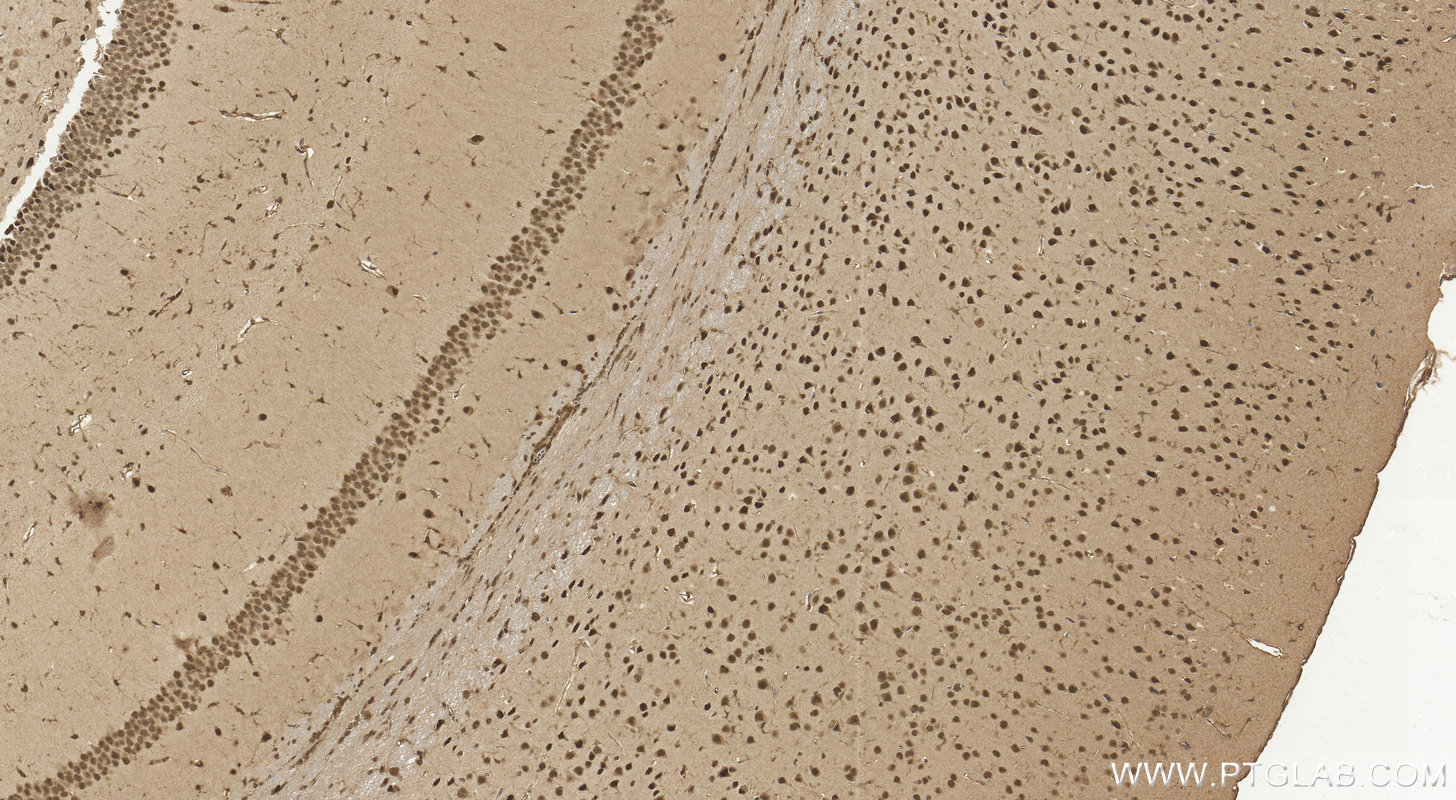
| Positive IHC detected in | mouse brain tissue Note: suggested antigen retrieval with TE buffer pH 9.0; (*) Alternatively, antigen retrieval may be performed with citrate buffer pH 6.0 |
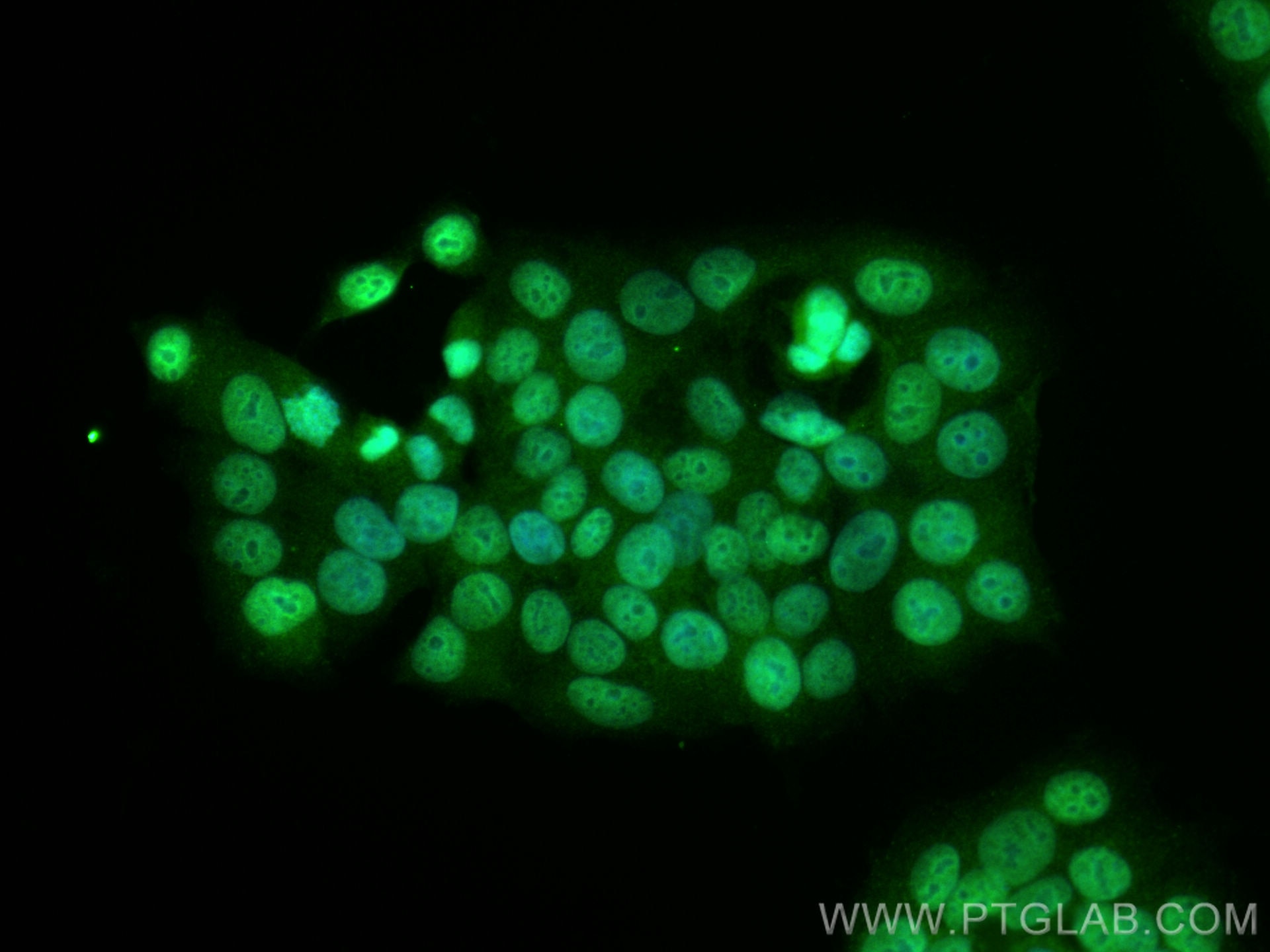
| Positive IF/ICC detected in | MCF-7 cells |
Recommended dilution
| Application | Dilution |
|---|---|
| Immunohistochemistry (IHC) | IHC : 1:400-1:1600 |
| Immunofluorescence (IF)/ICC | IF/ICC : 1:200-1:800 |
| It is recommended that this reagent should be titrated in each testing system to obtain optimal results. | |
| Sample-dependent, Check data in validation data gallery. | |
Product Information
10968-1-AP targets NCOA4 in IHC, IF/ICC, CoIP, ELISA applications and shows reactivity with human, mouse samples.
| Tested Reactivity | human, mouse |
| Cited Reactivity | human, mouse, rat |
| Host / Isotype | Rabbit / IgG |
| Class | Polyclonal |
| Type | Antibody |
| Immunogen |
CatNo: Ag1408 Product name: Recombinant human NCOA4 protein Source: e coli.-derived, PGEX-4T Tag: GST Domain: 1-400 aa of BC012736 Sequence: MNTFQDQSGSSSNREPLLRCSDARRDLELAIGGVLRAEQQIKDNLREVKAQIHSCISRHLECLRSREVWLYEQVDLIYQLKEETLQQQAQQLYSLLGQFNCLTHQLECTQNKDLANQVSVCLERLGSLTLKPEDSTVLLFEADTITLRQTITTFGSLKTIQIPEHLMAHASSANIGPFLEKRGCISMPEQKSASGIVAVPFSEWLLGSKPASGYQAPYIPSTDPQDWLTQKQTLENSQTSSRACNFFNNVGGNLKGLENWLLKSEKSSYQKCNSHSTTSSFSIEMEKVGDQELPDQDEMDLSDWLVTPQESHKLRKPENGSRETSEKFKLLFQSYNVNDWLVKTDSCTNCQGNQPKGVEIENLGNLKCLNDHLEAKKPLSTPSMVTEDWLVQNHQDPCKV Predict reactive species |
| Full Name | nuclear receptor coactivator 4 |
| Calculated Molecular Weight | 70 kDa |
| GenBank Accession Number | BC012736 |
| Gene Symbol | NCOA4 |
| Gene ID (NCBI) | 8031 |
| RRID | AB_3669123 |
| Conjugate | Unconjugated |
| Form | Liquid |
| Purification Method | Antigen affinity purification |
| UNIPROT ID | Q13772 |
| Storage Buffer | PBS with 0.02% sodium azide and 50% glycerol, pH 7.3. |
| Storage Conditions | Store at -20°C. Stable for one year after shipment. Aliquoting is unnecessary for -20oC storage. 20ul sizes contain 0.1% BSA. |
Background Information
Nuclear receptor coactivator 4 (NCOA4) also named androgen receptor (AR) coactivator ARA70, RFG and ELE1, is a putative co-activator that specifically enhances the activity of the androgen receptor. In human thyroid carcinomas, the Ret proto-oncogene fuses to ARA70 to form Ret/PTC3 by an intrachromosomal inversion of chromosome 10 in vivo. ARA70a can function as a ligand-enhanced co-activator of PPARg in adipocytes. However, PPARg-ARA70 transactivation can be squelched by AR, which suggests cross talk between PPARg- and AR-mediated response. ARA70a has no intrinsic transcription activation domain or histone acetyltransferase activity, but it interacts with histone acetyltransferase, p/CAF, CBP and p300/CBP-associated factors, and the basal transcription factor TFIIB. The interaction between ARA70 and AR occurs through the ligand-binding domain. The presence of ARA70 can enhance the androgenic activity of 17-b Estradiol (E2) and antiandrogens toward AR. ARA70 may be involved in prostate carcinogenesis and ovarian cancer and may serve as a key mediator of estrogen-androgen synergism.There are several isoforms of ZGPAT that are produced as a result of alternative splicing events. ARA70a is widely expressed, and its expression is highest in testis and adipose tissues, whereas ARA70b (The shorter variant, results from an internal 985-bp deletion.) is solely expressed in the testis.This antibody is a rabbit polyclonal antibody raised against the N-400aa of human NCOA4 protein.
Protocols
| Product Specific Protocols | |
|---|---|
| IF protocol for NCOA4 antibody 10968-1-AP | Download protocol |
| IHC protocol for NCOA4 antibody 10968-1-AP | Download protocol |
| Standard Protocols | |
|---|---|
| Click here to view our Standard Protocols |
Publications
What published studies show
The NCOA4 Polyclonal antibody (catalog number 10968-1-AP) has 22 citations. These appear in journals including Redox Biology, Advanced Science, Biomaterials, Journal of Controlled Release, Cell Death & Disease, Journal of Hazardous Materials, Environmental International, Journal of Translational Medicine, Free Radical Biology and Medicine, Cancer Cell International, Journal of Ethnopharmacology, ACS Omega, and Tissue Cell. Research fields center on ferroptosis and NCOA4-mediated ferritinophagy, spanning cancer therapy, neurodegeneration, sepsis, lung injury, cardiovascular disease, and metabolic disorders.
| Species | Application | Title |
|---|---|---|
Redox Biol S100A9 modulates USP7-mediated stabilization of NCOA4 to promote ferroptosis in sepsis-associated acute lung injury. | ||
Adv Sci (Weinh) BZW1 Drives Immune Evasion in Lung Adenocarcinoma via Ferroptosis Suppression | ||
Biomaterials Genetically programmed engineered nanodevices trigger cascade reinforcement between AMPK and cGAS-STING activation for colon cancer sonoimmunotherapy. | ||
J Control Release Metal phenolic networks-driven bufalin homodimeric prodrug nano-coassemblies for ferroptosis-augmented tumor therapy | ||
Cell Death Dis Pin1 targets phosphorylated NCOA4 for K29/K48-linked ubiquitination to suppress ferritinophagy and ferroptosis in anaplastic thyroid cancer. | ||



