
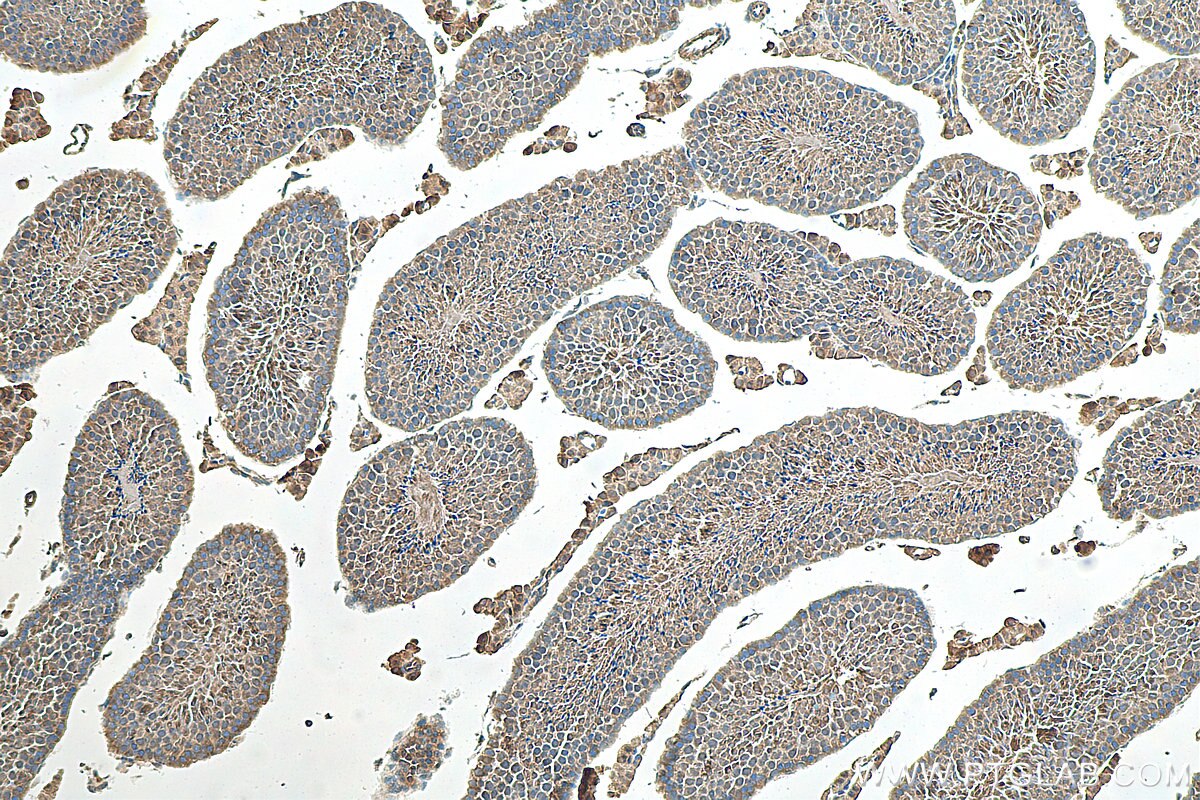
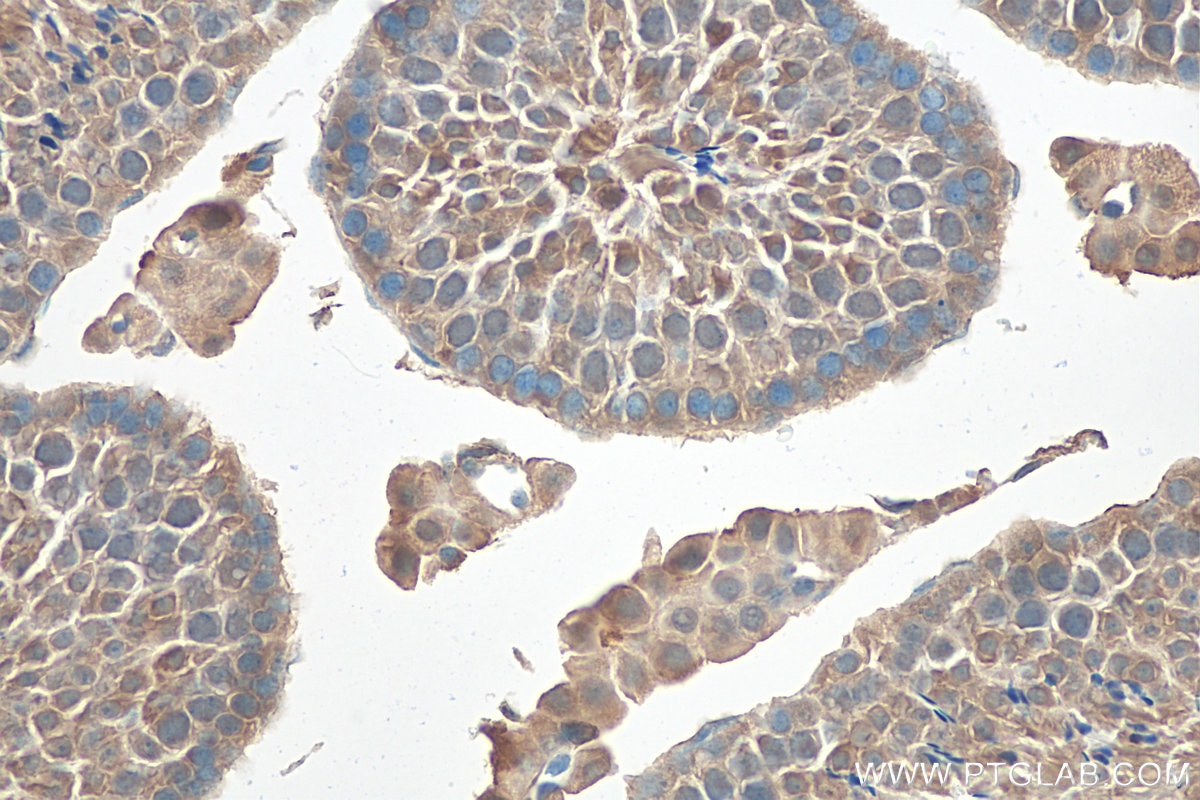

Tested Applications
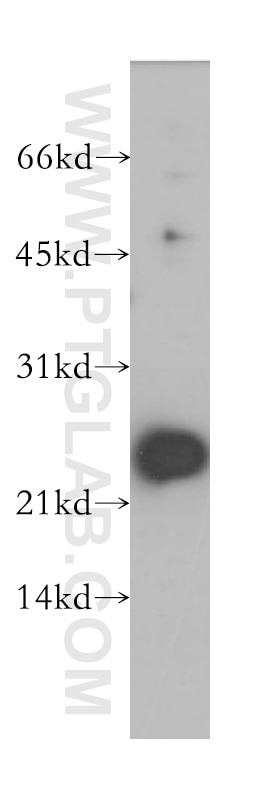
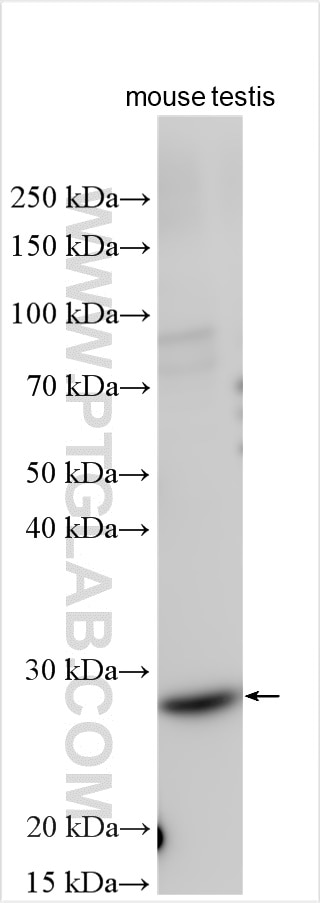
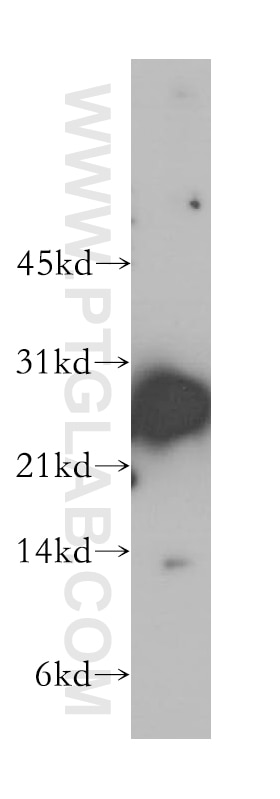
| Positive WB detected in | mouse testis tissue, human kidney tissue |
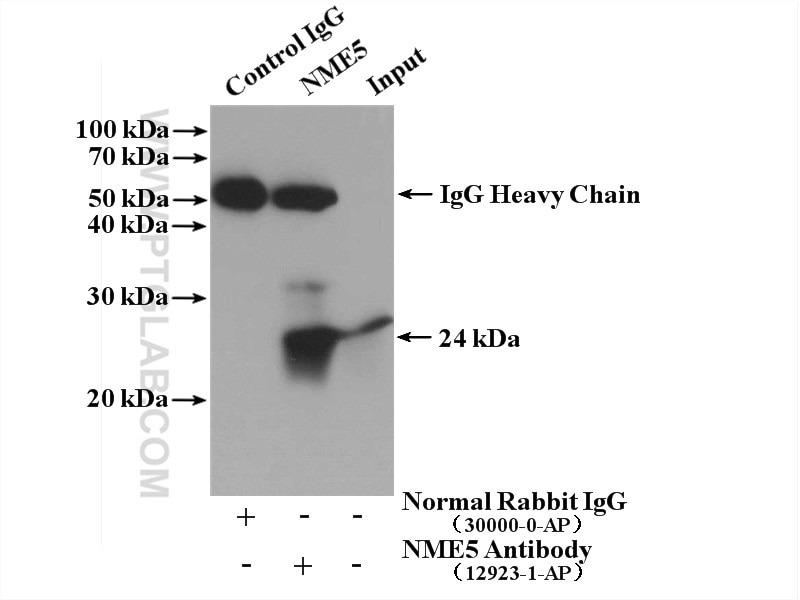
| Positive IP detected in | mouse testis tissue |
| Positive IHC detected in | mouse testis tissue Note: suggested antigen retrieval with TE buffer pH 9.0; (*) Alternatively, antigen retrieval may be performed with citrate buffer pH 6.0 |
Recommended dilution
| Application | Dilution |
|---|---|
| Western Blot (WB) | WB : 1:500-1:2400 |
| Immunoprecipitation (IP) | IP : 0.5-4.0 ug for 1.0-3.0 mg of total protein lysate |
| Immunohistochemistry (IHC) | IHC : 1:200-1:800 |
| It is recommended that this reagent should be titrated in each testing system to obtain optimal results. | |
| Sample-dependent, Check data in validation data gallery. | |
Product Information
12923-1-AP targets NME5 in WB, IHC, IF, IP, ELISA applications and shows reactivity with human, mouse, rat samples.
| Tested Reactivity | human, mouse, rat |
| Cited Reactivity | human, mouse |
| Host / Isotype | Rabbit / IgG |
| Class | Polyclonal |
| Type | Antibody |
| Immunogen |
CatNo: Ag3610 Product name: Recombinant human NME5 protein Source: e coli.-derived, PGEX-4T Tag: GST Domain: 1-212 aa of BC026182 Sequence: MEISMPPPQIYVEKTLAIIKPDIVDKEEEIQDIILRSGFTIVQRRKLRLSPEQCSNFYVEKYGKMFFPNLTAYMSSGPLVAMILARHKAISYWLELLGPNNSLVAKETHPDSLRAIYGTDDLRNALHGSNDFAAAEREIRFMFPEVIVEPIPIGQAAKDYLNLHIMPTLLEGLTELCKQKPADPLIWLADWLLKNNPNKPKLCHHPIVEEPY Predict reactive species |
| Full Name | non-metastatic cells 5, protein expressed in (nucleoside-diphosphate kinase) |
| Calculated Molecular Weight | 212 aa, 24 kDa |
| Observed Molecular Weight | 24 kDa |
| GenBank Accession Number | BC026182 |
| Gene Symbol | NME5 |
| Gene ID (NCBI) | 8382 |
| RRID | AB_2152973 |
| Conjugate | Unconjugated |
| Form | Liquid |
| Purification Method | Antigen affinity purification |
| UNIPROT ID | P56597 |
| Storage Buffer | PBS with 0.02% sodium azide and 50% glycerol, pH 7.3. |
| Storage Conditions | Store at -20°C. Stable for one year after shipment. Aliquoting is unnecessary for -20oC storage. 20ul sizes contain 0.1% BSA. |
Background Information
NME5(Nucleoside diphosphate kinase homolog 5) belongs to the NDK family. Its expression plays a critical role in spermiogenesis by increasing the cellular levels of GPX5 to eliminate reactive oxygen species. NME5 may have specific functions in the phosphotransfer network involved in spermiogenesis and flagellar movement.
Protocols
| Product Specific Protocols | |
|---|---|
| IHC protocol for NME5 antibody 12923-1-AP | Download protocol |
| IP protocol for NME5 antibody 12923-1-AP | Download protocol |
| WB protocol for NME5 antibody 12923-1-AP | Download protocol |
| Standard Protocols | |
|---|---|
| Click here to view our Standard Protocols |
Publications
What published studies show
The NME5 Polyclonal antibody (Cat# 12923-1-AP) has 8 citations published in journals including Cell Reports, Current Biology, Cellular and Molecular Life Sciences, Science China Life Sciences, Journal of Hazardous Materials, International Journal of Cancer, and Asian Journal of Andrology. Research fields span cilia and flagella biology (axoneme assembly, sperm motility, flagellum biogenesis), liver fibrosis and iron homeostasis, breast carcinoma biomarker analysis, and asthenozoospermia genetics. Applications cited include WB, IF, and IHC in mouse and human samples.
| Species | Application | Title |
|---|---|---|
J Hazard Mater TCDD promotes liver fibrosis through disordering systemic and hepatic iron homeostasis. | ||
Sci China Life Sci Adenylate kinase phosphate energy shuttle underlies energetic communication in flagellar axonemes | ||
Cell Rep Differential requirements of IQUB for the assembly of radial spoke 1 and the motility of mouse cilia and flagella | ||
Curr Biol CCDC176 stabilizes microtubule doublets 1 and 9 to ensure proper sperm movement | ||
Cell Mol Life Sci CFAP65 is essential for C2a projection integrity in axonemes: implications for organ-specific ciliary dysfunction and infertility | ||
Cell Mol Life Sci CCDC146 is required for sperm flagellum biogenesis and male fertility in mice |







