

Tested Applications
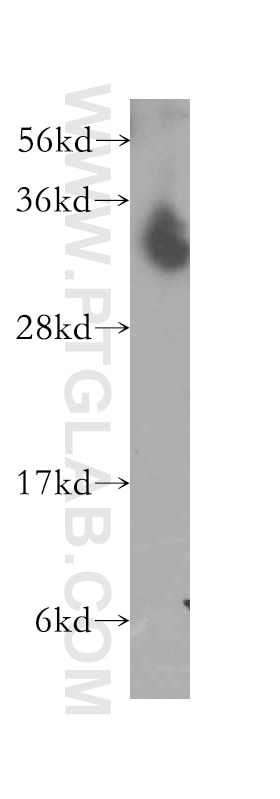
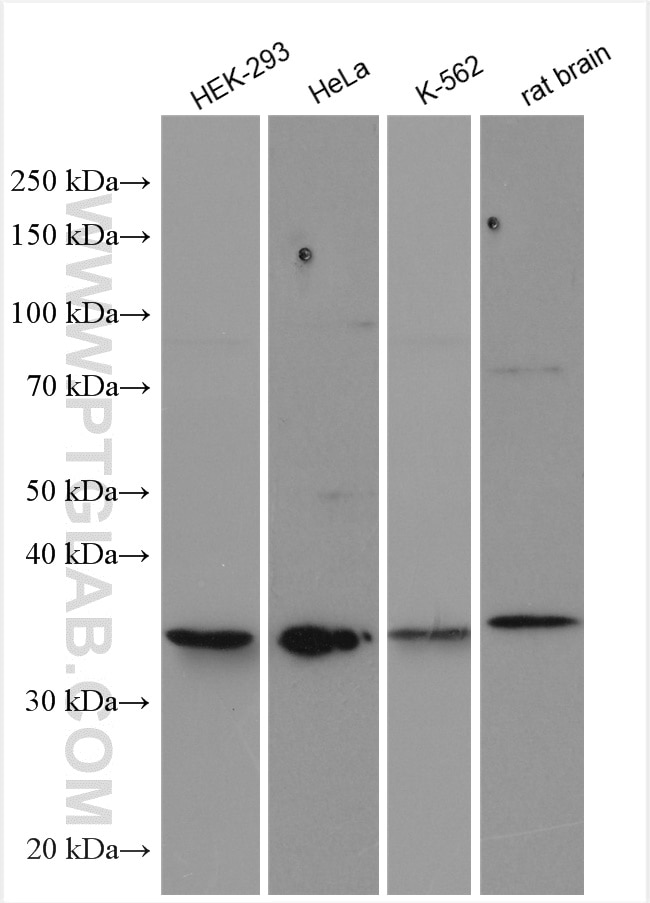
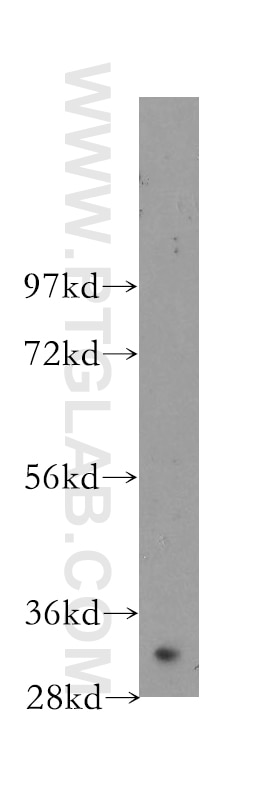
| Positive WB detected in | HEK-293 cells, human brain tissue, HeLa cells, K-562 cells, rat brain tissue |
Recommended dilution
| Application | Dilution |
|---|---|
| Western Blot (WB) | WB : 1:1000-1:4000 |
| It is recommended that this reagent should be titrated in each testing system to obtain optimal results. | |
| Sample-dependent, Check data in validation data gallery. | |
Product Information
11154-1-AP targets NTHL1 in WB, IP, ELISA applications and shows reactivity with human, mouse, rat samples.
| Tested Reactivity | human, mouse, rat |
| Cited Reactivity | human, mouse, rat |
| Host / Isotype | Rabbit / IgG |
| Class | Polyclonal |
| Type | Antibody |
| Immunogen |
CatNo: Ag1631 Product name: Recombinant human NTHL1 protein Source: e coli.-derived, Unknow Tag: N/A Domain: C16022 of BC003014 Sequence: Predict reactive species |
| Full Name | nth endonuclease III-like 1 (E. coli) |
| Calculated Molecular Weight | 34 aa, 3 kDa |
| Observed Molecular Weight | 34 kDa |
| GenBank Accession Number | BC003014 |
| Gene Symbol | NTHL1 |
| Gene ID (NCBI) | 4913 |
| RRID | AB_2283005 |
| Conjugate | Unconjugated |
| Form | Liquid |
| Purification Method | Antigen affinity purification |
| UNIPROT ID | P78549 |
| Storage Buffer | PBS with 0.02% sodium azide and 50% glycerol, pH 7.3. |
| Storage Conditions | Store at -20°C. Stable for one year after shipment. Aliquoting is unnecessary for -20oC storage. 20ul sizes contain 0.1% BSA. |
Background Information
NTHL1, also named as Endonuclease III-like protein 1 or OCTS3, is a 312 amino acid protein, which belongs to the Nth/MutY family. NTHL1 localizes in the nucleus and is widely expressed with highest levels in heart and lowest levels in lung and liver. NTHL1 has both an apurinic and/or apyrimidinic endonuclease activity and a DNA N-glycosylase activity and incises damaged DNA at cytosines, thymines and guanines. NTHL1 acts on a damaged strand, 5' from the damaged site and is required for the repair of both oxidative DNA damage and spontaneous mutagenic lesions.
Protocols
| Product Specific Protocols | |
|---|---|
| WB protocol for NTHL1 antibody 11154-1-AP | Download protocol |
| Standard Protocols | |
|---|---|
| Click here to view our Standard Protocols |
Publications
What published studies show
The NTHL1 Polyclonal antibody (Cat# 11154-1-AP) has 6 citations spanning journals including Nucleic Acids Research, Journal of Molecular Cell Biology, Respiratory Research, NAR Cancer, FASEB Journal, and Molecular Carcinogenesis. Research fields cover DNA base excision repair, oncology (breast and lung cancer), oxidative stress protection, and ovarian aging, with applications primarily in Western blot and immunoprecipitation across human, mouse, and rat species.
| Species | Application | Title |
|---|---|---|
Nucleic Acids Res The function of BCL11B in base excision repair contributes to its dual role as an oncogene and a haplo-insufficient tumor suppressor gene | ||
J Mol Cell Biol African swine fever virus DEAD-box helicase D1133L promotes OGG1-driven incision of genomic 8-oxoG via HDAC5 deacetylation | ||
Respir Res Protection of pulmonary epithelial cells from oxidative stress by hMYH adenine glycosylase. | ||
NAR Cancer The DNA repair function of BCL11A suppresses senescence and promotes continued proliferation of triple-negative breast cancer cells | ||
FASEB J Chronic gestational hypoxia accelerates ovarian aging and lowers ovarian reserve in next-generation adult rats. | ||
Mol Carcinog LINC02562 Promotes Progression of Lung Cancer by Regulating NTHL1 Dependent DNA Damage Repair Mechanisms |
Reviews
What customers say
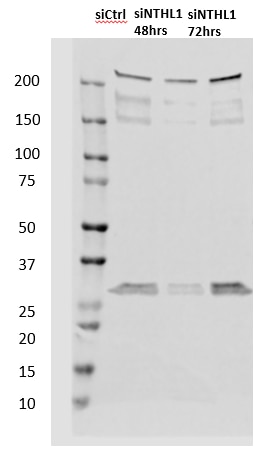
The single review for this product (rated 3/5) describes its use in Western Blot at a 1:1000 dilution on U2OS cells. The antibody recognized NTHL1 at the expected 34 kDa, but also produced non-specific bands at higher molecular weights (~150 kDa). These non-specific bands decreased when NTHL1 was knocked down with siRNA, suggesting the higher bands were related to the target. Overall, the reviewer found the antibody functional but noted some background that could be mitigated by knock-down.
The reviews below have been submitted by verified Proteintech customers who received an incentive for providing their feedback.
James (Verified Customer) (02-17-2023) | Recognises NTHL1 at 34kDa, but has non-specific bands which decrease with siRNA knock-down of NTHL1 at higher molecular weights (150kDa).
 |




