



Tested Applications
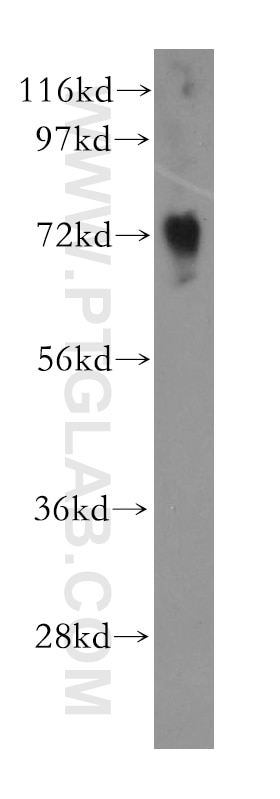
| Positive WB detected in | Jurkat cells, HepG2 cells, human heart tissue, rat heart tissue, rat liver tissue |
| Positive IP detected in | HepG2 cells |
| Positive IHC detected in | human liver tissue, mouse brain tissue, rat colon tissue Note: suggested antigen retrieval with TE buffer pH 9.0; (*) Alternatively, antigen retrieval may be performed with citrate buffer pH 6.0 |
| Positive IF/ICC detected in | HepG2 cells |
Recommended dilution
| Application | Dilution |
|---|---|
| Western Blot (WB) | WB : 1:500-1:1000 |
| Immunoprecipitation (IP) | IP : 0.5-4.0 ug for 1.0-3.0 mg of total protein lysate |
| Immunohistochemistry (IHC) | IHC : 1:250-1:1000 |
| Immunofluorescence (IF)/ICC | IF/ICC : 1:50-1:500 |
| It is recommended that this reagent should be titrated in each testing system to obtain optimal results. | |
| Sample-dependent, Check data in validation data gallery. | |
Product Information
11181-1-AP targets NUDT6 in WB, IHC, IF/ICC, IP, ELISA applications and shows reactivity with human, mouse, rat samples.
| Tested Reactivity | human, mouse, rat |
| Cited Reactivity | human, mouse, rat |
| Host / Isotype | Rabbit / IgG |
| Class | Polyclonal |
| Type | Antibody |
| Immunogen |
CatNo: Ag1638 Product name: Recombinant human NUDT6 protein Source: e coli.-derived, PGEX-4T Tag: GST Domain: 1-316 aa of BC009842 Sequence: MRQPLSWGRWRAMLARTYGPGPSAGYRWASGAQGYVRNPPVGACDLQGELDRFGGISVRLARLDALDRLDAAAFQKGLQAAVQQWRSEGRTAVWLHIPILQSRFIAPAASLGFCFHHAESDSSTLTLWLREGPSRLPGYASHQVGVAGAVFDESTRKILVVQDRNKLKNMWKFPGGLSEPEEDIGDTAVREVFEETGIKSEFRSVLSIRQQHTNPGAFGKSDMYIICRLKPYSFTINFCQEECLRCEWMDLNDLAKTENTTPITSRVARLLLYGYREGFDKIDLTVEELPAVYTGLFYKLYHKELPENYKTMKGID Predict reactive species |
| Full Name | nudix (nucleoside diphosphate linked moiety X)-type motif 6 |
| Calculated Molecular Weight | 36 kDa |
| Observed Molecular Weight | 72 kDa |
| GenBank Accession Number | BC009842 |
| Gene Symbol | NUDT6 |
| Gene ID (NCBI) | 11162 |
| RRID | AB_2236190 |
| Conjugate | Unconjugated |
| Form | Liquid |
| Purification Method | Antigen affinity purification |
| UNIPROT ID | P53370 |
| Storage Buffer | PBS with 0.02% sodium azide and 50% glycerol, pH 7.3. |
| Storage Conditions | Store at -20°C. Stable for one year after shipment. Aliquoting is unnecessary for -20oC storage. 20ul sizes contain 0.1% BSA. |
Background Information
NUDT6, also named as FGF2AS and GFG, belongs to the Nudix hydrolase family. It may contribute to the regulation of cell proliferation. NUDT6 maybe a candidate gene for fat deposition. The 72 kDa is a homodimer form of NUDT6.
Protocols
| Product Specific Protocols | |
|---|---|
| IF protocol for NUDT6 antibody 11181-1-AP | Download protocol |
| IHC protocol for NUDT6 antibody 11181-1-AP | Download protocol |
| IP protocol for NUDT6 antibody 11181-1-AP | Download protocol |
| WB protocol for NUDT6 antibody 11181-1-AP | Download protocol |
| Standard Protocols | |
|---|---|
| Click here to view our Standard Protocols |
Publications
What published studies show
The anti-FGF2 antibody (Cat# 11181-1-AP) has 8 citations published in journals including Frontiers in Immunology, Cancer Science, Molecular Endocrinology, The Journal of Physiology, Wound Repair and Regeneration, Molecular Carcinogenesis, Genes (Basel), and Burns. Research fields span endometriosis pain, breast tumor angiogenesis, FGF2 antisense RNA regulation, depression and neurogenesis, wound healing, cell adhesion and cell-cycle progression, and burn treatment. Applications include WB and IF.
| Species | Application | Title |
|---|---|---|
Front Immunol GPR30-mediated non-classic estrogen pathway in mast cells participates in endometriosis pain via the production of FGF2 | ||
Mol Endocrinol Regulation of fibroblast growth factor-2 by an endogenous antisense RNA and by argonaute-2. | ||
J Physiol FGF2 gene's antisense protein, NUDT6, plays a depressogenic role by promoting inflammation and suppressing neurogenesis without altering FGF2 signalling | ||
Wound Repair Regen GHK-Cu-liposomes accelerate scald wound healing in mice by promoting cell proliferation and angiogenesis. | ||
Mol Carcinog Regulation of FGF-2 by an endogenous antisense RNA: effects on cell adhesion and cell-cycle progression. |



