

Tested Applications
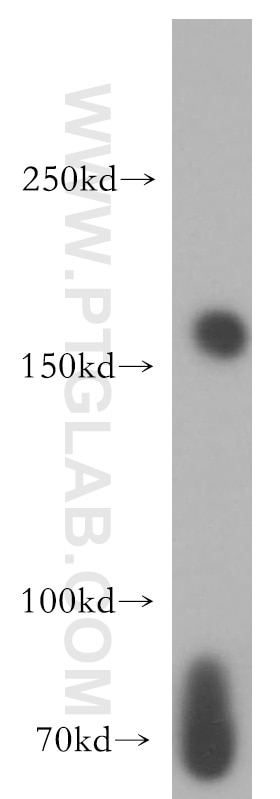
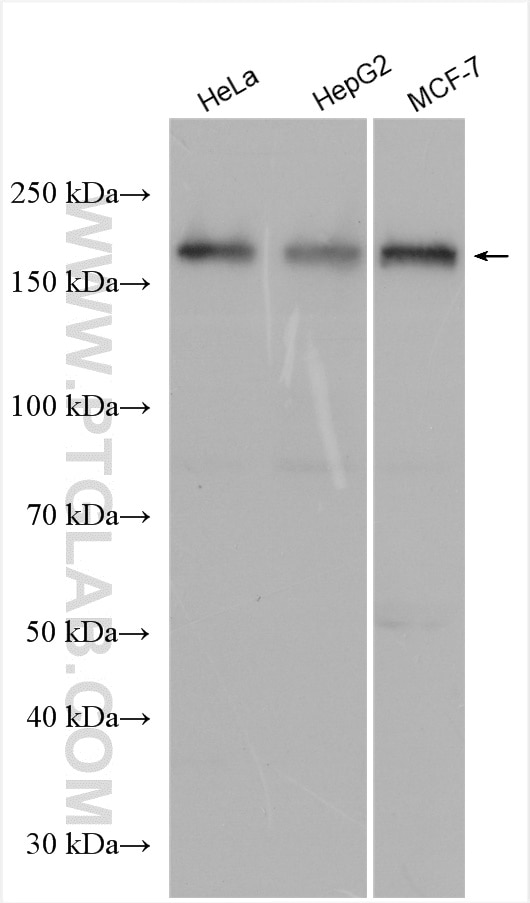
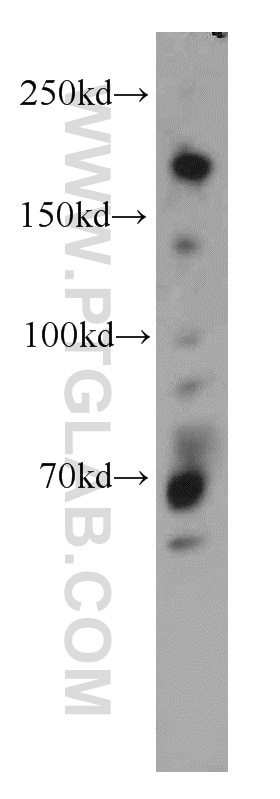
| Positive WB detected in | K-562 cells, HeLa cells, A431 cells, HepG2 cells, MCF-7 cells |
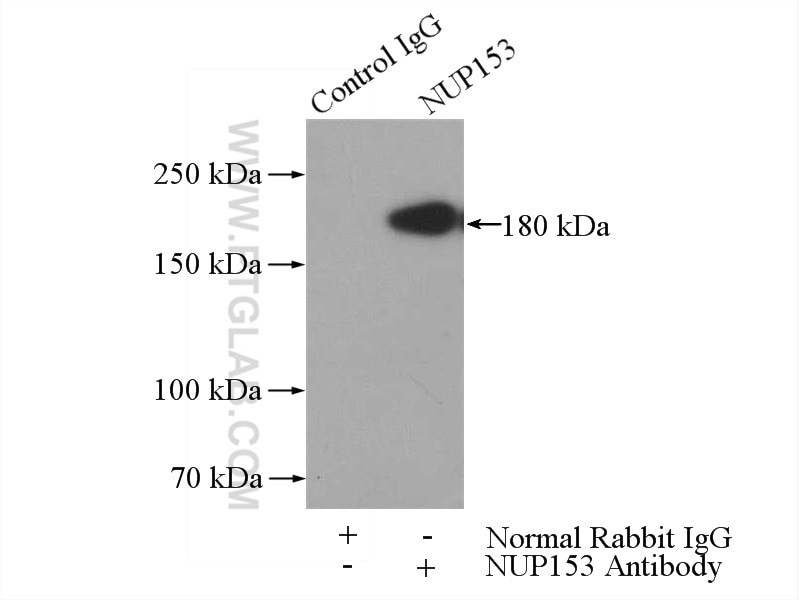
| Positive IP detected in | K-562 cells |
Recommended dilution
| Application | Dilution |
|---|---|
| Western Blot (WB) | WB : 1:500-1:2400 |
| Immunoprecipitation (IP) | IP : 0.5-4.0 ug for 1.0-3.0 mg of total protein lysate |
| It is recommended that this reagent should be titrated in each testing system to obtain optimal results. | |
| Sample-dependent, Check data in validation data gallery. | |
Product Information
14189-1-AP targets NUP153 in WB, IHC, IP, ELISA applications and shows reactivity with human, mouse, rat samples.
| Tested Reactivity | human, mouse, rat |
| Cited Reactivity | human, mouse, pig |
| Host / Isotype | Rabbit / IgG |
| Class | Polyclonal |
| Type | Antibody |
| Immunogen |
CatNo: Ag5519 Product name: Recombinant human NUP153 protein Source: e coli.-derived, PGEX-4T Tag: GST Domain: 1125-1475 aa of BC052965 Sequence: EEPKCQPVFSFGNSEQTKDENSSKSTFSFSMTKPSEKESEQPAKATFAFGAQTSTTADQGAAKPVFSFLNNSSSSSSTPATSAGGGIFGSSTSSSNPPVATFVFGQSSNPVSSSAFGNTAESSTSQSLLFSQDSKLATTSSTGTAVTPFVFGPGASSNNTTTSGFGFGATTTSSSAGSSFVFGTGPSAPSASPAFGANQTPTFGQSQGASQPNPPGFGSISSSTALFPTGSQPAPPTFGTVSSSSQPPVFGQQPSQSAFGSGTTPNSSSAFQFGSSTTNFNFTNNSPSGVFTFGANSSTPAASAQPSGSGGFPFNQSPAAFTVGSNGKNVFSSSGTSFSGRKIKTAVRRRK Predict reactive species |
| Full Name | nucleoporin 153kDa |
| Calculated Molecular Weight | 154 kDa |
| Observed Molecular Weight | 154 kDa |
| GenBank Accession Number | BC052965 |
| Gene Symbol | NUP153 |
| Gene ID (NCBI) | 9972 |
| RRID | AB_2154463 |
| Conjugate | Unconjugated |
| Form | Liquid |
| Purification Method | Antigen affinity purification |
| UNIPROT ID | P49790 |
| Storage Buffer | PBS with 0.02% sodium azide and 50% glycerol, pH 7.3. |
| Storage Conditions | Store at -20°C. Stable for one year after shipment. Aliquoting is unnecessary for -20oC storage. 20ul sizes contain 0.1% BSA. |
Background Information
NUP153 is an FG-repeat containing NUP, contains a high-affinity site for importin-β, localizes on the nucleoplasmic face of the nuclear pore and is required for assembly of the nuclear basket and import of a subset of nuclear proteins [PMID:18845677]. NUP153 also facilitates nuclear export of mRNA and ribonucleoprotein particles and may have additional functions within the nucleus [PMID:16195343]. The 53BP1-NUP153/importin-β pathway as an important aspect of the DDR network add to an emerging evidence of subcellular trafficking as an integral part of genome surveillance [PMID:22075984].
Protocols
| Product Specific Protocols | |
|---|---|
| IP protocol for NUP153 antibody 14189-1-AP | Download protocol |
| WB protocol for NUP153 antibody 14189-1-AP | Download protocol |
| Standard Protocols | |
|---|---|
| Click here to view our Standard Protocols |
Publications
What published studies show
The NUP153 Polyclonal antibody (Cat# 14189-1-AP) has 8 citations across journals including Nature Communications, Advanced Science, Cell Death Discovery, International Journal of Biological Macromolecules, Frontiers in Immunology, Biotechnology Journal, Journal of Medical Virology, and Cell Reports. Research fields span nucleocytoplasmic trafficking, innate immunity, ovarian and pancreatic cancer, lncRNA nuclear export, O-glycosylation, HBV replication, and cell expansion methods.
| Species | Application | Title |
|---|---|---|
Adv Sci (Weinh) Ascites circRNA ASCOR Drives Platinum Resistance of High-Grade Serous Ovarian Cancer by Facilitating RPA1 Nuclear Translocation. | ||
Cell Death Discov Exon junction complex and nuclear pore complex components preferentially govern the nuclear export of spliced lncRNAs. | ||
Int J Biol Macromol Subcellular proteomics reveals the crosstalk between nucleocytoplasmic trafficking and the innate immune response to Senecavirus A infection | ||
Front Immunol The functional and clinical significance of nucleoporin NUP153 across human cancers: a systematic study based on multi-omics analysis and bench work validation | ||
Biotechnol J Highly efficient identification of nucleocytoplasmic O-glycosylation by the TurboID-based proximity labeling method in living cells |





