





Tested Applications
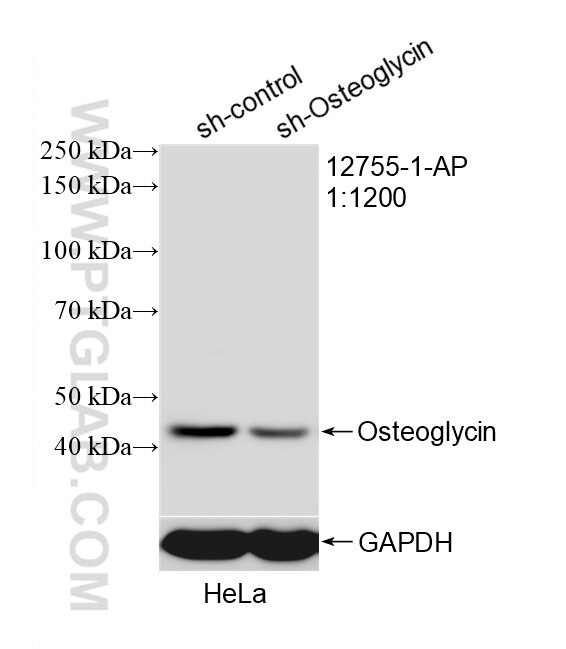
| Positive WB detected in | NIH/3T3 cells, HeLa cells, human liver tissue |
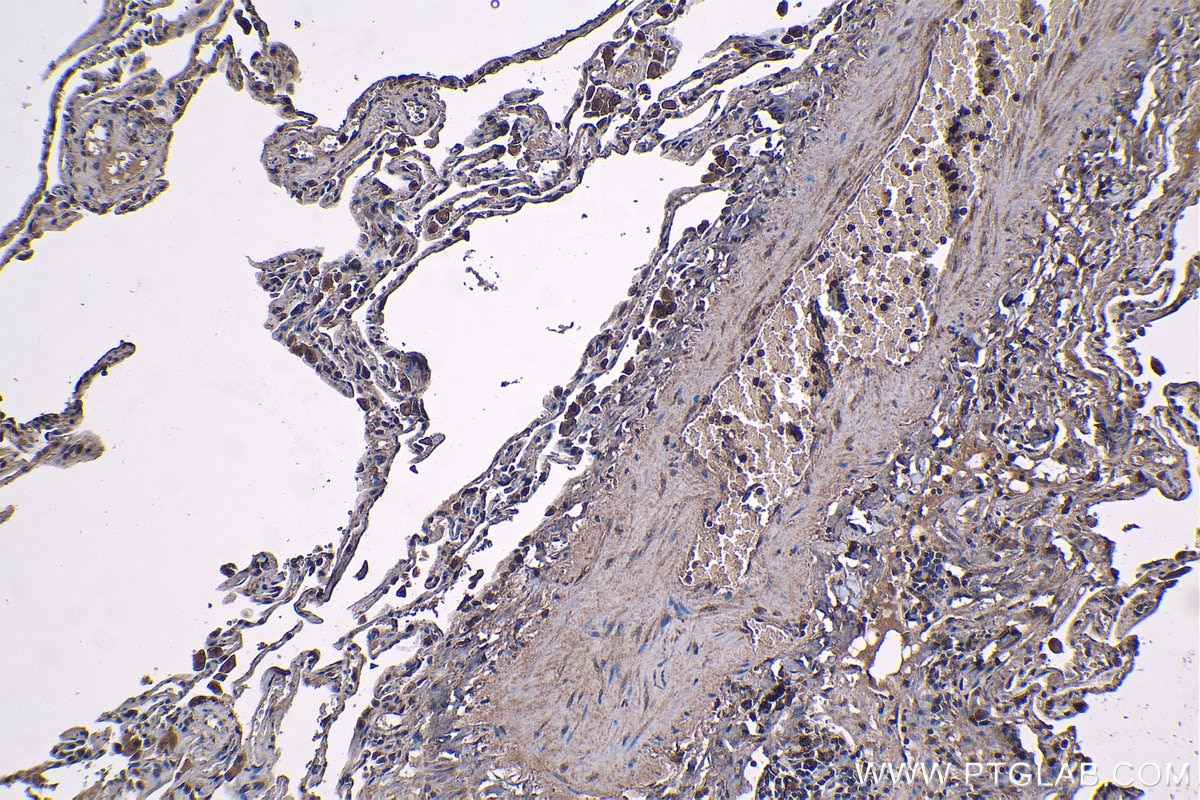
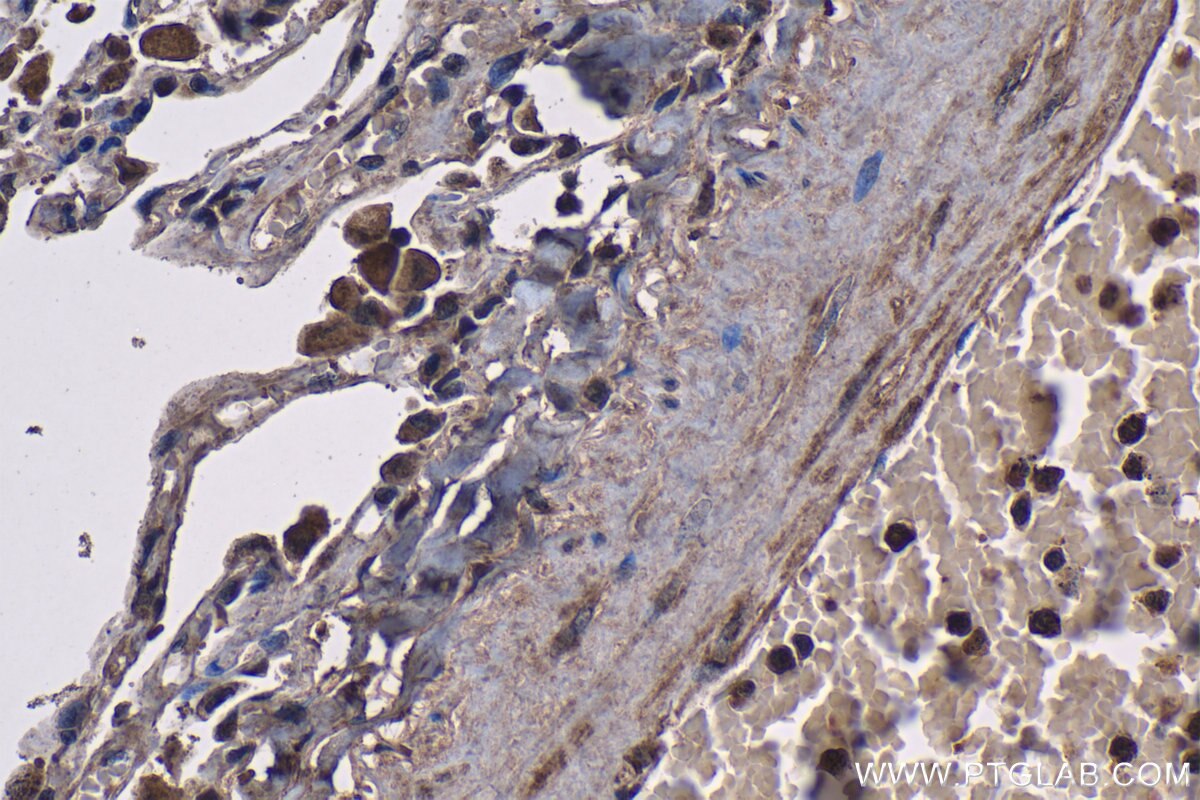
| Positive IHC detected in | human lung tissue Note: suggested antigen retrieval with TE buffer pH 9.0; (*) Alternatively, antigen retrieval may be performed with citrate buffer pH 6.0 |
| Positive IF/ICC detected in | HepG2 cells |
Recommended dilution
| Application | Dilution |
|---|---|
| Western Blot (WB) | WB : 1:500-1:2000 |
| Immunohistochemistry (IHC) | IHC : 1:250-1:1000 |
| Immunofluorescence (IF)/ICC | IF/ICC : 1:200-1:800 |
| It is recommended that this reagent should be titrated in each testing system to obtain optimal results. | |
| Sample-dependent, Check data in validation data gallery. | |
Product Information
12755-1-AP targets Osteoglycin in WB, IHC, IF/ICC, ELISA applications and shows reactivity with human, mouse, rat samples.
| Tested Reactivity | human, mouse, rat |
| Cited Reactivity | human, mouse |
| Host / Isotype | Rabbit / IgG |
| Class | Polyclonal |
| Type | Antibody |
| Immunogen |
CatNo: Ag3484 Product name: Recombinant human OGN protein Source: e coli.-derived, PGEX-4T Tag: GST Domain: 1-298 aa of BC037273 Sequence: MKTLQSTLLLLLLVPLIKPAPPTQQDSRIIYDYGTDNFEESIFSQDYEDKYLDGKNIKEKETVIIPNEKSLQLQKDEAITPLPPKKENDEMPTCLLCVCLSGSVYCEEVDIDAVPPLPKESAYLYARFNKIKKLTAKDFADIPNLRRLDFTGNLIEDIEDGTFSKLSLLEELSLAENQLLKLPVLPPKLTLFNAKYNKIKSRGIKANAFKKLNNLTFLYLDHNALESVPLNLPESLRVIHLQFNNIASITDDTFCKANDTSYIRDRIEEIRLEGNPIVLGKHPNSFICLKRLPIGSYF Predict reactive species |
| Full Name | osteoglycin |
| Calculated Molecular Weight | 298 aa, 34 kDa |
| Observed Molecular Weight | 34-40 kDa |
| GenBank Accession Number | BC037273 |
| Gene Symbol | OGN |
| Gene ID (NCBI) | 4969 |
| RRID | AB_10646479 |
| Conjugate | Unconjugated |
| Form | Liquid |
| Purification Method | Antigen affinity purification |
| UNIPROT ID | P20774 |
| Storage Buffer | PBS with 0.02% sodium azide and 50% glycerol, pH 7.3. |
| Storage Conditions | Store at -20°C. Stable for one year after shipment. Aliquoting is unnecessary for -20oC storage. 20ul sizes contain 0.1% BSA. |
Background Information
This gene encodes a member of the small leucine-rich proteoglycan (SLRP) family of proteins. The encoded protein induces ectopic bone formation in conjunction with transforming growth factor beta and may regulate osteoblast differentiation. High expression of the encoded protein may be associated with elevated heart left ventricular mass. Alternative splicing results in multiple transcript variants which forms proteins with different molecular weight.
Protocols
| Product Specific Protocols | |
|---|---|
| IF protocol for Osteoglycin antibody 12755-1-AP | Download protocol |
| IHC protocol for Osteoglycin antibody 12755-1-AP | Download protocol |
| WB protocol for Osteoglycin antibody 12755-1-AP | Download protocol |
| Standard Protocols | |
|---|---|
| Click here to view our Standard Protocols |
Publications
What published studies show
The anti-OGN (Osteoglycin) antibody (Cat# 12755-1-AP) has 9 citations across journals including Nature Communications, Journal of Hazardous Materials, Aging Cell, Frontiers in Immunology, Scientific Reports, Journal of Inflammation Research, FASEB Journal, OncoTargets and Therapy, and Cytotechnology. Research fields span spatial transcriptomics, epigenetics, neurotoxicity, periodontitis, vascular biology, rheumatoid arthritis, skin keloid, breast cancer, and polycystic ovary syndrome.
| Species | Application | Title |
|---|---|---|
Nat Commun Ultra-precision deconvolution of spatial transcriptomics decodes immune heterogeneity and fate-defining programs in tissues. | ||
J Hazard Mater Epigenetic reprogramming of HDAC2 in CA1 excitatory neurons determines Pb-induced non-spatial memory deficits | ||
Aging Cell Loss of Brain-Derived Estrogen Is Associated With Sex- and Age-Dependent Alterations in Memory, Affective Behavior, and Hippocampal Extracellular Matrix Gene Expression.
| ||
Front Immunol Identification of nine signature proteins involved in periodontitis by integrated analysis of TMT proteomics and transcriptomics | ||
Sci Rep Proteomic profiling of concurrently isolated primary microvascular endothelial cells, pericytes, and vascular smooth muscle cells from adult mouse heart. | ||
J Inflamm Res The m6A/m1A/m5C-Related Methylation Modification Patterns and Immune Landscapes in Rheumatoid Arthritis and Osteoarthritis Revealed by Microarray and Single-Cell Transcriptome |
Reviews
What customers say
The single review for this product (rated 3/5) reports use in Western Blot at a 1:1000 dilution on both mouse and human cell lines. The reviewer observed multiple bands, with two dominant signals at approximately 40 kDa and 55 kDa, noting that the ~40 kDa band was likely the band of interest. Overall, the antibody produced detectable signal but showed some non-specific bands, resulting in a moderate satisfaction rating.
The reviews below have been submitted by verified Proteintech customers who received an incentive for providing their feedback.
Huai-Chin (Verified Customer) (10-24-2022) | Multiple bands in Western blot. There are two dominant bands at ~40KD and ~55KD. The one ~40KD maybe the band of interest.
|








