

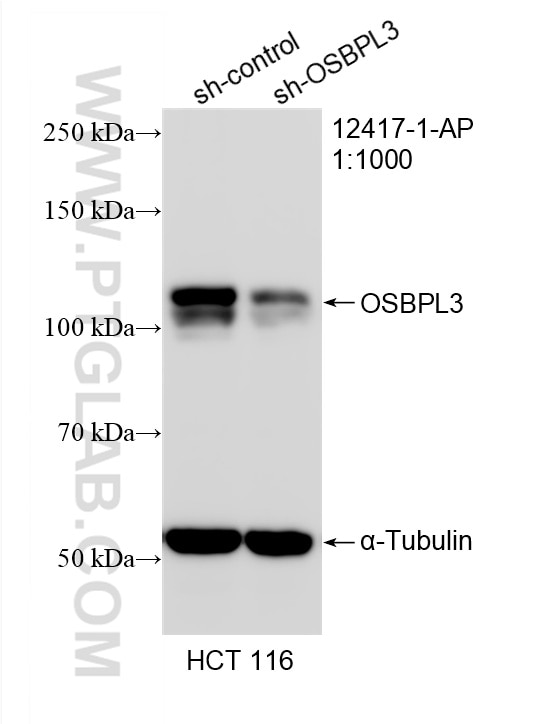



Tested Applications
| Positive WB detected in | HCT 116 cells, K-562 cells, HeLa cells |
| Positive IHC detected in | human colon cancer tissue, rat bladder tissue, human ovary cancer tissue, mouse kidney tissue, rat kidney tissue, mouse bladder tissue, human colon cancer tissue Note: suggested antigen retrieval with TE buffer pH 9.0; (*) Alternatively, antigen retrieval may be performed with citrate buffer pH 6.0 |
Recommended dilution
| Application | Dilution |
|---|---|
| Western Blot (WB) | WB : 1:1000-1:4000 |
| Immunohistochemistry (IHC) | IHC : 1:50-1:500 |
| It is recommended that this reagent should be titrated in each testing system to obtain optimal results. | |
| Sample-dependent, Check data in validation data gallery. | |
Product Information
12417-1-AP targets OSBPL3 in WB, IHC, ELISA applications and shows reactivity with human, mouse, rat samples.
| Tested Reactivity | human, mouse, rat |
| Cited Reactivity | human |
| Host / Isotype | Rabbit / IgG |
| Class | Polyclonal |
| Type | Antibody |
| Immunogen |
CatNo: Ag3044 Product name: Recombinant human OSBPL3 protein Source: e coli.-derived, PGEX-4T Tag: GST Domain: 1-350 aa of BC017731 Sequence: MMSDEKNLGVSQKLVSPSRSTSSCSSKQGSRQDSWEVVEGLRGEMNYTQEPPVQKGFLLKKRKWPLKGWHKRFFYLDKGILKYAKSQTDIEREKLHGCIDVGLSVMSVKKSSKCIDLDTEEHIYHLKVKSEEVFDEWVSKLRHHRMYRQNEIAMFPHEVNHFFSGSTITDSSSGVFDSISSRKRSSISKQNLFQTGSNVSFSCGGETRVPLWLQSSEDMEKCSKDLAHCHAYLVEMSQLLQSMDVLHRTYSAPAINAIQGGSFESPKKEKRSHRRWRSRAIGKDAKGTLQVPKPFSGPVRLHSSNPNLSTLDFGEEKNYSDGSETSSEFSKMQEDLCHIAHKVYFTLRSA Predict reactive species |
| Full Name | oxysterol binding protein-like 3 |
| Calculated Molecular Weight | 887 aa, 101 kDa |
| Observed Molecular Weight | 95-110 kDa |
| GenBank Accession Number | BC017731 |
| Gene Symbol | OSBPL3 |
| Gene ID (NCBI) | 26031 |
| RRID | AB_2156103 |
| Conjugate | Unconjugated |
| Form | Liquid |
| Purification Method | Antigen affinity purification |
| UNIPROT ID | Q9H4L5 |
| Storage Buffer | PBS with 0.02% sodium azide and 50% glycerol, pH 7.3. |
| Storage Conditions | Store at -20°C. Stable for one year after shipment. Aliquoting is unnecessary for -20oC storage. 20ul sizes contain 0.1% BSA. |
Background Information
OSBPL3 (ORP3) is an oxysterol-binding protein-related lipid transfer protein located at ER-plasma membrane contact sites. Its canonical isoform contains 887 amino acids with a theoretical molecular weight of 101.2 kDa. Western blot routinely detects a doublet around 103 kDa and 110 kDa, mainly caused by differential phosphorylation rather than splicing variants. It interacts with R-Ras and VAPA to modulate PI4P transport, actin cytoskeleton dynamics and cell adhesion. Aberrant OSBPL3 expression drives proliferation and metastasis in multiple cancers, acting as a prognostic biomarker and potential therapeutic target. (PMID: 32041906, 34584127)
Protocols
| Product Specific Protocols | |
|---|---|
| IHC protocol for OSBPL3 antibody 12417-1-AP | Download protocol |
| WB protocol for OSBPL3 antibody 12417-1-AP | Download protocol |
| Standard Protocols | |
|---|---|
| Click here to view our Standard Protocols |
Publications
What published studies show
The OSBPL3 Polyclonal antibody (Cat# 12417-1-AP) has 4 citations published in Translational Oncology, Biosci Reports (×2), and BMC Cancer. The research fields span lung adenocarcinoma metastasis and glycolysis regulation, colorectal cancer hub gene identification via WGCNA, and OSBPL family gene expression and immune infiltration in liver cancer. All citations used human samples with WB and/or IHC applications.
| Species | Application | Title |
|---|---|---|
Transl Oncol OSBPL3 promotes LUAD metastasis and glycolysis through transcriptional upregulation of PLAU via NFE2L2.
| ||
Biosci Rep Identification of hub genes in colorectal cancer based on weighted gene co-expression network analysis and clinical data from The Cancer Genome Atlas. | ||
BMC Cancer The expression, immune infiltration, prognosis, and experimental validation of OSBPL family genes in liver cancer | ||
Biosci Rep Identification of hub genes in colorectal cancer based on weighted gene co-expression network analysis. |




