

Tested Applications
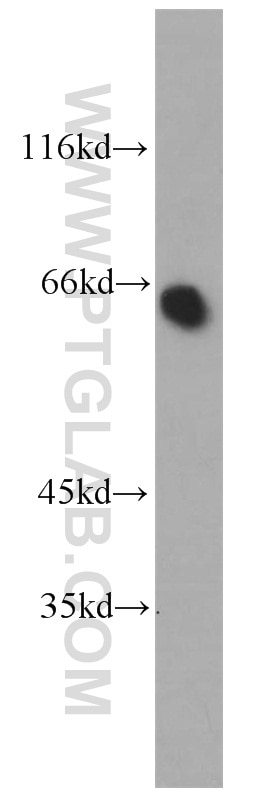
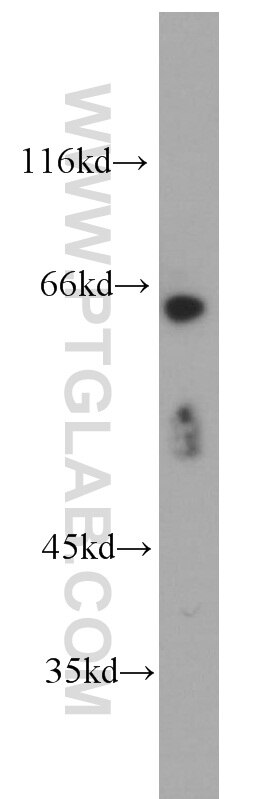
| Positive WB detected in | mouse kidney tissue, HEK-293 cells |
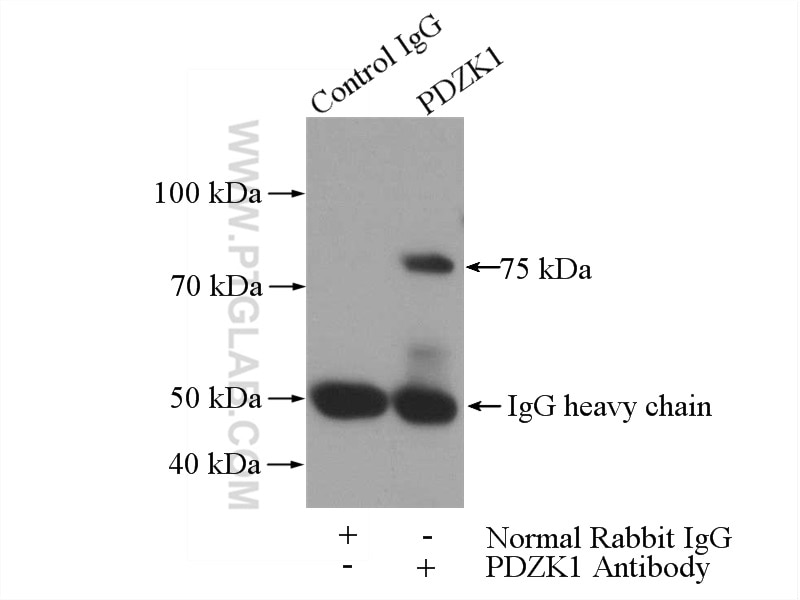
| Positive IP detected in | HEK-293 cells |
Recommended dilution
| Application | Dilution |
|---|---|
| Western Blot (WB) | WB : 1:500-1:1000 |
| Immunoprecipitation (IP) | IP : 0.5-4.0 ug for 1.0-3.0 mg of total protein lysate |
| It is recommended that this reagent should be titrated in each testing system to obtain optimal results. | |
| Sample-dependent, Check data in validation data gallery. | |
Product Information
10507-2-AP targets PDZK1 in WB, IHC, IF, IP, CoIP, ELISA applications and shows reactivity with human, mouse samples.
| Tested Reactivity | human, mouse |
| Cited Reactivity | human, mouse |
| Host / Isotype | Rabbit / IgG |
| Class | Polyclonal |
| Type | Antibody |
| Immunogen |
CatNo: Ag0787 Product name: Recombinant human PDZK1 protein Source: e coli.-derived, PGEX-4T Tag: GST Domain: 1-300 aa of BC006496 Sequence: MTSTFNPRECKLSKQEGQNYGFFLRIEKDTEGHLVRVVEKCSPAEKAGLQDGDRVLRINGVFVDKEEHMQVVDLVRKSGNSVTLLVLDGDSYEKAVKTRVDLKELGQSQKEQGLSDNILSPVMNGGVQTWTQPRLCYLVKEGGSYGFSLKTVQGKKGVYMTDITPQGVAMRAGVLADDHLIEVNGENVEDASHEEVVEKVKKSGSRVMFLLVDKETDKRHVEQKIQFKRETASLKLLPHQPRIVEMKKGSNGYGFYLRAGSEQKGQIIKDIDSGSPAEEAGLKNNDLVVAVNGESVETLD Predict reactive species |
| Full Name | PDZ domain containing 1 |
| Calculated Molecular Weight | 57 kDa |
| Observed Molecular Weight | 63-70 kDa |
| GenBank Accession Number | BC006496 |
| Gene Symbol | PDZK1 |
| Gene ID (NCBI) | 5174 |
| RRID | AB_2299495 |
| Conjugate | Unconjugated |
| Form | Liquid |
| Purification Method | Antigen affinity purification |
| UNIPROT ID | Q5T2W1 |
| Storage Buffer | PBS with 0.02% sodium azide and 50% glycerol, pH 7.3. |
| Storage Conditions | Store at -20°C. Stable for one year after shipment. Aliquoting is unnecessary for -20oC storage. 20ul sizes contain 0.1% BSA. |
Background Information
PDZK1 is a PDZ domain-containing membrane scaffold protein widely expressed in a variety of epithelial cells. It plays a key role in cell signal transduction and ion channel regulation by interacting with a variety of ion channels, transporters, and receptors. PDZK1 simultaneously anchors multiple membrane proteins through its PDZ domain to regulate membrane expression and activity. PDZK1 maintains cholesterol homeostasis and participates in the regulation of the urate/anion exchanger (URAT1) in renal tubular uric acid reabsorption.
Protocols
| Product Specific Protocols | |
|---|---|
| IP protocol for PDZK1 antibody 10507-2-AP | Download protocol |
| WB protocol for PDZK1 antibody 10507-2-AP | Download protocol |
| Standard Protocols | |
|---|---|
| Click here to view our Standard Protocols |
Publications
What published studies show
The anti-PDZK1 antibody (Cat# 10507-2-AP) has 13 total citations. These appear in journals including Bone Research, Advanced Science, Molecular Medicine, Biochemical Pharmacology, Oncotarget, Scientific Reports, Cell Division, Experimental Eye Research, Food Chemistry X, Nutrients, Aging, and Clinical and Experimental Pharmacology and Physiology. Research fields span osteoarthritis, diabetic retinopathy, hyperuricemia, breast cancer, hepatocellular carcinoma, glioma, renal fibrosis, ovarian cancer drug resistance, and vascular hypertension.
| Species | Application | Title |
|---|---|---|
Bone Res PDZK1 protects against mechanical overload-induced chondrocyte senescence and osteoarthritis by targeting mitochondrial function | ||
Adv Sci (Weinh) PDZK1 Protects Against RPE Senescence by Targeting the 14-3-3ε-mTOR Axis to Attenuate Early Diabetic Retinopathy | ||
Food Chem X The mature stem of green Asparagus as a potential dietary supplement for hyperuricemia: Asparagus ameliorates hyperuricemia by regulating hepatic uric acid metabolism and renal uric acid excretion. | ||
Mol Med Correlation between PDZK1, Cdc37, Akt and breast cancer malignancy: the role of PDZK1 in cell growth through Akt stabilization by increasing and interacting with Cdc37. | ||
Mol Med PDZK1 Is a Novel Factor in Breast Cancer That Is Indirectly Regulated by Estrogen through IGF-1R and Promotes Estrogen-Mediated Growth. | ||
Biochem Pharmacol GRP/GRPR signaling pathway aggravates hyperuricemia-induced renal inflammation and fibrosis via ABCG2-dependent mechanisms. |




