
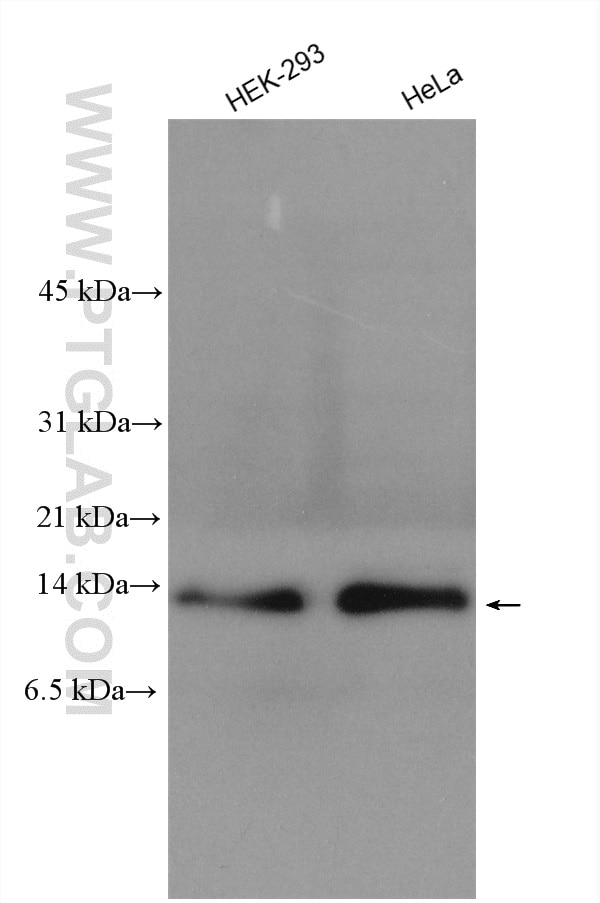
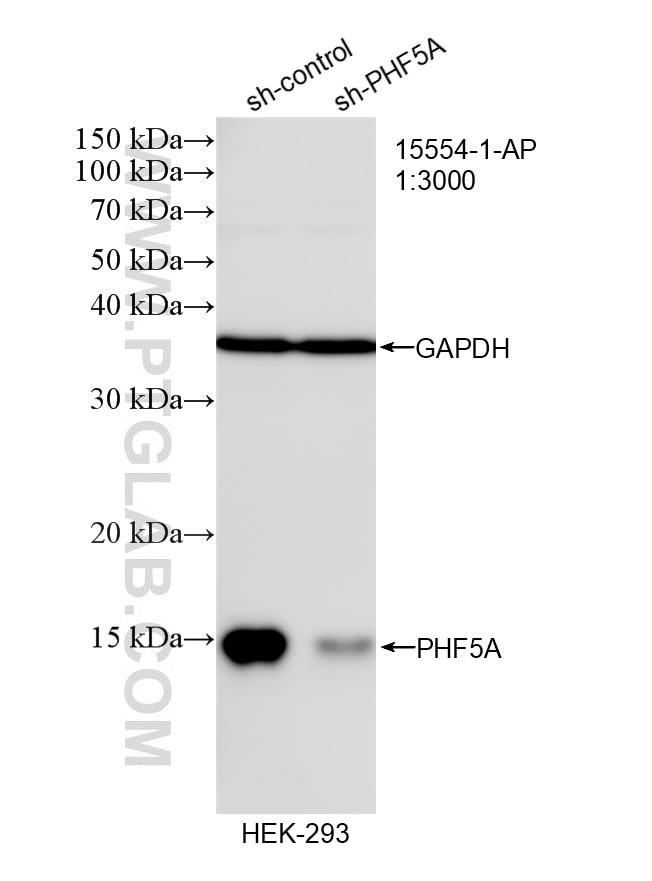
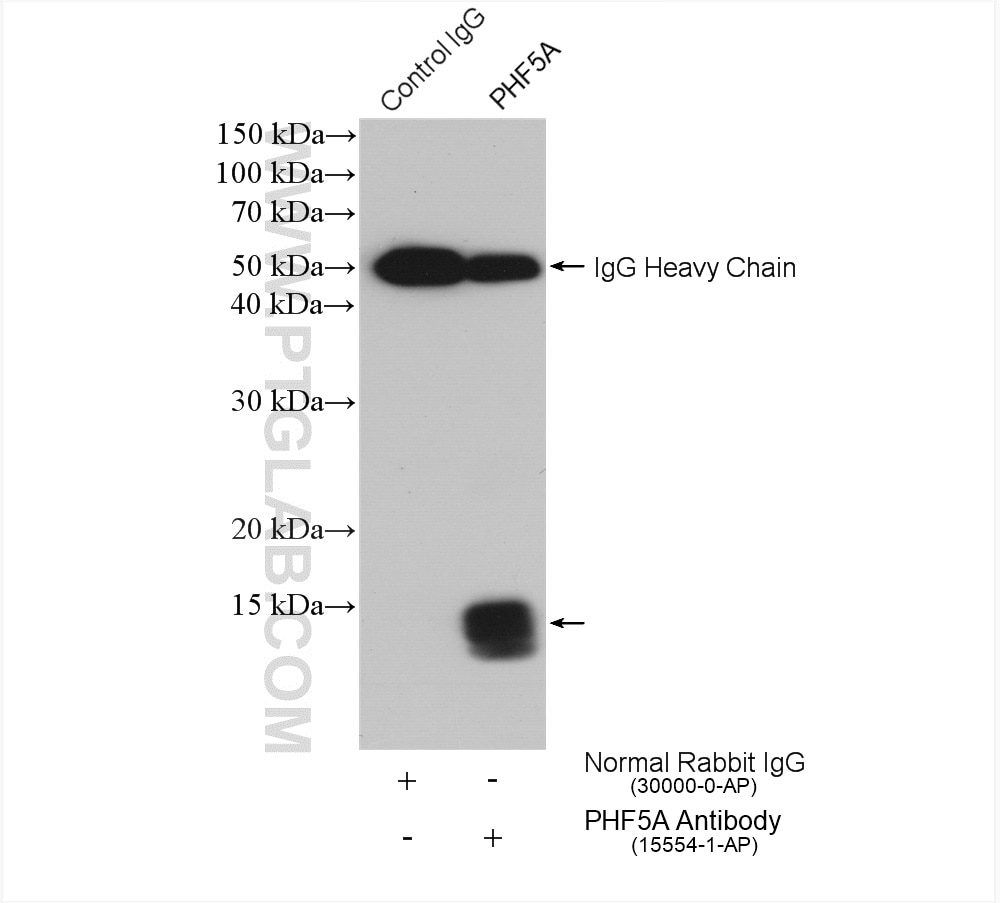
Tested Applications
| Positive WB detected in | HEK-293 cells, HeLa cells |
| Positive IP detected in | HeLa cells |
Recommended dilution
| Application | Dilution |
|---|---|
| Western Blot (WB) | WB : 1:1000-1:6000 |
| Immunoprecipitation (IP) | IP : 0.5-4.0 ug for 1.0-3.0 mg of total protein lysate |
| It is recommended that this reagent should be titrated in each testing system to obtain optimal results. | |
| Sample-dependent, Check data in validation data gallery. | |
Product Information
15554-1-AP targets PHF5A in WB, IHC, IF, IP, CoIP, ChIP, ELISA applications and shows reactivity with human, mouse samples.
| Tested Reactivity | human, mouse |
| Cited Reactivity | human, mouse, chicken |
| Host / Isotype | Rabbit / IgG |
| Class | Polyclonal |
| Type | Antibody |
| Immunogen |
CatNo: Ag7918 Product name: Recombinant human INI-1 protein Source: e coli.-derived, PGEX-4T Tag: GST Domain: 1-110 aa of BC007321 Sequence: MAKHHPDLIFCRKQAGVAIGRLCEKCDGKCVICDSYVRPCTLVRICDECNYGSYQGRCVICGGPGVSDAYYCKECTIQEKDRDGCPKIVNLGSSKTDLFYERKKYGFKKR Predict reactive species |
| Full Name | PHD finger protein 5A |
| Calculated Molecular Weight | 12 kDa |
| Observed Molecular Weight | 12-14 kDa |
| GenBank Accession Number | BC007321 |
| Gene Symbol | PHF5A |
| Gene ID (NCBI) | 84844 |
| RRID | AB_2165365 |
| Conjugate | Unconjugated |
| Form | Liquid |
| Purification Method | Antigen affinity purification |
| UNIPROT ID | Q7RTV0 |
| Storage Buffer | PBS with 0.02% sodium azide and 50% glycerol, pH 7.3. |
| Storage Conditions | Store at -20°C. Stable for one year after shipment. Aliquoting is unnecessary for -20oC storage. 20ul sizes contain 0.1% BSA. |
Background Information
The PHD finger-like domain protein 5a (PHF5A) is ubiquitously expressed and is located in the nucleus. The gene Phf5a and its human counterpart PHF5A (former name Ini) are located on rat chromosome 7 (RNO7q34) and human chromosome 22 (HSA2213q2), respectively. The rat gene consists of four exons, while the human gene have five exons. Both genes encode a highly conserved protein of 110 amino acids that contains a PHD finger domain.(PMID: 23675859) It acts as a transcriptional regulator by binding to the GJA1/Cx43 promoter and enhancing its up-regulation by ESR1/ER-alpha and is involved in pre-mRNA splicing.
Protocols
| Product Specific Protocols | |
|---|---|
| IP protocol for PHF5A antibody 15554-1-AP | Download protocol |
| WB protocol for PHF5A antibody 15554-1-AP | Download protocol |
| Standard Protocols | |
|---|---|
| Click here to view our Standard Protocols |
Publications
What published studies show
| Species | Application | Title |
|---|---|---|
Nat Cell Biol Regulation of transcriptional elongation in pluripotency and cell differentiation by the PHD-finger protein Phf5a.
| ||
Gastroenterology RNA Polymerase II-Associated Factor 1 Regulates Stem Cell Features of Pancreatic Cancer Cells, Independently of the PAF1 Complex, via Interactions With PHF5A and DDX3. | ||
Gastroenterology Enterotoxigenic Bacteroides fragilis promotes intestinal inflammation and malignancy by inhibiting exosomes-packaged miR-149-3p. | ||
Nat Commun KMT2A associates with PHF5A-PHF14-HMG20A-RAI1 subcomplex in pancreatic cancer stem cells and epigenetically regulates their characteristics | ||
Nat Commun Determination of trunk neural crest cell fate and susceptibility to splicing perturbation by the DLC1-SF3B1-PHF5A splicing complex | ||
Genes Dev The cryo-EM structure of the SF3b spliceosome complex bound to a splicing modulator reveals a pre-mRNA substrate competitive mechanism of action. |




