
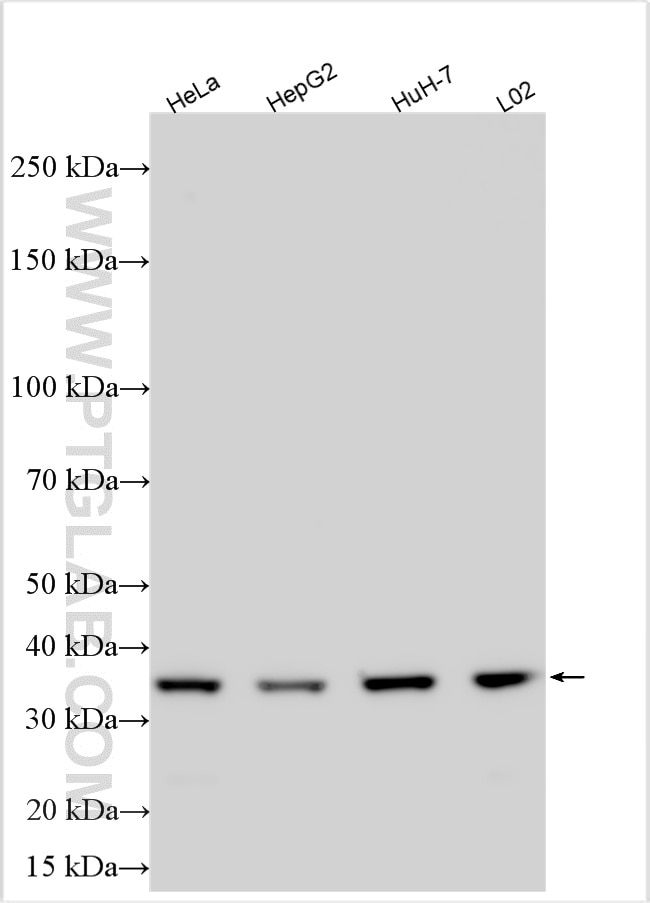
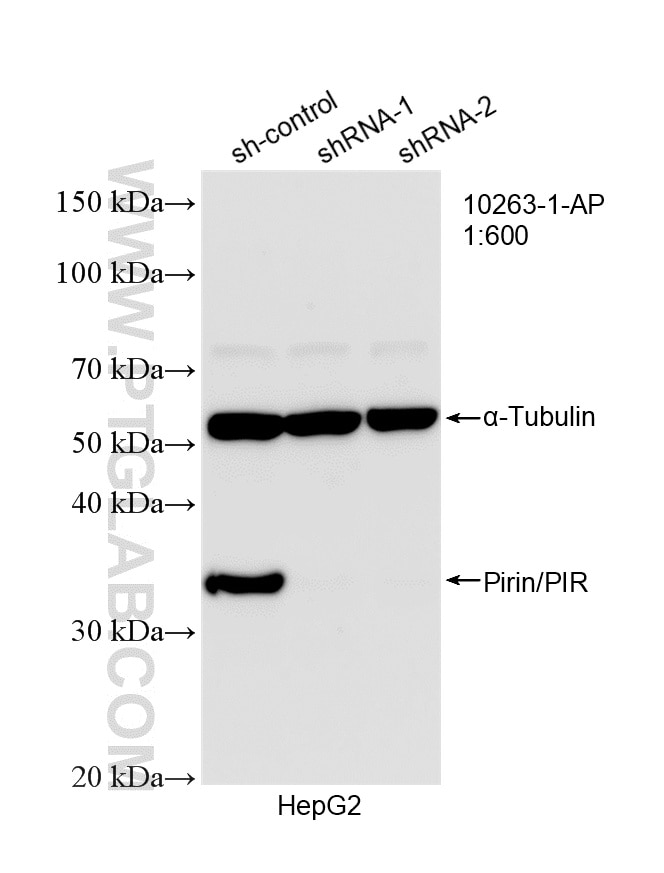



Tested Applications
| Positive WB detected in | HeLa cells, HepG2 cells, HuH-7 cells, L02 cells |
| Positive IP detected in | HeLa cells |
| Positive IHC detected in | human liver tissue Note: suggested antigen retrieval with TE buffer pH 9.0; (*) Alternatively, antigen retrieval may be performed with citrate buffer pH 6.0 |
Recommended dilution
| Application | Dilution |
|---|---|
| Western Blot (WB) | WB : 1:500-1:3000 |
| Immunoprecipitation (IP) | IP : 0.5-4.0 ug for 1.0-3.0 mg of total protein lysate |
| Immunohistochemistry (IHC) | IHC : 1:50-1:500 |
| It is recommended that this reagent should be titrated in each testing system to obtain optimal results. | |
| Sample-dependent, Check data in validation data gallery. | |
Product Information
10263-1-AP targets Pirin/PIR in WB, IHC, IP, ELISA applications and shows reactivity with human samples.
| Tested Reactivity | human |
| Cited Reactivity | human, mouse |
| Host / Isotype | Rabbit / IgG |
| Class | Polyclonal |
| Type | Antibody |
| Immunogen |
CatNo: Ag0330 Product name: Recombinant human PIR protein Source: e coli.-derived, PGEX-4T Tag: GST Domain: 46-230 aa of BC002517 Sequence: KGGRPGGFPDHPHRGFETVSYLLEGGSMAHEDFCGHTGKMNPGDLQWMTAGRGILHAEMPCSEEPAHGLQLWVNLRSSEKMVEPQYQELKSEEIPKPSKDGVTVAVISGEALGIKSKVYTRTPTLYLDFKLDPGAKHSQPIPKGWTSFIYTISGDVYIGPDDAQQKIEPHHTAVLGEGDSVQVEN Predict reactive species |
| Full Name | pirin (iron-binding nuclear protein) |
| Calculated Molecular Weight | 32 kDa |
| Observed Molecular Weight | 35 kDa |
| GenBank Accession Number | BC002517 |
| Gene Symbol | PIR |
| Gene ID (NCBI) | 8544 |
| RRID | AB_2283879 |
| Conjugate | Unconjugated |
| Form | Liquid |
| Purification Method | Antigen affinity purification |
| UNIPROT ID | O00625 |
| Storage Buffer | PBS with 0.02% sodium azide and 50% glycerol, pH 7.3. |
| Storage Conditions | Store at -20°C. Stable for one year after shipment. Aliquoting is unnecessary for -20oC storage. 20ul sizes contain 0.1% BSA. |
Background Information
Pirin (iron-binding nuclear protein, PIR) is a highly conserved 32-kDa protein consisting of 290 amino acids. Pirin mRNA is expressed weakly in all human tissues. Confocal immunofluorescence experiments demonstrate a predominant localization of Pirin within dot-like subnuclear structures. Pirin interacts with the oncoprotein B-cell lymphoma 3-encoded (Bcl-3) and nuclear factor I (NFI).
Protocols
| Product Specific Protocols | |
|---|---|
| IHC protocol for Pirin/PIR antibody 10263-1-AP | Download protocol |
| IP protocol for Pirin/PIR antibody 10263-1-AP | Download protocol |
| WB protocol for Pirin/PIR antibody 10263-1-AP | Download protocol |
| Standard Protocols | |
|---|---|
| Click here to view our Standard Protocols |
Publications
What published studies show
The Pirin/PIR Polyclonal antibody (Cat# 10263-1-AP) has 2 citations. These appear in Gut (2026), where the antibody was used in WB to study nuclear Pirin's role in promoting hepatocellular carcinoma via inflammation, and in Cell Cycle (2019), where it was applied in WB to investigate PIR-driven breast cancer tumorigenesis through E2F1 upregulation. The associated research fields encompass liver cancer inflammation and breast cancer cell cycle regulation.
| Species | Application | Title |
|---|---|---|
Cell Cycle PIR promotes tumorigenesis of breast cancer by upregulating cell cycle activator E2F1.
|




