
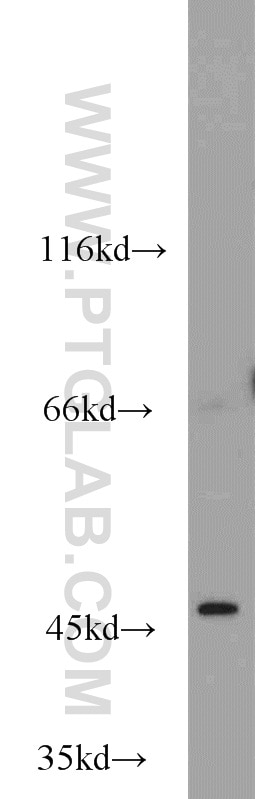
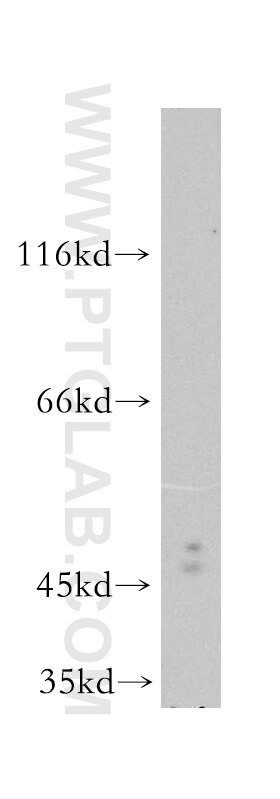

Tested Applications
| Positive WB detected in | HEK-293 cells |
Recommended dilution
| Application | Dilution |
|---|---|
| Western Blot (WB) | WB : 1:500-1:1000 |
| It is recommended that this reagent should be titrated in each testing system to obtain optimal results. | |
| Sample-dependent, Check data in validation data gallery. | |
Product Information
18997-1-AP targets Oct6-Specific in WB, IHC, IF, ELISA applications and shows reactivity with human, mouse, rat samples.
| Tested Reactivity | human, mouse, rat |
| Cited Reactivity | human, mouse, rat, rabbit |
| Host / Isotype | Rabbit / IgG |
| Class | Polyclonal |
| Type | Antibody |
| Immunogen |
Peptide Predict reactive species |
| Full Name | POU class 3 homeobox 1 |
| Calculated Molecular Weight | 46 kDa |
| Observed Molecular Weight | 46 kDa |
| GenBank Accession Number | NM_002699 |
| Gene Symbol | POU3F1 |
| Gene ID (NCBI) | 5453 |
| RRID | AB_2167357 |
| Conjugate | Unconjugated |
| Form | Liquid |
| Purification Method | Antigen affinity purification |
| UNIPROT ID | Q03052 |
| Storage Buffer | PBS with 0.02% sodium azide and 50% glycerol, pH 7.3. |
| Storage Conditions | Store at -20°C. Stable for one year after shipment. Aliquoting is unnecessary for -20oC storage. 20ul sizes contain 0.1% BSA. |
Background Information
OCT6, also named as POU3F1 and OTF6, belongs to the POU transcription factor family and Class-3 subfamily. OCT6 is a transcription factor that binds to the octamer motif (5'-ATTTGCAT-3'). It is thought to be involved in early embryogenesis and neurogenesis. The antibody is specific to OCT6.
Protocols
| Product Specific Protocols | |
|---|---|
| WB protocol for Oct6-Specific antibody 18997-1-AP | Download protocol |
| Standard Protocols | |
|---|---|
| Click here to view our Standard Protocols |
Publications
What published studies show
The Oct6 (POU3F1)-Specific Polyclonal antibody (Cat# 18997-1-AP) has 6 total citations. These appear in Nature Communications, Developmental Cell, British Journal of Cancer, Cell Reports, Neurochemistry Research, and Journal of Biological Chemistry. The research fields span cardiac fibrosis and mechanosensing, spermatogonial stem cell development, colorectal cancer immunotherapy, Schwann cell homeostasis and necroptosis, neurite outgrowth after nerve injury, and mitochondrial dysfunction in facial nerve injury.
| Species | Application | Title |
|---|---|---|
Nat Commun Intercellular chemerin-cmklr1 couples epicardial mechanosensing to fibroblasts in pressure overload. | ||
Dev Cell DDX20 is required for cell-cycle reentry of prospermatogonia and establishment of spermatogonial stem cell pool during testicular development in mice | ||
Br J Cancer Impact of gut microbiome on radiotherapy and immunotherapy efficacy in microsatellite-stable colorectal cancer: role of propionic acid and B. fragilis | ||
Cell Rep Nucleoporin Seh1 maintains Schwann cell homeostasis by regulating genome stability and necroptosis | ||
Neurochem Res Runx2 was Correlated with Neurite Outgrowth and Schwann Cell Differentiation, Migration After Sciatic Nerve Crush. | ||
J Biol Chem Neurofascin stabilization by contactin-associated protein-like 2 and CTCF alleviates mitochondrial dysfunction in Schwann cells during facial nerve injury. |



