

Tested Applications
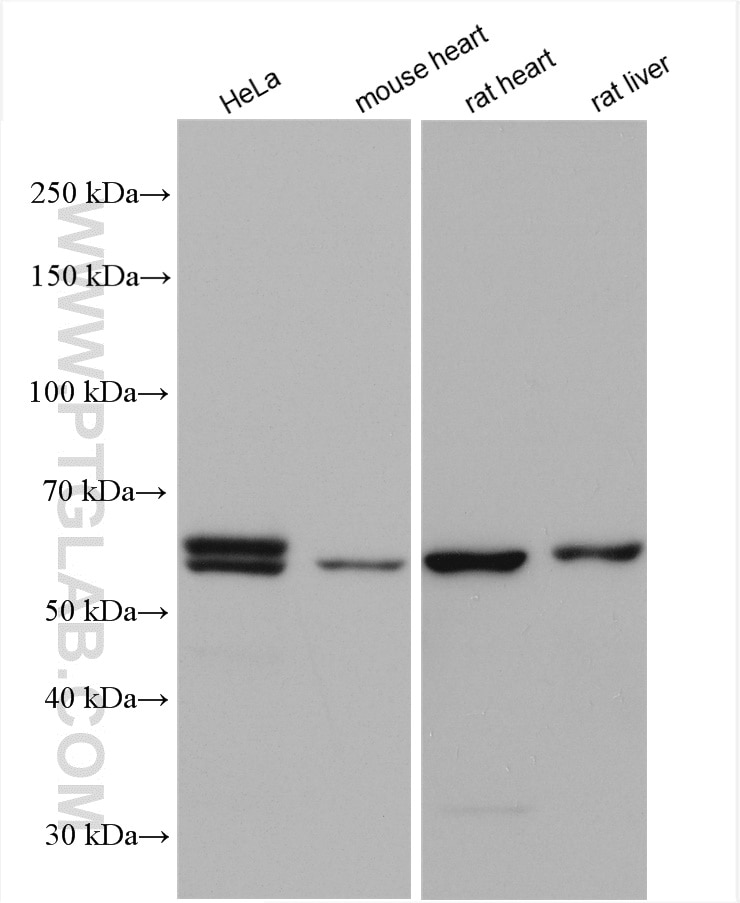
| Positive WB detected in | HeLa cells, mouse heart tissue, rat heart tissue, rat liver tissue |
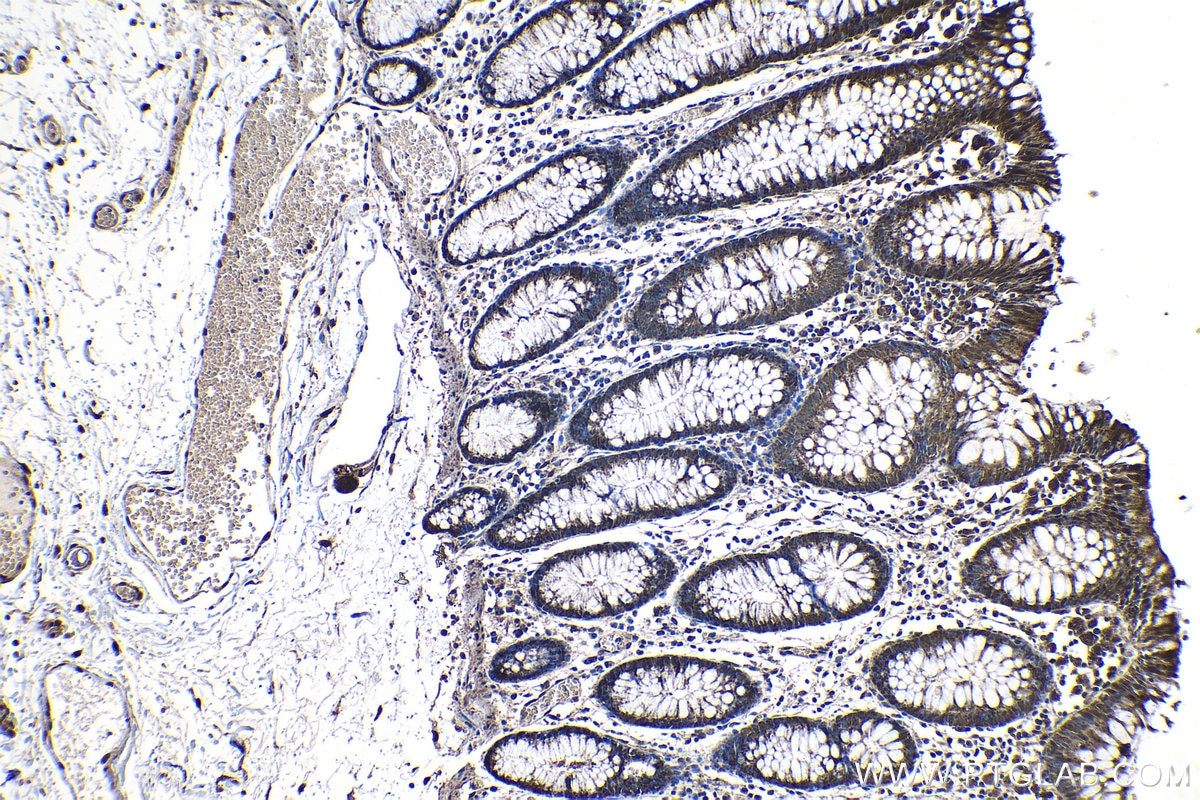
| Positive IHC detected in | human colon tissue Note: suggested antigen retrieval with TE buffer pH 9.0; (*) Alternatively, antigen retrieval may be performed with citrate buffer pH 6.0 |
Recommended dilution
| Application | Dilution |
|---|---|
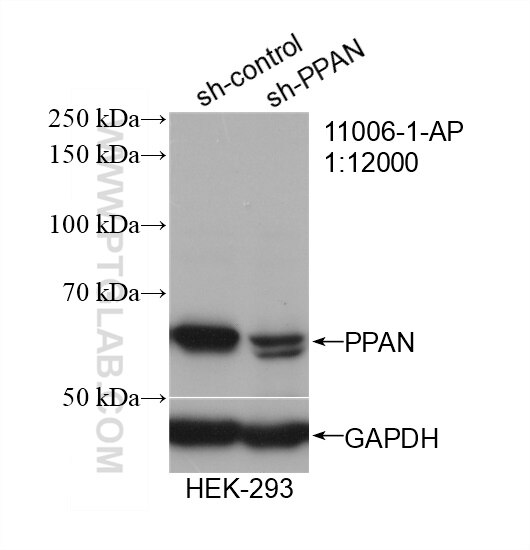
| Western Blot (WB) | WB : 1:1000-1:4000 |
| Immunohistochemistry (IHC) | IHC : 1:500-1:2000 |
| It is recommended that this reagent should be titrated in each testing system to obtain optimal results. | |
| Sample-dependent, Check data in validation data gallery. | |
Product Information
11006-1-AP targets PPAN in WB, IHC, IF, IP, ELISA applications and shows reactivity with human, mouse, rat samples.
| Tested Reactivity | human, mouse, rat |
| Cited Reactivity | human, mouse, xenopus |
| Host / Isotype | Rabbit / IgG |
| Class | Polyclonal |
| Type | Antibody |
| Immunogen |
CatNo: Ag1419 Product name: Recombinant human PPAN protein Source: e coli.-derived, PGEX-4T Tag: GST Domain: 174-473 aa of BC009833 Sequence: LNTIKRCLLIDYNPDSQELDFRHYSIKVVPVGASRGMKKLLQEKFPNMSRLQDISELLATGAGLSESEAEPDGDHNITELPQAVAGRGNMRAQQSAVRLTEIGPRMTLQLIKVQEGVGEGKVMFHSFVSKTEEELQAILEAKEKKLRLKAQRQAQQAQNVQRKQEQREAHRKKSLEGMKKARVGGSDEEASGIPSRTASLELGEDDDEQEDDDIEYFCQAVGEAPSEDLFPEAKQKRLAKSPGRKRKRWEMDRGRGRLCDQKFPKTKDKSQGAQARRGPRGASRDGGRGRGRGRPGKRVA Predict reactive species |
| Full Name | peter pan homolog (Drosophila) |
| Calculated Molecular Weight | 53 kDa |
| Observed Molecular Weight | 55-58 kDa |
| GenBank Accession Number | BC009833 |
| Gene Symbol | PPAN |
| Gene ID (NCBI) | 56342 |
| RRID | AB_2168040 |
| Conjugate | Unconjugated |
| Form | Liquid |
| Purification Method | Antigen affinity purification |
| UNIPROT ID | Q9NQ55 |
| Storage Buffer | PBS with 0.02% sodium azide and 50% glycerol, pH 7.3. |
| Storage Conditions | Store at -20°C. Stable for one year after shipment. Aliquoting is unnecessary for -20oC storage. 20ul sizes contain 0.1% BSA. |
Background Information
PPAN (or SSF, SSF1 or SSF2) gene is widely expressed, and encodes peter pan homolog protein which may be localized in nucleus. Two isoforms are produced through alternative splicing. So far the characterization of this protein is largely unknown, multiple phosphorylation sites has been revealed based on high-throughput phosphorylation analysis. This antibody is raised against the C-terminal of huaman PPAN and recognize bands around 55 kDa.
Protocols
| Product Specific Protocols | |
|---|---|
| IHC protocol for PPAN antibody 11006-1-AP | Download protocol |
| WB protocol for PPAN antibody 11006-1-AP | Download protocol |
| Standard Protocols | |
|---|---|
| Click here to view our Standard Protocols |
Publications
What published studies show
The anti-Peter Pan (PPAN) antibody (Cat# 11006-1-AP) has 8 total citations published in journals including Molecular Cell, EMBO Journal, Cells, Cancers, Biochimica et Biophysica Acta, Journal of Biological Chemistry, Development, and Biology of the Cell. Research fields span nucleolar stress, autophagy, ribosome biogenesis, cell cycle regulation, apoptosis, Wnt signaling, neurogenesis, and embryonic development in human, mouse, and Xenopus models.
| Species | Application | Title |
|---|---|---|
EMBO J The long non-coding RNA Paupar promotes KAP1-dependent chromatin changes and regulates olfactory bulb neurogenesis. | ||
Cells Loss of Peter Pan (PPAN) Affects Mitochondrial Homeostasis and Autophagic Flux.
| ||
Cancers (Basel) Nucleolar Stress Functions Upstream to Stimulate Expression of Autophagy Regulators.
| ||
Biochim Biophys Acta Mol Cell Res Loss of Peter Pan protein is associated with cell cycle defects and apoptotic events.
| ||
J Biol Chem The Wnt target Peter Pan defines a novel p53-independent nucleolar stress response pathway.
|




