
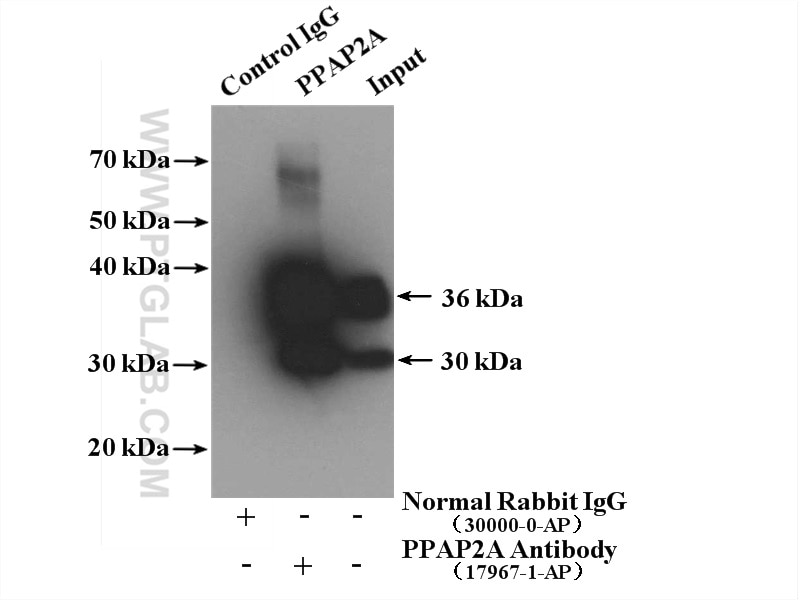

Tested Applications
| Positive IP detected in | LNCaP cells |
Recommended dilution
| Application | Dilution |
|---|---|
| Immunoprecipitation (IP) | IP : 0.5-4.0 ug for 1.0-3.0 mg of total protein lysate |
| It is recommended that this reagent should be titrated in each testing system to obtain optimal results. | |
| Sample-dependent, Check data in validation data gallery. | |
Product Information
17967-1-AP targets PPAP2A in WB, IP, IHC, ELISA applications and shows reactivity with human samples.
| Tested Reactivity | human |
| Cited Reactivity | human |
| Host / Isotype | Rabbit / IgG |
| Class | Polyclonal |
| Type | Antibody |
| Immunogen |
CatNo: Ag11615 Product name: Recombinant human PPAP2A protein Source: e coli.-derived, PET28a Tag: 6*His Domain: 26-284 aa of BC039847 Sequence: ILTSRHTPFQRGVFCNDESIKYPYKEDTIPYALLGGIIIPFSIIVIILGETLSVYCNLLHSNSFIRNNYIATIYKAIGTFLFGAAASQSLTDIAKYSIGRLRPHFLDVCDPDWSKINCSDGYIEYYICRGNAERVKEGRLSFYSGHSSFSMYCMLFVALYLQARMKGDWARLLRPTLQFGLVAVSIYVGLSRVSDYKHHWSDVLTGLIQGALVAILVAVYVSDFFKERTSFKERKEEDSHTTLHETPTTGNHYPSNHQP Predict reactive species |
| Full Name | phosphatidic acid phosphatase type 2A |
| Calculated Molecular Weight | 284 aa, 32 kDa |
| Observed Molecular Weight | 30-36 kDa |
| GenBank Accession Number | BC039847 |
| Gene Symbol | PPAP2A |
| Gene ID (NCBI) | 8611 |
| RRID | AB_2878473 |
| Conjugate | Unconjugated |
| Form | Liquid |
| Purification Method | Antigen affinity purification |
| UNIPROT ID | O14494 |
| Storage Buffer | PBS with 0.02% sodium azide and 50% glycerol, pH 7.3. |
| Storage Conditions | Store at -20°C. Stable for one year after shipment. Aliquoting is unnecessary for -20oC storage. 20ul sizes contain 0.1% BSA. |
Protocols
| Product Specific Protocols | |
|---|---|
| IP protocol for PPAP2A antibody 17967-1-AP | Download protocol |
| Standard Protocols | |
|---|---|
| Click here to view our Standard Protocols |
Publications
What published studies show
The PPAP2A Polyclonal Antibody (Cat# 17967-1-AP) has 1 citation. It was used in a study published in International Journal of Molecular Sciences (2023), investigating how Z-Ligustilide combined with cisplatin reduces PLPP1-mediated phospholipid synthesis to impair cisplatin resistance in lung cancer. The research field is oncology, specifically lung cancer drug resistance mechanisms. The antibody was applied via Western blot and immunohistochemistry in human samples.
| Species | Application | Title |
|---|---|---|
Int J Mol Sci Z-Ligustilide Combined with Cisplatin Reduces PLPP1-Mediated Phospholipid Synthesis to Impair Cisplatin Resistance in Lung Cancer |


