



Tested Applications
| Positive WB detected in | mouse brain tissue, A549 cells |
| Positive IP detected in | mouse brain tissue |
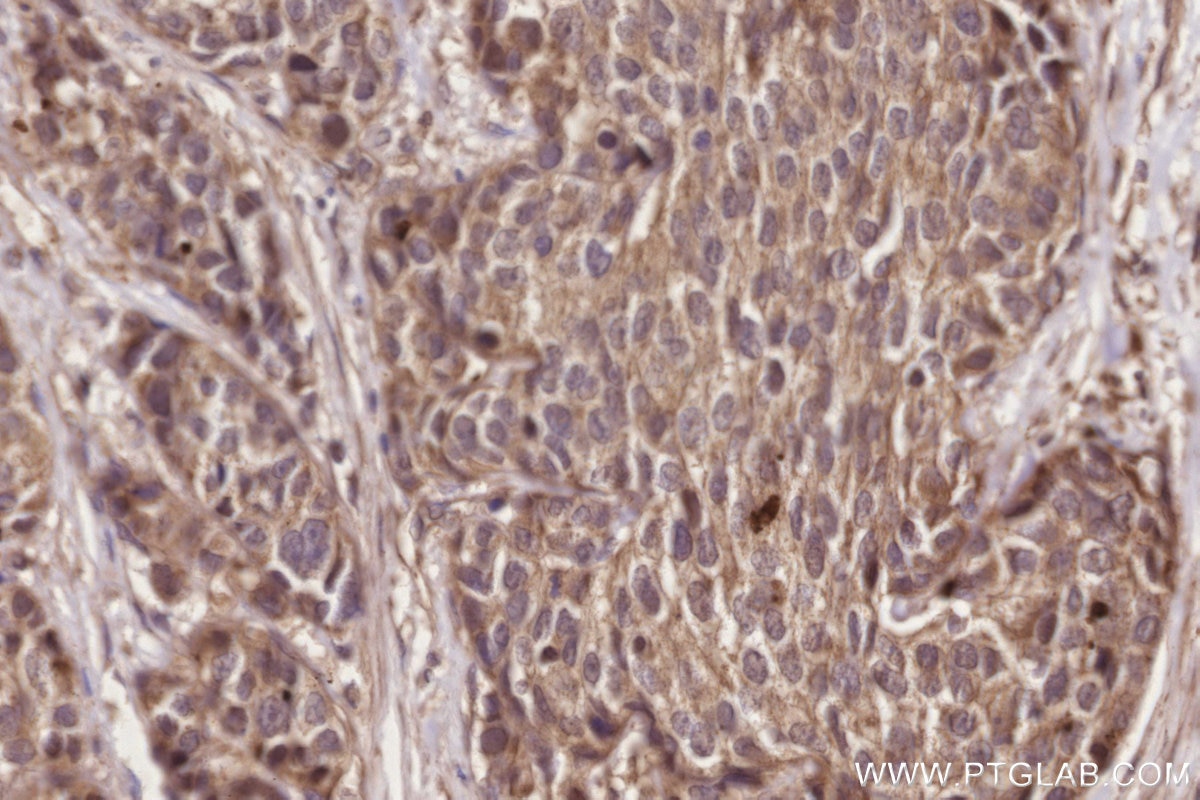
| Positive IHC detected in | human stomach cancer tissue, human brain tissue Note: suggested antigen retrieval with TE buffer pH 9.0; (*) Alternatively, antigen retrieval may be performed with citrate buffer pH 6.0 |
Recommended dilution
| Application | Dilution |
|---|---|
| Western Blot (WB) | WB : 1:1000-1:8000 |
| Immunoprecipitation (IP) | IP : 0.5-4.0 ug for 1.0-3.0 mg of total protein lysate |
| Immunohistochemistry (IHC) | IHC : 1:500-1:2000 |
| It is recommended that this reagent should be titrated in each testing system to obtain optimal results. | |
| Sample-dependent, Check data in validation data gallery. | |
Product Information
55129-1-AP targets Neurabin 2 in WB, IHC, IP, ELISA applications and shows reactivity with human, mouse samples.
| Tested Reactivity | human, mouse |
| Cited Reactivity | human, mouse |
| Host / Isotype | Rabbit / IgG |
| Class | Polyclonal |
| Type | Antibody |
| Immunogen |
Peptide Predict reactive species |
| Full Name | protein phosphatase 1, regulatory (inhibitor) subunit 9B |
| Calculated Molecular Weight | 89 kDa |
| Observed Molecular Weight | 120-130 kDa |
| GenBank Accession Number | NM_032595 |
| Gene Symbol | Spinophilin/Neurabin 2 |
| Gene ID (NCBI) | 84687 |
| RRID | AB_10837358 |
| Conjugate | Unconjugated |
| Form | Liquid |
| Purification Method | Antigen affinity purification |
| UNIPROT ID | Q96SB3 |
| Storage Buffer | PBS with 0.02% sodium azide and 50% glycerol, pH 7.3. |
| Storage Conditions | Store at -20°C. Stable for one year after shipment. Aliquoting is unnecessary for -20oC storage. 20ul sizes contain 0.1% BSA. |
Background Information
Neurabin 2, also named as Spinophilin, seems to act as a scaffold protein in multiple signaling pathways. It modulates excitatory synaptic transmission and dendritic spine morphology. PPP1R9B binds to actin filaments (F-actin) and shows cross-linking activity. It may play an important role in linking the actin cytoskeleton to the plasma membrane at the synaptic junction. PPP1R9B plays a role in regulation of G-protein coupled receptor signaling, including D2Rs and alpha-adrenergic receptors. PPP1R9B probably regulates p70 S6 kinase activity by forming a complex with TIAM. The antibody is specific to PPP1R9B. The predicted molecular weight of spinophilin is 89 kDa, which differs significantly from the apparent MW seen in SDS/PAGE. Both the expressed full-length cDNA and the endogenous protein run at 120-130 kDa. This may be due to an extended conformation and/or low SDS binding capacity. (PMID: 28941770, PMID: 9275233).
Protocols
| Product Specific Protocols | |
|---|---|
| IHC protocol for Neurabin 2 antibody 55129-1-AP | Download protocol |
| IP protocol for Neurabin 2 antibody 55129-1-AP | Download protocol |
| WB protocol for Neurabin 2 antibody 55129-1-AP | Download protocol |
| Standard Protocols | |
|---|---|
| Click here to view our Standard Protocols |
Publications
What published studies show
The Neurabin 2 (PPP1R9B) Polyclonal Antibody (Cat# 55129-1-AP) has 5 total citations. These appear in Genes Dis, Cell Death Differ, Neural Regen Res, Biomolecules, and Toxicology. The cited research spans neuroscience (synaptic plasticity, cognitive impairment, microglia polarization), autophagy and cell death signaling, neurotoxicology (methamphetamine effects), and oncology (renal cell carcinoma). Applications used include WB and IP in human and mouse samples.
| Species | Application | Title |
|---|---|---|
Genes Dis Hippocampal overexpression of TREM2 ameliorates high fat diet induced cognitive impairment and modulates phenotypic polarization of the microglia. | ||
Cell Death Differ Lysine methylation of PPP1CA by the methyltransferase SUV39H2 disrupts TFEB-dependent autophagy and promotes intervertebral disc degeneration | ||
Neural Regen Res 3'-Deoxyadenosin alleviates methamphetamine-induced aberrant synaptic plasticity and seeking behavior by inhibiting the NLRP3 inflammasome | ||
Biomolecules CYTH4 Facilitates Renal Cell Carcinoma via Enhancing Proliferation and Likely Immune Evasion. | ||
Toxicology Changes in memory and synaptic plasticity induced in male rats after maternal exposure to Bisphenol A. |





