
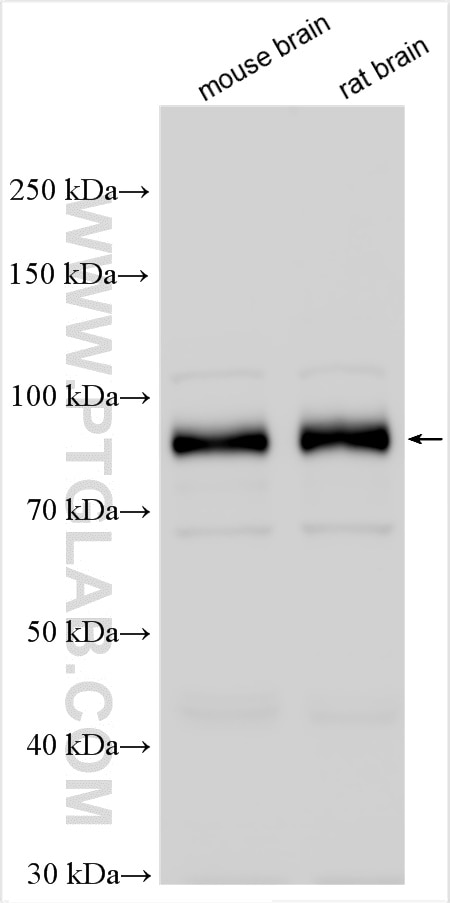



Tested Applications
| Positive WB detected in | mouse brain tissue, rat brain tissue |
| Positive IHC detected in | mouse brain tissue Note: suggested antigen retrieval with TE buffer pH 9.0; (*) Alternatively, antigen retrieval may be performed with citrate buffer pH 6.0 |
| Positive IF-P detected in | mouse brain tissue |
Recommended dilution
| Application | Dilution |
|---|---|
| Western Blot (WB) | WB : 1:5000-1:50000 |
| Immunohistochemistry (IHC) | IHC : 1:50-1:500 |
| Immunofluorescence (IF)-P | IF-P : 1:50-1:500 |
| It is recommended that this reagent should be titrated in each testing system to obtain optimal results. | |
| Sample-dependent, Check data in validation data gallery. | |
Product Information
30255-1-AP targets PSD95 in WB, IHC, IF-P, ELISA applications and shows reactivity with human, mouse, rat samples.
| Tested Reactivity | human, mouse, rat |
| Cited Reactivity | human, mouse, rat |
| Host / Isotype | Rabbit / IgG |
| Class | Polyclonal |
| Type | Antibody |
| Immunogen |
CatNo: Ag33000 Product name: Recombinant human PSD95 protein Source: e coli.-derived, PGEX-4T Tag: GST Domain: 630-724 aa of NM_001365 Sequence: VSANAVRRLQAAHLHPIAIFIRPRSLENVLEINKRITEEQARKAFDRATKLEQEFTECFSAIVEGDSFEEIYHKVKRVIEDLSGPYIWVPARERL Predict reactive species |
| Full Name | discs, large homolog 4 (Drosophila) |
| Calculated Molecular Weight | 81 kDa |
| Observed Molecular Weight | 90-95 kDa |
| GenBank Accession Number | NM_001365 |
| Gene Symbol | PSD95 |
| Gene ID (NCBI) | 1742 |
| RRID | AB_3086283 |
| Conjugate | Unconjugated |
| Form | Liquid |
| Purification Method | Antigen affinity purification |
| UNIPROT ID | P78352 |
| Storage Buffer | PBS with 0.02% sodium azide and 50% glycerol, pH 7.3. |
| Storage Conditions | Store at -20°C. Stable for one year after shipment. Aliquoting is unnecessary for -20oC storage. 20ul sizes contain 0.1% BSA. |
Background Information
PSD-95 (postsynaptic density protein 95) also known as SAP-90 (synapse-associated protein 90) is a protein that in humans is encoded by the DLG4 (disks large homolog 4) gene. PSD-95 is a scaffolding protein of the MAGUK protein family, and engages in several vital protein-protein interactions in the brain with its PDZ domains. It has been suggested that PSD-95 is composed of two supramodules, one of which is the PDZ1-2 tandem domain. It plays an important role in synaptic plasticity and the stabilization of synaptic changes during long-term potentiation. Observed MW of PSD95 is 90-95 kDa due to phosphorylation (PMID: 20682303).
Protocols
| Product Specific Protocols | |
|---|---|
| IF protocol for PSD95 antibody 30255-1-AP | Download protocol |
| IHC protocol for PSD95 antibody 30255-1-AP | Download protocol |
| WB protocol for PSD95 antibody 30255-1-AP | Download protocol |
| Standard Protocols | |
|---|---|
| Click here to view our Standard Protocols |
Publications
What published studies show
The PSD95 Polyclonal antibody (Cat# 30255-1-AP) has 39 citations. These appear in journals including Gut Microbes, J Nanobiotechnology, Acta Pharm Sin B, Advanced Science, Cell Reports, Brain, FASEB Journal, Experimental Neurology, and Journal of Hazardous Materials. Research fields are dominated by neuroscience: neurodegeneration (Alzheimer's, Parkinson's), synaptic plasticity, neuroinflammation, microglial activation, depression, and cognitive impairment, with applications mainly in Western blot, IF, and IHC.
| Species | Application | Title |
|---|---|---|
Gut Microbes Simulated microgravity induces cerebral dysfunction by disturbing protective microbiota-metabolite-microglia signaling across the gut‒brain axis. | ||
J Nanobiotechnology Disruption of cerebral cholesterol homeostasis by PS-NPs: astrocytic endoplasmic reticulum stress. | ||
Acta Pharm Sin B High glucose induces hippocampal neuron impairment through the SKP1/COX7C pathway: A potential mechanism for perimenopausal depression. | ||
Adv Sci (Weinh) Inhibiting Liver-Derived C3 Protein Rescues Anesthesia/Surgery-Induced Cognitive Impairment, Synaptic Disorders, and Microglial Phagocytosis. | ||
Cell Commun Signal Impaired docking and recycling of synaptic vesicles in inherited lysosomal sphingolipidoses. | ||
J Neuroinflammation FADS1 contributes to anesthesia/surgery-induced cognitive impairment by aggravating omega-6 fatty acid metabolic disruption in aged mice. |
Reviews
What customers say
Both reviewers gave 5-star ratings. One used the antibody for Western Blot on mouse tissues and cell lines at 1:1000 dilution, noting the signal was already saturated at just 2.5 seconds of exposure, suggesting it could be diluted further. They found it superior to another PSD95 antibody for mouse samples, with no non-specificity in non-brain tissues. The principal band ranged from 80 to 110 kDa. The other reviewer used it for IHC and IF, praising its high specificity and sensitivity, providing reliable and reproducible results.
The reviews below have been submitted by verified Proteintech customers who received an incentive for providing their feedback.
Olga (Verified Customer) (10-03-2025) | You can surely dilute it more than 1:1000, as the signal was already saturated at 2.5 seconds of exposition. I find it better for mouse samples as it does not give non-specificity in non-brain tissues (comparing to 20665-1-AP PSD95 antibody) - all the mouse cells tested are of neuronal origin. The principal band size depends on protein marker used (see picture) - and can vary from 80 to 110 kDa.
 |
Alessandro (Verified Customer) (02-04-2025) | high specificity and sensitivity, providing reliable and reproducible results
|



