
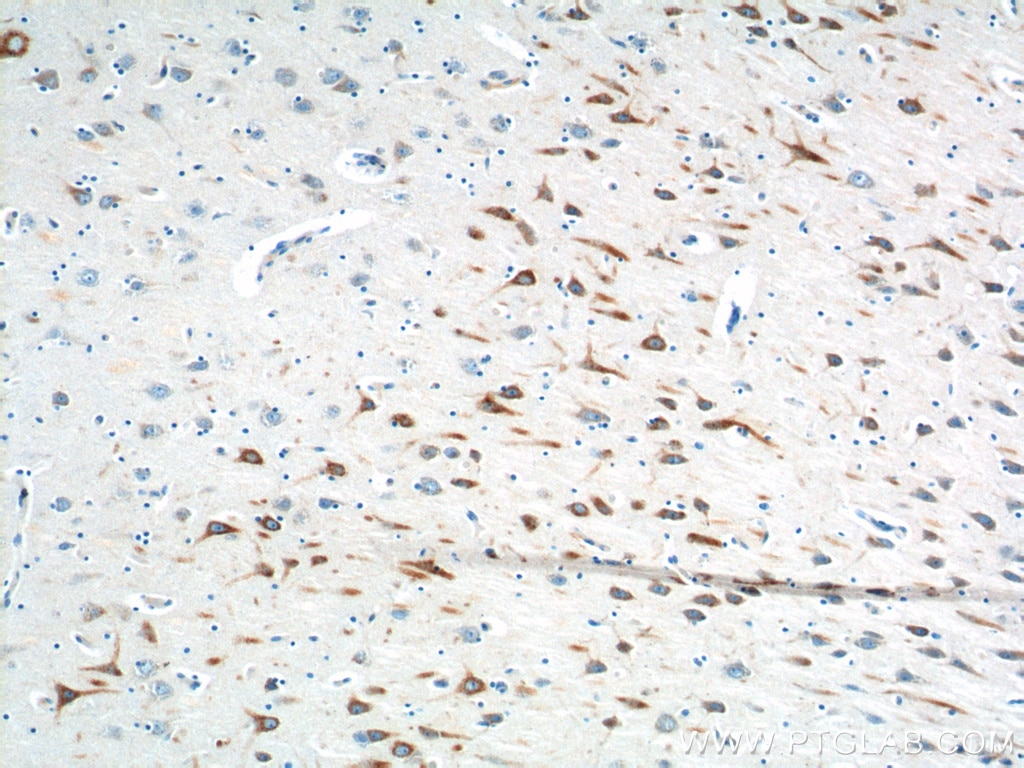
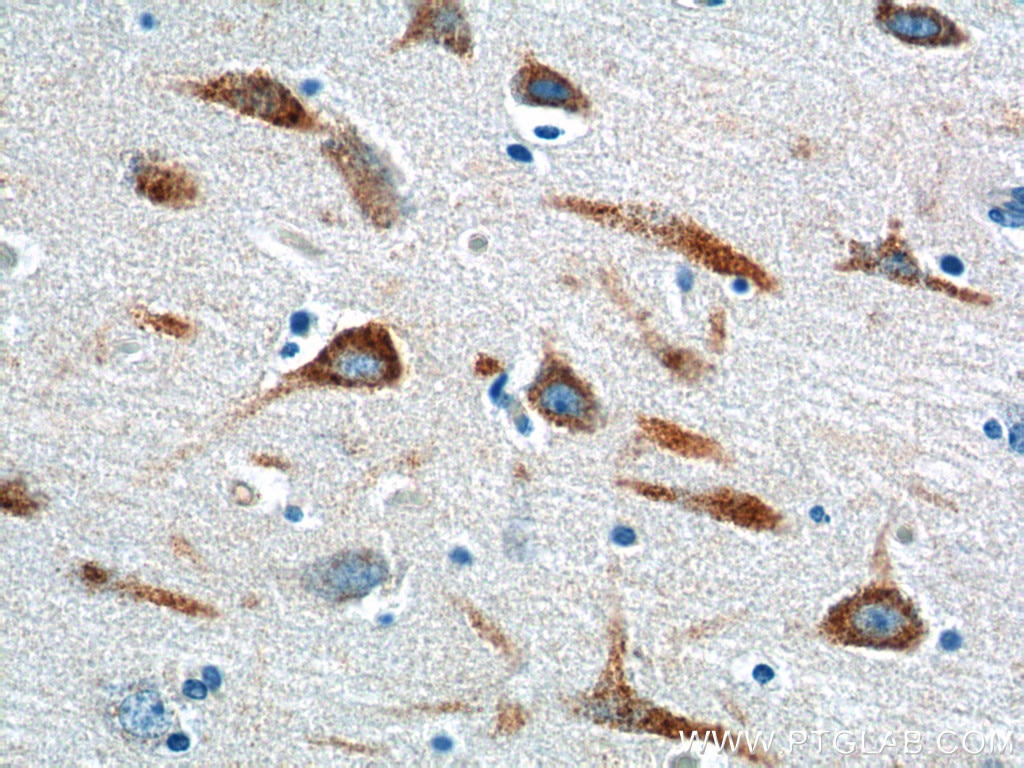

Tested Applications
| Positive IHC detected in | human brain tissue Note: suggested antigen retrieval with TE buffer pH 9.0; (*) Alternatively, antigen retrieval may be performed with citrate buffer pH 6.0 |
Recommended dilution
| Application | Dilution |
|---|---|
| Immunohistochemistry (IHC) | IHC : 1:50-1:500 |
| It is recommended that this reagent should be titrated in each testing system to obtain optimal results. | |
| Sample-dependent, Check data in validation data gallery. | |
Product Information
14357-1-AP targets PTGER3 in WB, IHC, IF, ELISA applications and shows reactivity with human, mouse, rat samples.
| Tested Reactivity | human, mouse, rat |
| Cited Reactivity | human, mouse, rat |
| Host / Isotype | Rabbit / IgG |
| Class | Polyclonal |
| Type | Antibody |
| Immunogen |
CatNo: Ag5711 Product name: Recombinant human PTGER3 protein Source: e coli.-derived, PET28a Tag: 6*His Domain: 1-374 aa of BC024229 Sequence: MKETRGYGGDAPFCTRLNHSYTGMWAPERSAEARGNLTRPPGSGEDCGSVSVAFPITMLLTGFVGNALAMLLVSRSYRRRESKRKKSFLLCIGWLALTDLVGQLLTTPVVIVVYLSKQRWEHIDPSGRLCTFFGLTMTVFGLSSLFIASAMAVERALAIRAPHWYASHMKTRATRAVLLGVWLAVLAFALLPVLGVGQYTVQWPGTWCFISTGRGGNGTSSSHNWGNLFFASAFAFLGLLALTVTFSCNLATIKALVSRCRAKATASQSSAQWGRITTETAIQLMGIMCVLSVCWSPLLIMMLKMIFNQTSVEHCKTHTEKQKECNFFLIAVRLASLNQILDPWVYLLLRKILLRKFCQMRKRRLREQEEFWGN Predict reactive species |
| Full Name | prostaglandin E receptor 3 (subtype EP3) |
| Calculated Molecular Weight | 43 kDa |
| GenBank Accession Number | BC024229 |
| Gene Symbol | PTGER3 |
| Gene ID (NCBI) | 5733 |
| RRID | AB_2237964 |
| Conjugate | Unconjugated |
| Form | Liquid |
| Purification Method | Antigen affinity purification |
| UNIPROT ID | P43115 |
| Storage Buffer | PBS with 0.02% sodium azide and 50% glycerol, pH 7.3. |
| Storage Conditions | Store at -20°C. Stable for one year after shipment. Aliquoting is unnecessary for -20oC storage. 20ul sizes contain 0.1% BSA. |
Background Information
PTGER3 (Prostaglandin E Receptor 3), also known as EP3, is a G protein-coupled receptor (GPCR). Activates pathways involved in proliferation, migration, and apoptosis, often via cross-talk with PI3K-AKT and MAPK cascades (PMID: 38566528). High PTGER3 levels drive tumorigenesis, angiogenesis, and cisplatin resistance via the Ras-MAPK/Erk-ETS1-ELK1/CFTR1 axis (PMID: 30655206).
Protocols
| Product Specific Protocols | |
|---|---|
| IHC protocol for PTGER3 antibody 14357-1-AP | Download protocol |
| Standard Protocols | |
|---|---|
| Click here to view our Standard Protocols |
Publications
What published studies show
The PTGER3 Polyclonal antibody (Cat# 14357-1-AP) has 11 citations spanning journals including Cancer Cell, Oxidative Medicine and Cellular Longevity, Neurobiology of Disease, Acta Physiologica, Biomolecules, International Journal of Molecular Sciences, Aging, Frontiers in Cell and Developmental Biology, Biology of Procedures Online, Neurogastroenterology and Motility, and Urolithiasis. Research fields cover oncology, cardiovascular disease, neurology, gastroenterology, urology, and pharmacology.
| Species | Application | Title |
|---|---|---|
Cancer Cell Lipid oxidation reprogramming in cancer-associated fibroblasts enhances CD8(+) T cell cytotoxicity and therapeutic response. | ||
Oxid Med Cell Longev Inhibition of Prostaglandin E2 Receptor EP3 Attenuates Oxidative Stress and Neuronal Apoptosis Partially by Modulating p38MAPK/FOXO3/Mul1/Mfn2 Pathway after Subarachnoid Hemorrhage in Rats | ||
Neurobiol Dis RecQ dysfunction contributes to social and depressive-like behavior and affects aldolase activity in mice | ||
Acta Physiol (Oxf) c-Jun N-terminal Kinase mediates prostaglandin induced sympathoexcitation in rats with chronic heart failure by reducing GAD1 and GABRA1 expression. | ||
Biomolecules In Silico, In Vitro, and In Vivo Analysis of Tanshinone IIA and Cryptotanshinone from Salvia miltiorrhiza as Modulators of Cyclooxygenase-2/mPGES-1/Endothelial Prostaglandin EP3 Pathway. | ||
Int J Mol Sci Correlative Study on Impaired Prostaglandin E2 Regulation in Epicardial Adipose Tissue and its Role in Maladaptive Cardiac Remodeling via EPAC2 and ST2 Signaling in Overweight Cardiovascular Disease Subjects. |



