
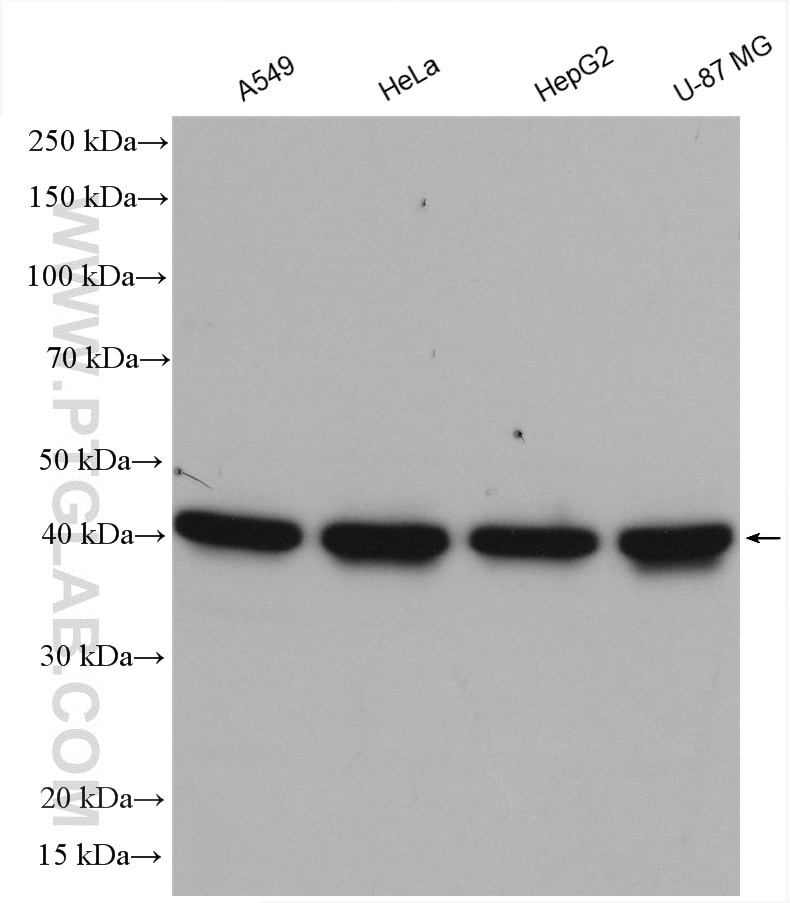
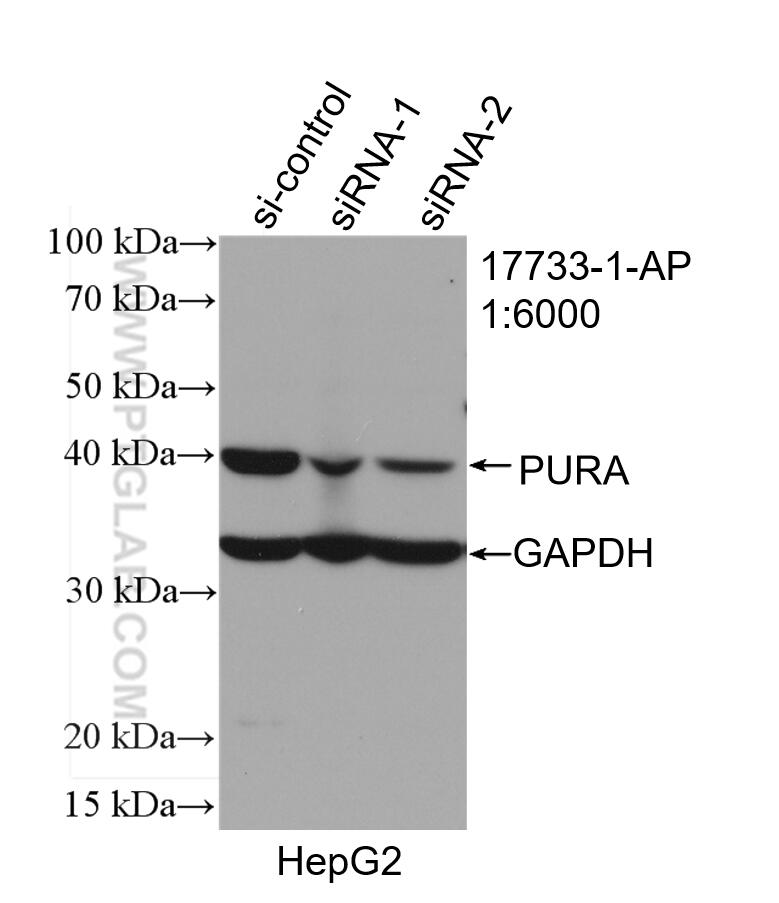

Tested Applications
| Positive WB detected in | A549 cells, HepG2 cells, Hela cells, U-87 MG cells |
Recommended dilution
| Application | Dilution |
|---|---|
| Western Blot (WB) | WB : 1:1000-1:6000 |
| It is recommended that this reagent should be titrated in each testing system to obtain optimal results. | |
| Sample-dependent, Check data in validation data gallery. | |
Product Information
17733-1-AP targets PURA in WB, IHC, IF, IP, RIP, ELISA applications and shows reactivity with human, mouse, rat samples.
| Tested Reactivity | human, mouse, rat |
| Cited Reactivity | human, rat |
| Host / Isotype | Rabbit / IgG |
| Class | Polyclonal |
| Type | Antibody |
| Immunogen |
CatNo: Ag12173 Product name: Recombinant human PURA protein Source: e coli.-derived, PGEX-4T Tag: GST Domain: 1-322 aa of BC036087 Sequence: MADRDSGSEQGGAALGSGGSLGHPGSGSGSGGGGGGGGGGGGSGGGGGGAPGGLQHETQELASKRVDIRNKRFYLDVKQNAKGRFLKIAEVGAGGNKSRLTLSMSVAVEFRDYLGDFIEHYAQLGPSQPPDLAQAQDEPRRALKSEFLVRENRKYYMDLKENQRGRFLRIRQTVNRGPGLGSTQGQTIALPAQGLIEFRDALAKLIDDYGVEEEPAELPEGTSLTVDNKRFFFDVGSNKYGVFMRVSEVKPTYRNSITVPYKVWAKFGHTFCKYSEEMKKIQEKQREKRAACEQLHQQQQQQQEETAAATLLLQGEEEGEED Predict reactive species |
| Full Name | purine-rich element binding protein A |
| Calculated Molecular Weight | 322 aa, 35 kDa |
| Observed Molecular Weight | 35-40 kDa |
| GenBank Accession Number | BC036087 |
| Gene Symbol | PURA |
| Gene ID (NCBI) | 5813 |
| RRID | AB_2173875 |
| Conjugate | Unconjugated |
| Form | Liquid |
| Purification Method | Antigen affinity purification |
| UNIPROT ID | Q00577 |
| Storage Buffer | PBS with 0.02% sodium azide and 50% glycerol, pH 7.3. |
| Storage Conditions | Store at -20°C. Stable for one year after shipment. Aliquoting is unnecessary for -20oC storage. 20ul sizes contain 0.1% BSA. |
Background Information
PURA, also named as Transcriptional activator protein Pur-alpha, is a 322 amino acid protein, which belongs to the PUR DNA-binding protein family and can form homodimer or heterodimer with PURB and heterotrimer with PURB and YBX1/Y-box protein 1. PURA is a probable transcription activator that specifically binds the purine-rich single strand of the PUR element located upstream of the MYC gene and may play a role in the initiation of DNA replication and in recombination.
Protocols
| Product Specific Protocols | |
|---|---|
| WB protocol for PURA antibody 17733-1-AP | Download protocol |
| Standard Protocols | |
|---|---|
| Click here to view our Standard Protocols |
Publications
What published studies show
Anti-PURA antibody (Cat# 17733-1-AP) has 10 citations across journals including Cancer Research, Nucleic Acids Research, EBioMedicine, Phytomedicine, Cell Reports, Int J Biol Macromol, Ecotoxicol Environ Saf, Front Mol Neurosci, and Acta Histochem. Research fields span breast cancer endocrine resistance, p53 acetylation regulation, cancer metastasis, endometrial cancer, HIV infection, vascular endothelial dysfunction in diabetes, cleft palate development, Schwann cell biology, and neuroprotection after subarachnoid hemorrhage.
| Species | Application | Title |
|---|---|---|
Cancer Res LncRNA AGPG confers endocrine resistance in breast cancer by promoting E2F1 activity | ||
Nucleic Acids Res Quantitative proteomics reveals that long non-coding RNA MALAT1 interacts with DBC1 to regulate p53 acetylation. | ||
Nucleic Acids Res Corrigendum to article "Quantitative proteomics reveals that long non-coding RNA MALAT1 interacts with DBC1 to regulate p53 acetylation''. | ||
Phytomedicine Chikusetsusaponin V improves vascular endothelial dysfunction by binding to ITGB1 and mediating PURA-eNOS activation in mice with diabetes mellitus. | ||
EBioMedicine Genome-wide CRISPR/Cas9 screening identifies a targetable MEST-PURA interaction in cancer metastasis
| ||
Int J Biol Macromol MTA1-DT promotes endometrial cancer growth by modulating G2/M-related gene transcription via PURα |
Reviews
What customers say
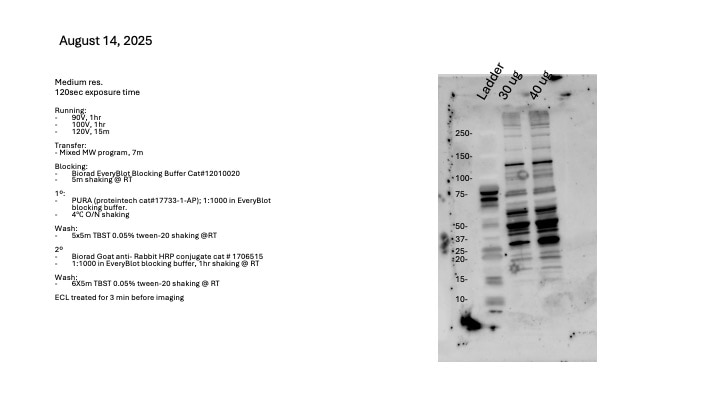
One customer rated this antibody 4 out of 5 stars for Western Blot. They used it at a 1:1000 dilution on human fibroblast cell lines derived from patients with a confirmed PURA syndrome diagnosis and reported clear, specific band detection. The overall feedback was positive, confirming the antibody's performance in detecting the target protein in a clinically relevant cell model.
The reviews below have been submitted by verified Proteintech customers who received an incentive for providing their feedback.
Kaitlynn (Verified Customer) (08-18-2025) | We used this antibody with patient derived fibroblast cell lines which have a known diagnosis of PURA syndrome. We were able to see clear bands from the antibody staining
 |



