
Product Information
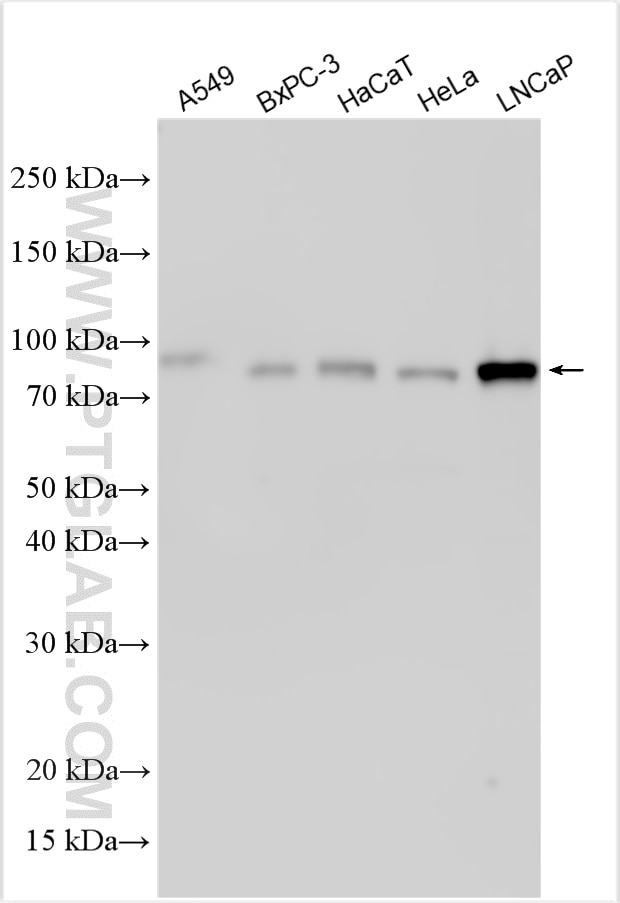
32112-1-PBS targets PWWP2B in WB, Indirect ELISA applications and shows reactivity with human samples.
| Tested Reactivity | human |
| Host / Isotype | Rabbit / IgG |
| Class | Polyclonal |
| Type | Antibody |
| Immunogen |
CatNo: Ag36839 Product name: Recombinant human PWWP2B protein Source: e coli.-derived, PGEX-4T Tag: GST Domain: 199-413 aa of BC068574 Sequence: SLEPFRPQQAPQDDGSQDPEVLDRESRDRPSCAPSASIPKLKLTRPVPAGADLPPPKIRLKPHRLGDSEHEPVYRAELVGELNGYLRDSSPAPCADGPAGGLADLSSGSSGEDDDFKSCPQGPQGREGLAFLVSCPEGRADCASESACSSDSLDEARSSGSEGTPADTGDLSPGHGASAPSVSREARQTVPPLTVRLHTQSVSECITEDGRTVAV Predict reactive species |
| Full Name | PWWP domain containing 2B |
| Observed Molecular Weight | 90 kDa |
| GenBank Accession Number | BC068574 |
| Gene Symbol | PWWP2B |
| Gene ID (NCBI) | 170394 |
| RRID | AB_3742527 |
| Conjugate | Unconjugated |
| Form | Liquid |
| Purification Method | Antigen affinity Purification |
| UNIPROT ID | Q6NUJ5 |
| Storage Buffer | PBS only, pH 7.3. |
| Storage Conditions | Store at -80°C. |
Background Information
PWWP2B (PWWP structural domain protein 2B) is a PWWP structural domain-containing protein involved in a variety of cellular functions and biological processes. PWWP2B is highly expressed in brown and beige adipose tissue and its expression is induced by cold stimulation. It has been shown that PWWP2B negatively regulates adipose tissue thermogenesis by recruiting and stabilizing the histone deacetylase HDAC1/2, which binds to the promoter regions of thermogenic genes and reduces histone acetylation levels. In adipocytes, PWWP2B acts as part of the nucleosome remodeling and deacetylation complex (NuRD) to inhibit the expression of thermogenic genes and avoid overactivation of thermogenic functions. In addition, PWWP2B plays an important role in DNA damage repair, as its PWWP structural domain moves to DNA damage sites, interacts with UHRF1 and recruits MRE11 to promote DNA end resection and homologous recombination repair. In pathology, downregulation of PWWP2B is associated with recurrent gastric cancer and promotes cell proliferation and migration.


