
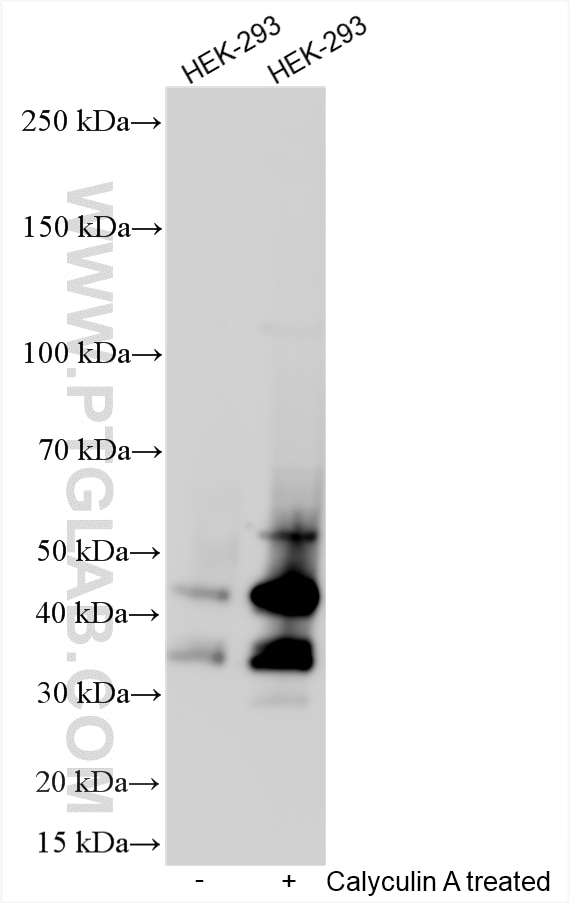



Tested Applications
| Positive WB detected in | Calyculin A treated HEK-293 cells, Forskolin treated HSC-T6 cells, HeLa cells, NIH/3T3 cells, Forskolin treated NIH/3T3 cells |
| Positive IHC detected in | human liver tissue Note: suggested antigen retrieval with TE buffer pH 9.0; (*) Alternatively, antigen retrieval may be performed with citrate buffer pH 6.0 |
Recommended dilution
| Application | Dilution |
|---|---|
| Western Blot (WB) | WB : 1:1000-1:4000 |
| Immunohistochemistry (IHC) | IHC : 1:50-1:500 |
| It is recommended that this reagent should be titrated in each testing system to obtain optimal results. | |
| Sample-dependent, Check data in validation data gallery. | |
Product Information
28792-1-AP targets Phospho-CREB1 (Ser133) in WB, IHC, IF, ELISA applications and shows reactivity with human, mouse, rat samples.
| Tested Reactivity | human, mouse, rat |
| Cited Reactivity | human, mouse, rat |
| Host / Isotype | Rabbit / IgG |
| Class | Polyclonal |
| Type | Antibody |
| Immunogen |
Peptide Predict reactive species |
| Full Name | cAMP responsive element binding protein 1 |
| Calculated Molecular Weight | 341 aa, 35 kDa |
| Observed Molecular Weight | 35-46 kDa |
| GenBank Accession Number | BC010636 |
| Gene Symbol | CREB1 |
| Gene ID (NCBI) | 1385 |
| RRID | AB_2918203 |
| Conjugate | Unconjugated |
| Form | Liquid |
| Purification Method | Antigen affinity purification |
| UNIPROT ID | P16220 |
| Storage Buffer | PBS with 0.02% sodium azide and 50% glycerol, pH 7.3. |
| Storage Conditions | Store at -20°C. Stable for one year after shipment. Aliquoting is unnecessary for -20oC storage. 20ul sizes contain 0.1% BSA. |
Background Information
The cAMP-response element binding protein (CREB) is localized in the nucleus and acts as a transcription factor, which binds to the cAMP response element (CRE) of the promoters of its target genes, upon phosphorylation at Ser133 by different receptor-activated protein kinases, such as protein kinase A (PKA), calmodulin-dependent protein kinase (CaMK), mitogen-activated protein kinases (MAPK), and other kinases. The activity of CREB1 in neurons has been correlated with various intracellular processes, including proliferation, differentiation, survival, long-term synaptic potentiation, neurogenesis, and neuronal plasticity. CREB1 belongs to the CREB/activating transcription factor (ATF) family of transcription factors. (PMID: 30214393, PMID: 33917483, PMID: 32605164) The antibody also detects the phosphorylated form of the CREB-related protein ATF1.
Protocols
| Product Specific Protocols | |
|---|---|
| IHC protocol for Phospho-CREB1 (Ser133) antibody 28792-1-AP | Download protocol |
| WB protocol for Phospho-CREB1 (Ser133) antibody 28792-1-AP | Download protocol |
| Standard Protocols | |
|---|---|
| Click here to view our Standard Protocols |
Publications
What published studies show
Phospho-CREB1 (Ser133) Polyclonal antibody (Cat# 28792-1-AP) has 114 citations spanning journals such as Nature Communications, Neuron, Gut, Cancer Research, Autophagy, Free Radical Biology and Medicine, Journal of Ethnopharmacology, Acta Biomaterialia, FASEB Journal, International Journal of Molecular Sciences, and Cell Death & Disease. Associated research fields include neuroscience, oncology, metabolic disorders, immunology, liver disease, cardiovascular biology, reproductive endocrinology, and pharmacology.
| Species | Application | Title |
|---|---|---|
Gut ISG15 deficiency in hepatic stellate cells promotes TGFβ2-induced liver fibrosis by counteracting CREB1 ISGylation | ||
Cancer Res Cancer-Associated Fibroblasts Expressing Sulfatase 1 Facilitate VEGFA-Dependent Microenvironmental Remodeling to Support Colorectal Cancer | ||
Drug Resist Updat Sciatic nerve stimulation enhances NK cell cytotoxicity through dopamine signaling and synergizes immunotherapy in triple-negative breast cancer | ||
Autophagy CENPN suppresses autophagy and increases paclitaxel resistance in nasopharyngeal carcinoma cells by inhibiting the CREB-VAMP8 signaling axis | ||
Autophagy PINK1-deficiency facilitates mitochondrial iron accumulation and colon tumorigenesis | ||
Nat Commun Cdo1-Camkk2-AMPK axis confers the protective effects of exercise against NAFLD in mice |
Reviews
What customers say
The single review for this product is highly positive, rated 5 stars. The reviewer used the antibody at a 1:1000 dilution for Western Blot on liver tissue and reported it performed well, describing it as "good for Western blot." Overall, the feedback is favorable, with no negative comments or issues raised.
The reviews below have been submitted by verified Proteintech customers who received an incentive for providing their feedback.
MALLIKARJUNA (Verified Customer) (10-24-2025) | good for Western blot
|



