
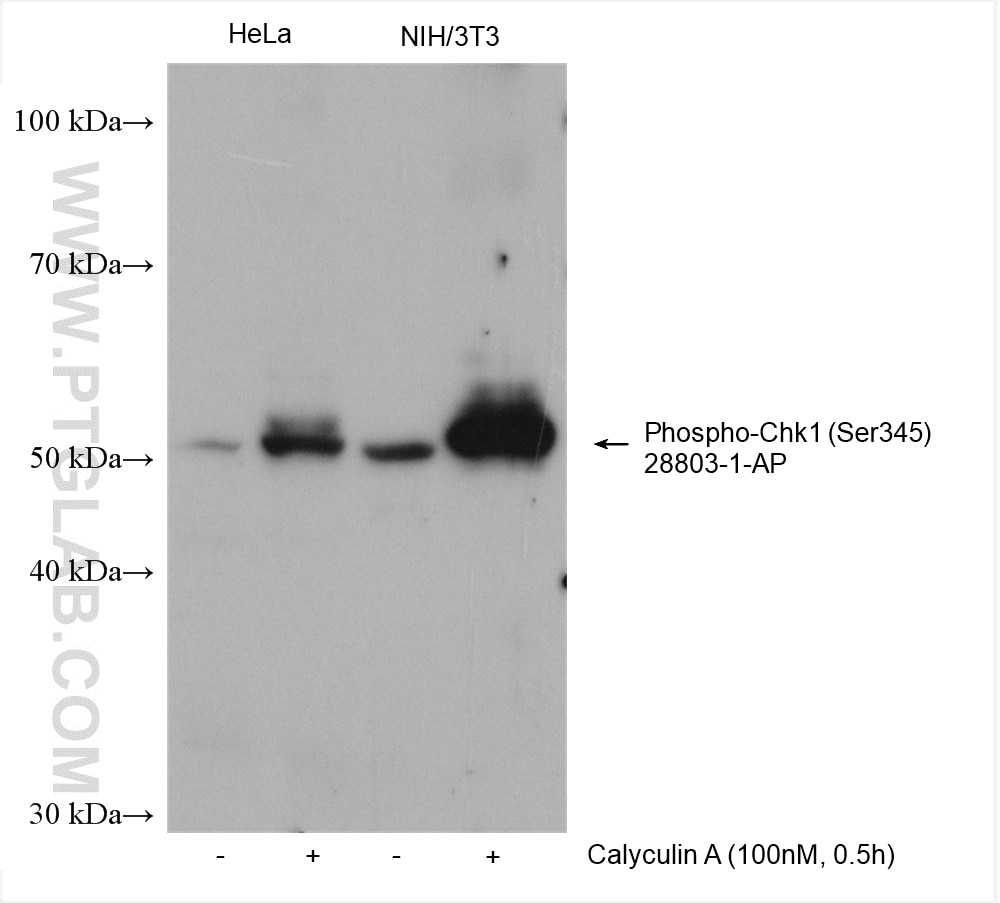
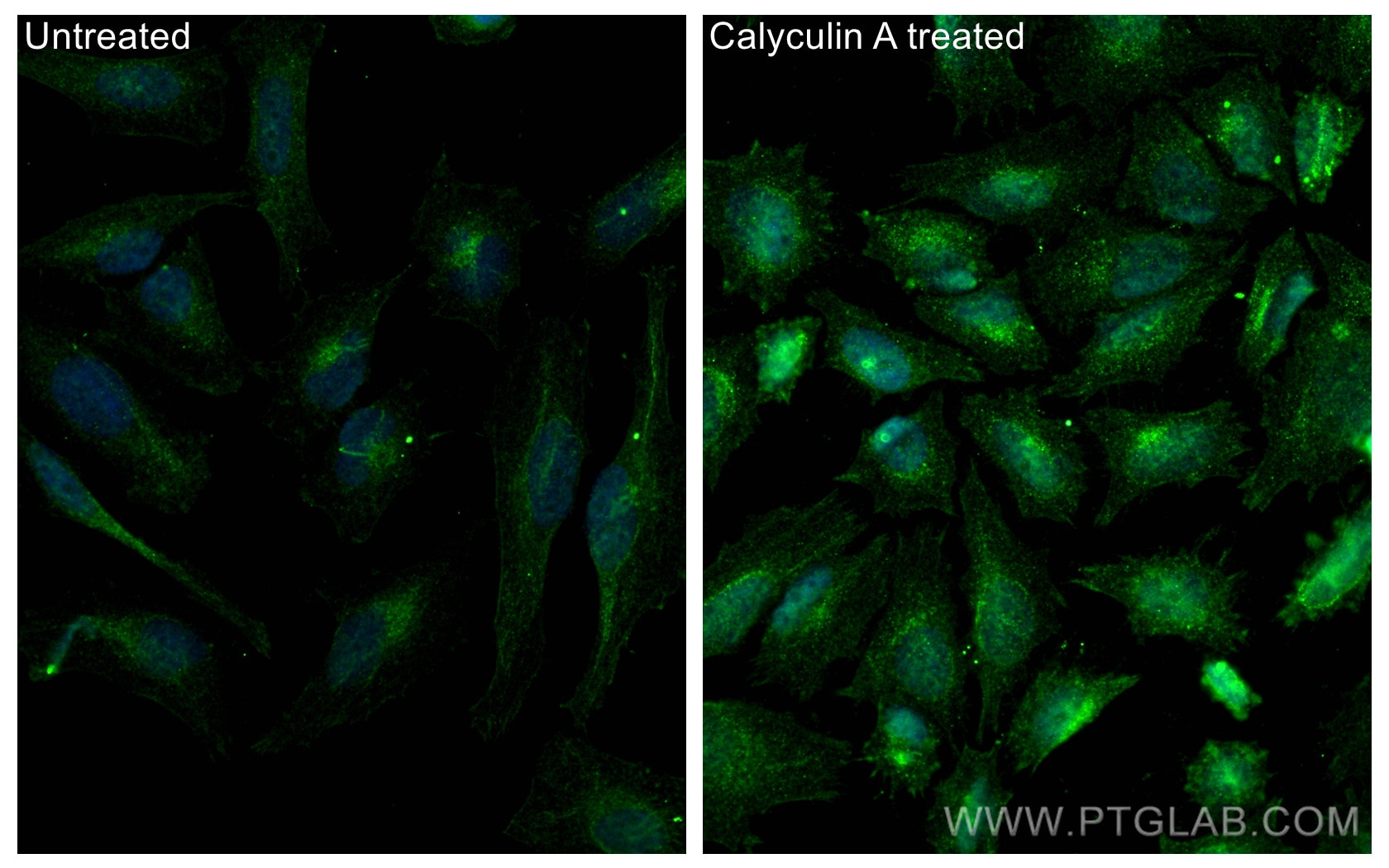

Tested Applications
| Positive WB detected in | Calyculin A treated NIH/3T3 cells, Calyculin A treated HeLa cells |
| Positive IF/ICC detected in | Calyculin A treated HeLa cells |
Recommended dilution
| Application | Dilution |
|---|---|
| Western Blot (WB) | WB : 1:500-1:2000 |
| Immunofluorescence (IF)/ICC | IF/ICC : 1:200-1:800 |
| It is recommended that this reagent should be titrated in each testing system to obtain optimal results. | |
| Sample-dependent, Check data in validation data gallery. | |
Product Information
28803-1-AP targets Phospho-Chk1 (Ser345) in WB, IF/ICC, ELISA applications and shows reactivity with human, mouse samples.
| Tested Reactivity | human, mouse |
| Cited Reactivity | human, mouse |
| Host / Isotype | Rabbit / IgG |
| Class | Polyclonal |
| Type | Antibody |
| Immunogen |
Peptide Predict reactive species |
| Full Name | CHK1 checkpoint homolog (S. pombe) |
| Calculated Molecular Weight | 54 kDa |
| Observed Molecular Weight | 50 kDa |
| GenBank Accession Number | BC004202 |
| Gene Symbol | Chk1 |
| Gene ID (NCBI) | 1111 |
| RRID | AB_2918206 |
| Conjugate | Unconjugated |
| Form | Liquid |
| Purification Method | Antigen affinity purification |
| UNIPROT ID | O14757 |
| Storage Buffer | PBS with 0.02% sodium azide and 50% glycerol, pH 7.3. |
| Storage Conditions | Store at -20°C. Stable for one year after shipment. Aliquoting is unnecessary for -20oC storage. 20ul sizes contain 0.1% BSA. |
Background Information
The checkpoint kinase 1 (Chk1) is a conserved kinase that imposes cell cycle delays in response to impediments to DNA replication. Chk1 kinase is downstream of the ATR kinase. ATR phosphorylates Chk1 kinase and other proteins to ensure replication is being blocked as to avoid replication fork collapse and DNA damage. Activation of Chk1 involves phosphorylation at Ser317 and Ser345 by ATM/ATR, followed by autophosphorylation of Ser296. In vitro Chk1 binds to and phosphorylate the dual-specificity protein phosphatases Cdc25A, Cdc25B, and Cdc25C, which control cell cycle transitions by dephosphorylating cyclin-dependent kinases. (PMID:22941630, PMID: 32571801, PMID:19276361)
Protocols
| Product Specific Protocols | |
|---|---|
| IF protocol for Phospho-Chk1 (Ser345) antibody 28803-1-AP | Download protocol |
| WB protocol for Phospho-Chk1 (Ser345) antibody 28803-1-AP | Download protocol |
| Standard Protocols | |
|---|---|
| Click here to view our Standard Protocols |
Publications
What published studies show
Phospho-Chk1 (Ser345) Polyclonal antibody (Cat# 28803-1-AP) has 13 citations across journals including Nature Biomedical Engineering, Drug Resistance Updates, Autophagy, Journal of Experimental & Clinical Cancer Research, Phytomedicine, Brain, Behavior, and Immunity, Biochemical Pharmacology, Bioorganic Chemistry, Cancer Science, Translational Oncology, Cell Biology International, Biochemical & Biophysical Research Communications, and International Immunopharmacology. Research fields span cancer biology (gastric, bladder, lung, melanoma, hepatocellular), DNA damage response, drug resistance, autophagy, neurology, and cardiovascular pathology.
| Species | Application | Title |
|---|---|---|
Drug Resist Updat RAD1 promotes oxaliplatin resistance in gastric cancer by reinforcing NRF2-driven antioxidant defense and DDR checkpoint signaling. | ||
Autophagy CCPG1-mediated reticulophagy promotes tumorigenesis and cisplatin resistance in bladder cancer. | ||
J Exp Clin Cancer Res HIF-1α-HPRT1 axis promotes tumorigenesis and gefitinib resistance by enhancing purine metabolism in EGFR-mutant lung adenocarcinoma | ||
Phytomedicine Epiberberine induced p53/p21-dependent G2/M cell cycle arrest and cell apoptosis in gastric cancer cells by activating γ-aminobutyric acid receptor- β3 | ||
Brain Behav Immun Targeting AARS1-dependent lactylation improves neuronal process plasticity and mitigates cognitive deficits in sepsis-associated encephalopathy. |
Reviews
What customers say
The single review for this product rates it 4 out of 5 stars. The reviewer used it for Western Blot on HeLa cells at a 1:1000 dilution and noted that the antibody produced some aspecific bands at the same molecular weight as the target, suggesting minor non-specific binding. Overall, the product performed adequately for its intended application, though the presence of off-target bands at the expected size was a concern.
The reviews below have been submitted by verified Proteintech customers who received an incentive for providing their feedback.
Arnaud (Verified Customer) (08-04-2026) | Some aspecific bands at the same size
|



