
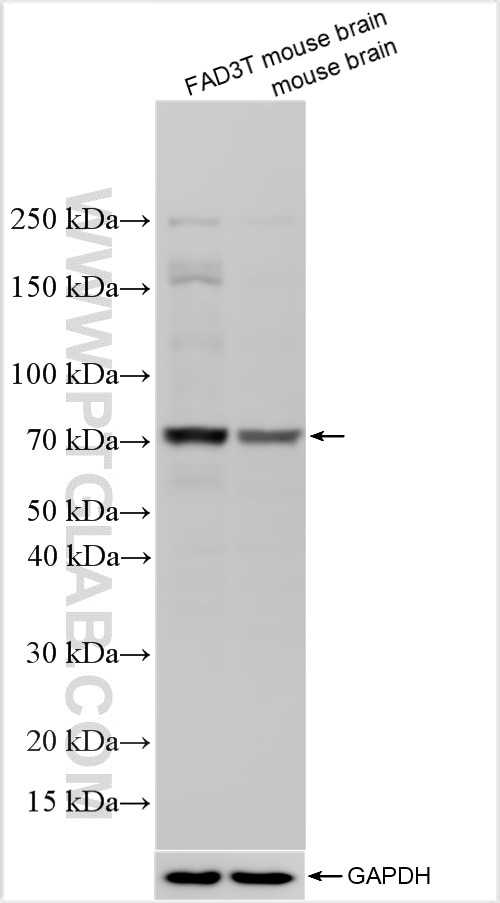
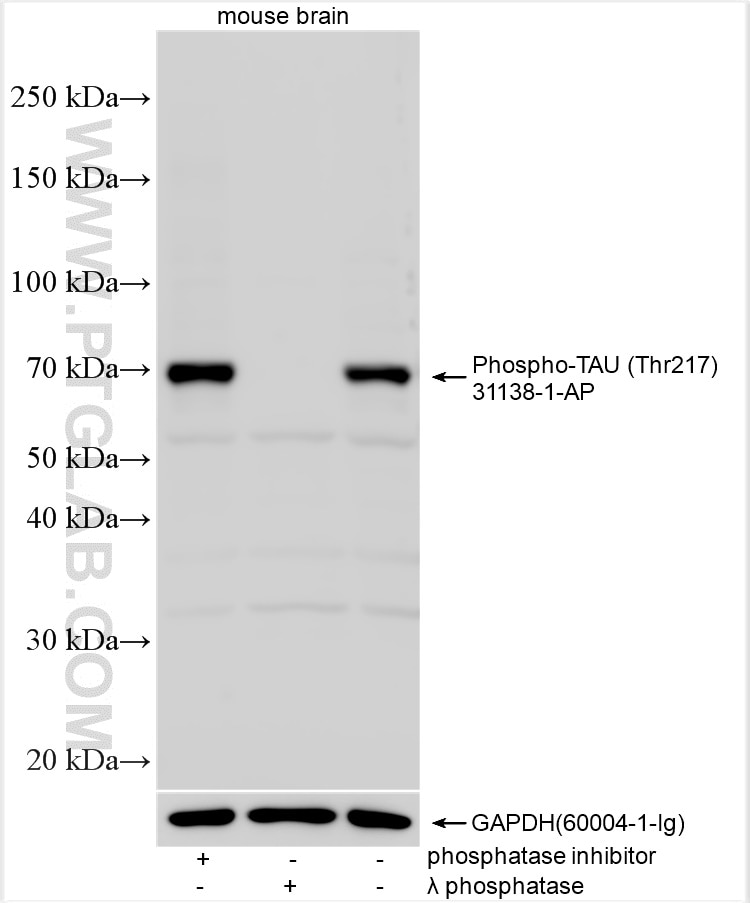
Tested Applications
| Positive WB detected in | FAD3T mouse brain tissue, mouse brain tissue |
Recommended dilution
| Application | Dilution |
|---|---|
| Western Blot (WB) | WB : 1:500-1:1000 |
| It is recommended that this reagent should be titrated in each testing system to obtain optimal results. | |
| Sample-dependent, Check data in validation data gallery. | |
Product Information
31138-1-AP targets Phospho-TAU (Thr217) in WB, ELISA applications and shows reactivity with human, mouse samples.
| Tested Reactivity | human, mouse |
| Host / Isotype | Rabbit / IgG |
| Class | Polyclonal |
| Type | Antibody |
| Immunogen |
Peptide Predict reactive species |
| Full Name | microtubule-associated protein tau |
| Calculated Molecular Weight | 37-46, 79-81 kDa |
| Observed Molecular Weight | 70 kDa |
| GenBank Accession Number | BC000558 |
| Gene Symbol | TAU |
| Gene ID (NCBI) | 4137 |
| RRID | AB_3742399 |
| Conjugate | Unconjugated |
| Form | Liquid |
| Purification Method | Antigen affinity purification |
| UNIPROT ID | P10636 |
| Storage Buffer | PBS with 0.02% sodium azide and 50% glycerol, pH 7.3. |
| Storage Conditions | Store at -20°C. Stable for one year after shipment. Aliquoting is unnecessary for -20oC storage. 20ul sizes contain 0.1% BSA. |
Background Information
Tau (tubulin-associated unit) is a microtubule-associated protein (also known as MAPT), expressed mainly in neurons of the central nervous system. Its primary function is to modulate microtubule dynamics for maintaining axonal cytoskeleton. Various isoforms of Tau exist due to the alternative splicing, and short isoforms around 45-69 kDa and long isoforms around 100-110 kDa have been reported in different literature (8752131,15965697). Phosphorylated tau at threonine 217 (p-tau217) is one of the emerging tau markers that has repeatedly shown more promise than other p-tau isoforms as a marker of AD pathology.
Protocols
| Product Specific Protocols | |
|---|---|
| WB protocol for Phospho-TAU (Thr217) antibody 31138-1-AP | Download protocol |
| Standard Protocols | |
|---|---|
| Click here to view our Standard Protocols |



