
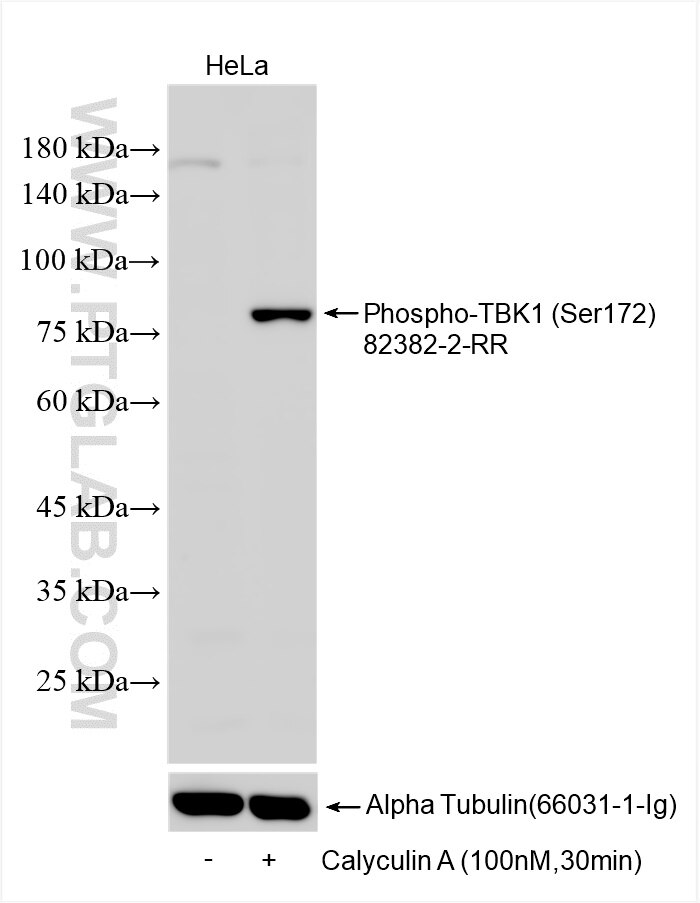
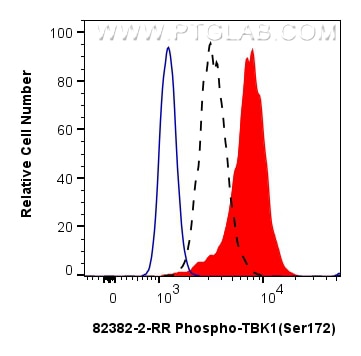

Tested Applications
| Positive WB detected in | Calyculin A treated HeLa cells |
| Positive FC (Intra) detected in | Calyculin A treated HeLa cells |
Recommended dilution
| Application | Dilution |
|---|---|
| Western Blot (WB) | WB : 1:500-1:2000 |
| Flow Cytometry (FC) (INTRA) | FC (INTRA) : 0.06 ug per 10^6 cells in a 100 µl suspension |
| It is recommended that this reagent should be titrated in each testing system to obtain optimal results. | |
| Sample-dependent, Check data in validation data gallery. | |
Product Information
82382-2-RR targets Phospho-TBK1 (Ser172) in WB, FC (Intra), ELISA applications and shows reactivity with human samples.
| Tested Reactivity | human |
| Cited Reactivity | human, mouse, rat |
| Host / Isotype | Rabbit / IgG |
| Class | Recombinant |
| Type | Antibody |
| Immunogen |
Peptide Predict reactive species |
| Full Name | TANK-binding kinase 1 |
| Observed Molecular Weight | 84 kDa |
| GenBank Accession Number | BC034950 |
| Gene Symbol | TBK1 |
| Gene ID (NCBI) | 29110 |
| Conjugate | Unconjugated |
| Form | Liquid |
| Purification Method | Protein A purification |
| UNIPROT ID | Q9UHD2 |
| Storage Buffer | PBS with 0.02% sodium azide and 50% glycerol, pH 7.3. |
| Storage Conditions | Store at -20°C. Stable for one year after shipment. Aliquoting is unnecessary for -20oC storage. 20ul sizes contain 0.1% BSA. |
Background Information
The serine/threonine protein kinase TBK1, discovered two decades ago as a member of the IκB kinase (IKK) protein kinase family, plays crucial roles in regulating innate immune response by promoting type I interferon (IFN) and modulating NF-κB signaling. The phosphorylation of Ser172 residue on TBK1 is critical and is commonly used as an indicator for its activity. (PMID: 39279883)
Protocols
| Product Specific Protocols | |
|---|---|
| WB protocol for Phospho-TBK1 (Ser172) antibody 82382-2-RR | Download protocol |
| Standard Protocols | |
|---|---|
| Click here to view our Standard Protocols |
Publications
What published studies show
Phospho-TBK1 (Ser172) Recombinant monoclonal antibody (Cat# 82382-2-RR) has 14 citations. These appear in journals including Mater Today Bio, J Transl Med, Int J Biol Macromol, Clin Transl Med, Brain Behav Immun, Life Sci, Int Immunopharmacol, Int J Mol Sci, and Front Immunol. Research fields span the cGAS-STING pathway, hepatocellular carcinoma, bladder cancer, diabetic kidney disease, neuroinflammation, antiviral innate immunity, NASH, cervical cancer immunotherapy, pulmonary inflammation, liver ischemia-reperfusion injury, and PANoptosis.
| Species | Application | Title |
|---|---|---|
Mater Today Bio Nano-bionic bacteria armed adoptive macrophage therapy against bladder cancer. | ||
J Transl Med Activation of the cGAS-STING pathway by clofoctol through mitochondrial damage in triple-negative breast cancer. | ||
Int J Biol Macromol Promotion of hepatocellular carcinoma by small nuclear ribonucleoprotein polypeptide F through upregulation of transmembrane P24 trafficking protein 2 and triggering of the cGAS-STING pathway. | ||
Clin Transl Med Elevation of ISG15 promotes diabetic kidney disease by modulating renal tubular epithelial cell pyroptosis | ||
Brain Behav Immun Exercise alleviates neuroinflammation and cognitive decline in aged mice via hepatic FGF21-driven microglial mitophagy. | ||
J Agric Food Chem Quercetin Restores Antiviral Innate Immunity by Blocking BVDV Npro-Hsp70-Mediated ELF4 Degradation. |
Reviews
What customers say
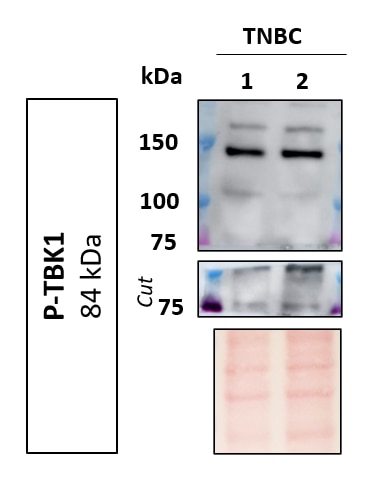
One reviewer used this antibody for Western Blot on triple negative breast cancer cell lines at a 1:500 dilution with overnight incubation. They observed higher molecular weight bands over 100 kDa, and when the membrane was cut, subtle bands appeared around 75 kDa. Ponceau staining served as the total protein loading control. The reviewer rated the product 3 out of 5 stars.
The reviews below have been submitted by verified Proteintech customers who received an incentive for providing their feedback.
Marina (Verified Customer) (12-20-2025) | 1:500 dilution, overnight incubation. Higher molecular weight bands were observed (over 100 kDa). When the membrane was cut, subtle bands were observed at around 75 kDa. Ponceau staining was used as total protein loading control.
 |



