

Tested Applications
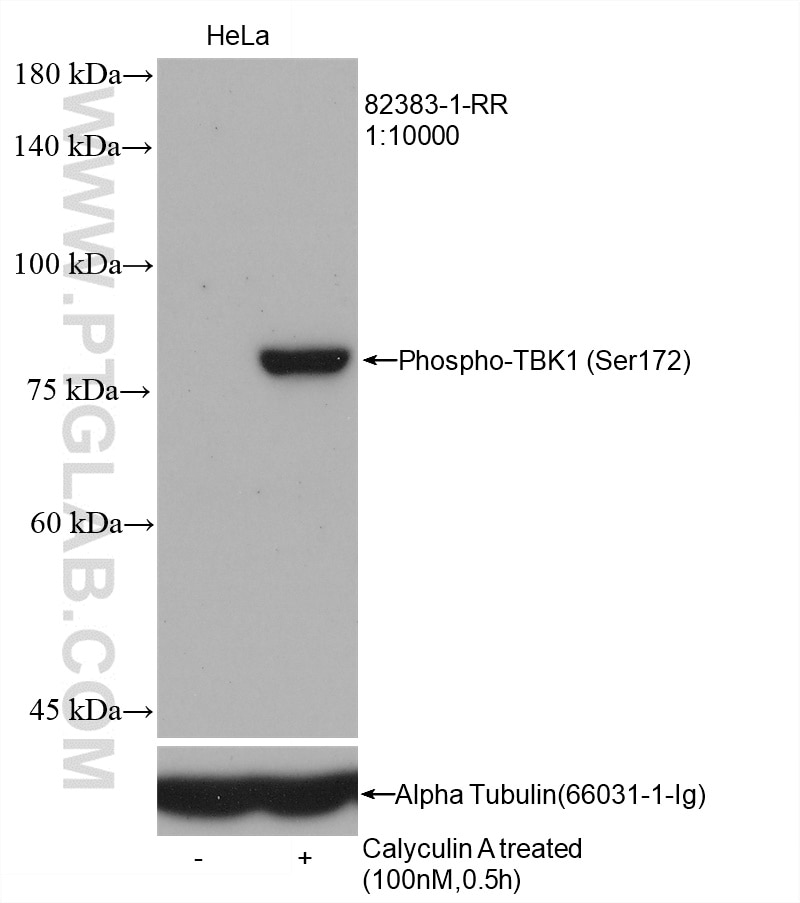
| Positive WB detected in | Calyculin A treated HeLa cells |
Recommended dilution
| Application | Dilution |
|---|---|
| Western Blot (WB) | WB : 1:5000-1:50000 |
| It is recommended that this reagent should be titrated in each testing system to obtain optimal results. | |
| Sample-dependent, Check data in validation data gallery. | |
Product Information
82383-1-RR targets Phospho-TBK1 (Ser172) in WB, ELISA applications and shows reactivity with human samples.
| Tested Reactivity | human |
| Cited Reactivity | human, mouse, pig |
| Host / Isotype | Rabbit / IgG |
| Class | Recombinant |
| Type | Antibody |
| Immunogen |
Peptide Predict reactive species |
| Full Name | TANK-binding kinase 1 |
| Observed Molecular Weight | 84 kDa |
| GenBank Accession Number | BC034950 |
| Gene Symbol | TBK1 |
| Gene ID (NCBI) | 29110 |
| Conjugate | Unconjugated |
| Form | Liquid |
| Purification Method | Protein A purification |
| UNIPROT ID | Q9UHD2 |
| Storage Buffer | PBS with 0.02% sodium azide and 50% glycerol, pH 7.3. |
| Storage Conditions | Store at -20°C. Stable for one year after shipment. Aliquoting is unnecessary for -20oC storage. 20ul sizes contain 0.1% BSA. |
Background Information
TBK1, also named as tumor necrosis factor (TNF) receptor-associated factor NF-kB activator (TANK)-binding kinase 1 (TBK1), NF-kB-activating kinase (NAK), T2K, is a multimeric kinase that modulates inflammation and autophagy. It is a ubiquitously expressed serine-threonine kinase belonging to the 'noncanonical IkB kinases' (IKKs) recognized for its critical role in regulating type I IFN production (PMID: 27211305). And TBK1 is an important player in yet another critical cellular function, autophagy.
Publications
What published studies show
The Phospho-TBK1 (Ser172) Recombinant Monoclonal Antibody (Cat# 82383-1-RR) has 17 citations. These appear in journals including Signal Transduction and Targeted Therapy, Cell Reports, Phytomedicine, Matter Today Bio, Molecular Medicine, British Journal of Pharmacology, FASEB Journal, Journal of Virology, and others. Research fields span the cGAS-STING innate immune pathway, antiviral responses (SARS-CoV-2, PRV, Getah virus), inflammation, pyroptosis/necroptosis, cancer immunology, fibrosis, neurodegeneration, and metabolic/cardiac disease.
| Species | Application | Title |
|---|---|---|
Signal Transduct Target Ther The cGAS-STING pathway-dependent sensing of mitochondrial DNA mediates ocular surface inflammation | ||
J Nanobiotechnology Fibroblast-derived exosomes induce macrophage pyroptosis to mediate orthodontic bone remodeling through the mtDNA/NLRP3 axis. | ||
Phytomedicine Disruption of cholesterol homeostasis triggers NLRP3-cGAS-STING axis-dependent hepatic fibrosis and honokiol intervention effects | ||
Phytomedicine Epimedium brevicornu flavonoids alleviate neuroinflammation and Alzheimer's disease pathology via immune-related pathways. | ||
Mater Today Bio Rational design of a V-shaped DNA-targeted photosensitizer enables endogenous DNA damage-driven cGAS-STING activation and systemic antitumor immunity. | ||
Int J Biol Macromol Inhibiting UGCG prevents PRV infection by decreasing lysosome-associated autophage |
Reviews
What customers say
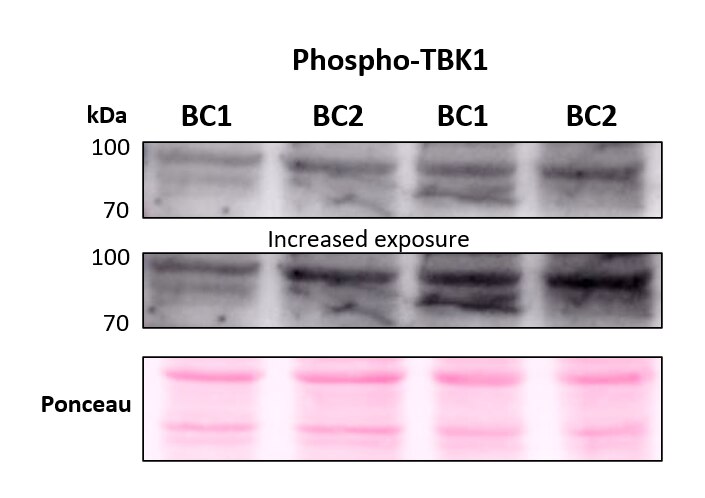
The single review covers a Western Blot using the p-TBK1 antibody at a 1:5000 dilution, incubated overnight at 4°C. The reviewer tested two triple-negative breast cancer cell lines, run in duplicate, with Ponceau staining as the total protein loading control. A prominent band appeared below 100 kDa, and with longer exposure, an additional band around 80 kDa was visible. The product received a 3-star rating.
The reviews below have been submitted by verified Proteintech customers who received an incentive for providing their feedback.
Marina (Verified Customer) (09-27-2023) | Western blot using p-TBK1 antibody at 1:5000 dilution overnight at 4ºC. Samples are two breast cancer (BC) cell lines, ran in duplicate. Ponceau staining is shown as total protein loading control. A more prominent band can be seen below 100 kDa, and after more exposure, another band at around 80 kDa can be observed.
 |


