

Tested Applications
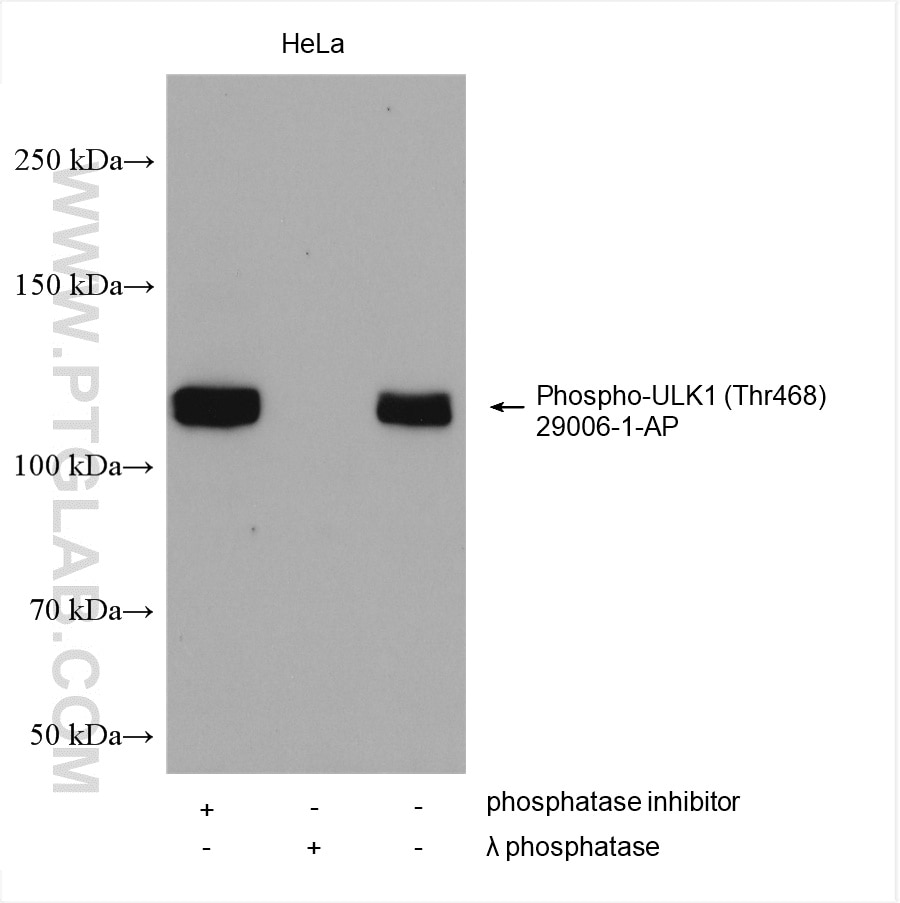
| Positive WB detected in | HeLa cells |
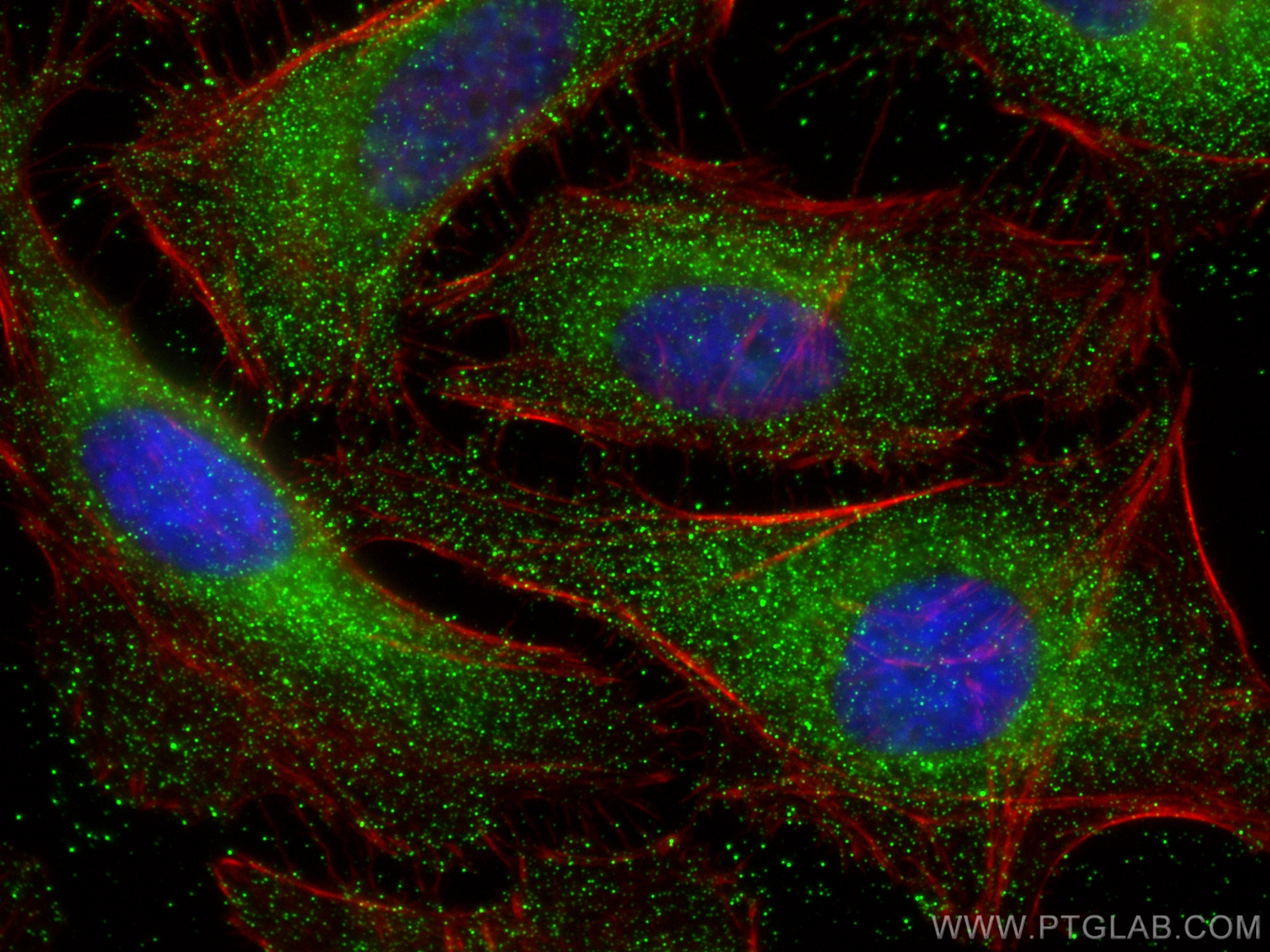
| Positive IF/ICC detected in | HeLa cells |
Recommended dilution
| Application | Dilution |
|---|---|
| Western Blot (WB) | WB : 1:1000-1:8000 |
| Immunofluorescence (IF)/ICC | IF/ICC : 1:50-1:500 |
| It is recommended that this reagent should be titrated in each testing system to obtain optimal results. | |
| Sample-dependent, Check data in validation data gallery. | |
Product Information
29006-1-AP targets Phospho-ULK1 (Thr468) in WB, IF/ICC, ELISA applications and shows reactivity with human samples.
| Tested Reactivity | human |
| Cited Reactivity | human, mouse, rat, pig |
| Host / Isotype | Rabbit / IgG |
| Class | Polyclonal |
| Type | Antibody |
| Immunogen |
Peptide Predict reactive species |
| Full Name | unc-51-like kinase 1 (C. elegans) |
| Observed Molecular Weight | 130-140 kDa |
| GenBank Accession Number | NM_003565 |
| Gene Symbol | ULK1 |
| Gene ID (NCBI) | 8408 |
| RRID | AB_2918229 |
| Conjugate | Unconjugated |
| Form | Liquid |
| Purification Method | Antigen affinity purification |
| UNIPROT ID | O75385 |
| Storage Buffer | PBS with 0.02% sodium azide and 50% glycerol, pH 7.3. |
| Storage Conditions | Store at -20°C. Stable for one year after shipment. Aliquoting is unnecessary for -20oC storage. 20ul sizes contain 0.1% BSA. |
Background Information
Unc-51-like-kinase 1 (ULK1) is a target of both the mechanistic target of rapamycin (mTOR) and AMP activated protein kinase (AMPK), whose role is to facilitate the initiation of autophagy in response to starvation. ULK1 is phosphorylated on serine 638 and 758 sites by mTOR in nutrient-rich conditions, inhibiting ULK1 activation by disrupting its binding to AMPK. Upon glucose starvation, dissociation of mTOR from ULK1 and phosphorylation by AMPK leads to the activation of ULK1 activity. S467, S556, and T574 are sites responsible for regulating mitochondrial homeostasis during starvation. (PMID: 30517873, PMID: 21258367)
Protocols
| Product Specific Protocols | |
|---|---|
| IF protocol for Phospho-ULK1 (Thr468) antibody 29006-1-AP | Download protocol |
| WB protocol for Phospho-ULK1 (Thr468) antibody 29006-1-AP | Download protocol |
| Standard Protocols | |
|---|---|
| Click here to view our Standard Protocols |
Publications
What published studies show
The anti-ULK1 antibody (Cat# 29006-1-AP) has 8 total citations across journals including Phytomedicine, Ecotoxicology and Environmental Safety, Environmental Toxicology, Brain Research Bulletin, Journal of Nutrition, Stem Cells International, and Analytical and Cellular Pathology. Research fields span autophagy regulation, AMPK/mTOR/ULK1 signaling, hepatocellular carcinoma, esophageal cancer, osteogenic differentiation, neuroprotection, and intestinal microbiota, with applications in WB across human, rat, mouse, and pig species.
| Species | Application | Title |
|---|---|---|
Phytomedicine The pathogenesis of hepatocellular carcinoma: ERK/ULK1/NCOA4-mediated inhibition of iron autophagy, and Epimedium extract targeted modulation of this pathway to treat hepatocellular carcinoma | ||
Ecotoxicol Environ Saf Maternal lead exposure impairs offspring growth and intestinal microbiota via AMPK/ULK1 pathway activation | ||
Environ Toxicol Lysine specific demethylase 1 inhibits sodium arsenite activation of HSCs by regulating SESN2/AMPK/ULK1 signaling pathway activity | ||
Brain Res Bull N-linoleyltyrosine protects neurons against Aβ1-40-induced cell toxicity via autophagy involving the CB2/AMPK/mTOR/ULK1 pathway | ||
J Nutr Odd-chain fatty acids-enriched fats improved the growth and intestinal morphology and function in milk replacers-fed piglets | ||
Stem Cells Int POs-Ca Drives Osteogenic Differentiation of Human Dental Pulp Stem Cells Via AMPK-Dependent Autophagy Activation and Reciprocal Calcium-Autophagy Crosstalk. |



