
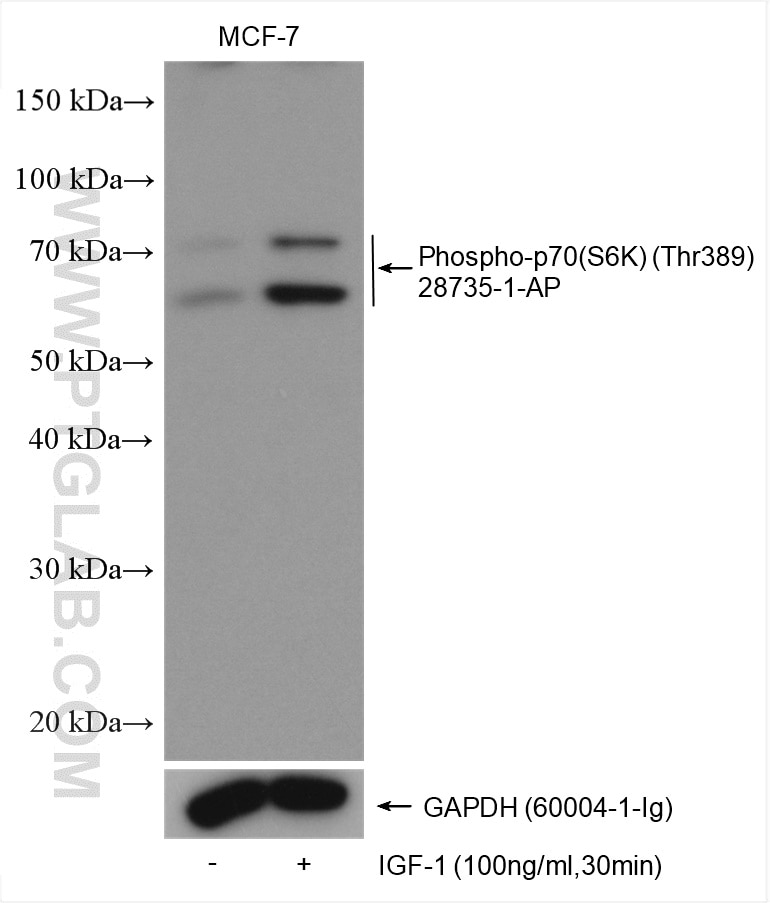
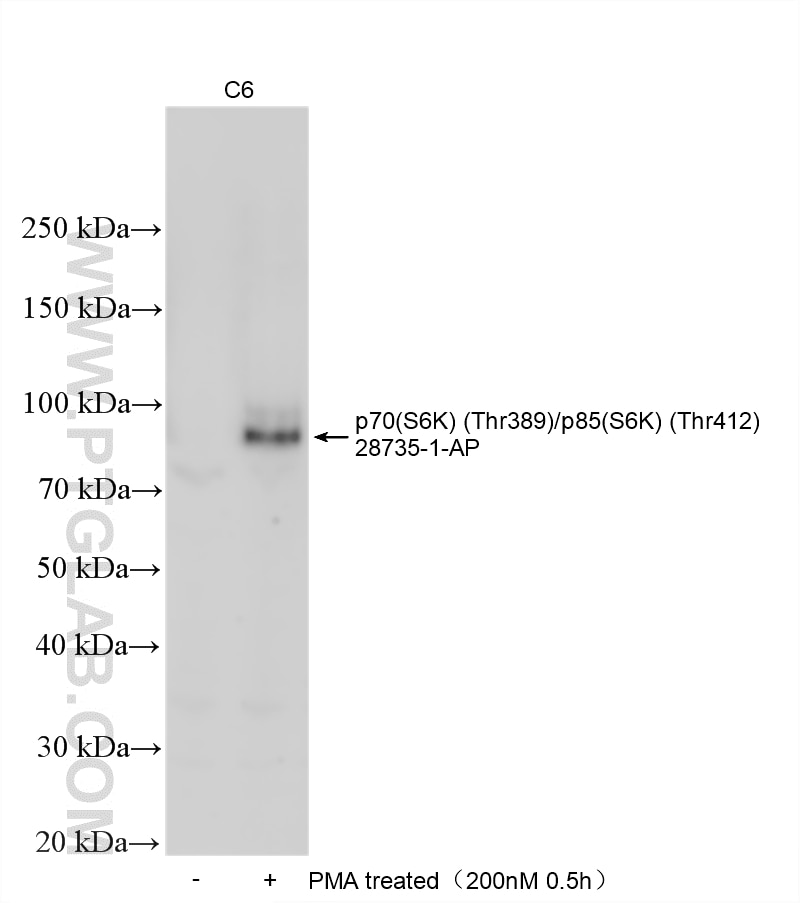

Tested Applications
| Positive WB detected in | IGF-1 treated MCF-7 cells |
Recommended dilution
| Application | Dilution |
|---|---|
| Western Blot (WB) | WB : 1:1000-1:8000 |
| It is recommended that this reagent should be titrated in each testing system to obtain optimal results. | |
| Sample-dependent, Check data in validation data gallery. | |
Product Information
28735-1-AP targets Phospho-p70(S6K) (Thr389)/p85(S6K) (Thr412) in WB, IHC, IF, ELISA applications and shows reactivity with human, rat samples.
| Tested Reactivity | human, rat |
| Cited Reactivity | human, mouse, rat, pig, bovine |
| Host / Isotype | Rabbit / IgG |
| Class | Polyclonal |
| Type | Antibody |
| Immunogen |
Peptide Predict reactive species |
| Full Name | ribosomal protein S6 kinase, 70kDa, polypeptide 1 |
| Observed Molecular Weight | 65-85 kDa |
| GenBank Accession Number | NM_003161 |
| Gene Symbol | p70 S6K |
| Gene ID (NCBI) | 6198 |
| RRID | AB_2918197 |
| Conjugate | Unconjugated |
| Form | Liquid |
| Purification Method | Antigen affinity purification |
| UNIPROT ID | P23443 |
| Storage Buffer | PBS with 0.02% sodium azide and 50% glycerol, pH 7.3. |
| Storage Conditions | Store at -20°C. Stable for one year after shipment. Aliquoting is unnecessary for -20oC storage. 20ul sizes contain 0.1% BSA. |
Background Information
The Rps6kb1 gene encodes the 70 kDa ribosomal protein S6 kinase (p70S6K), which is a serine/threonine kinase regulated by phosphoinositide 3-kinase (PI3K)/mammalian target of rapamycin (mTOR) pathway. P70(S6K) plays a crucial role in controlling cell cycle, growth and survival. The PI3K/mTOR signalling pathway is one of the major mechanisms for controlling cell survival, proliferation and metabolism and is the central regulator of translation of some components of protein synthesis system. Due to alternative translation two isoform S6K1 proteins are known to exist in mammalian cells: p85(S6K) and p70(S6K), which is identical to p85(S6K) but lacks its first 23 amino acids. In addition, mammalian cells express a second S6K1 isoform spanning 316 amino acids (p31 S6K1). mTOR is know to phosphorylate and thereby activate p70(S6K) at Thr389 and p85(S6K) at Thr412. (PMID: 25100792, PMID: 24970012, PMID: 21602892)
Protocols
| Product Specific Protocols | |
|---|---|
| WB protocol for Phospho-p70(S6K) (Thr389)/p85(S6K) (Thr412) antibody 28735-1-AP | Download protocol |
| Standard Protocols | |
|---|---|
| Click here to view our Standard Protocols |
Publications
What published studies show
The mTOR antibody (catalog no. 28735-1-AP) has 88 citations. It appears across journals including Cell Stem Cell, Cancer Research, Nature Communications, Autophagy, Advanced Science, Cell Death & Differentiation, Cell Reports, EMBO Reports, and Scientific Reports, among others. Research fields center on mTOR/mTORC1 signaling and autophagy, spanning oncology (breast, lung, gastric, liver, prostate, and other cancers), drug resistance, metabolism, ferroptosis, and immune regulation, with applications mainly in Western blot, IHC, and IF.
| Species | Application | Title |
|---|---|---|
Cell Stem Cell Psychological stress drives aging-like hematopoietic stem cell dysfunction through a brain-gut-bone marrow axis. | ||
Cancer Res ASS1-mediated reductive carboxylation of cytosolic glutamine confers ferroptosis resistance in cancer cells | ||
Drug Resist Updat Host-directed novel mechanistic insights of doxorubicin reveal its efficacy against drug-resistant HSV-1 underscoring risks with oncolytic virotherapy. | ||
Drug Resist Updat Methylation of GPRC5A promotes liver metastasis and docetaxel resistance through activating mTOR signaling pathway in triple negative breast cancer | ||
Autophagy FGF21 rejuvenates aged human adipose-derived mesenchymal stem cells via enhancement of TFE3-mediated autophagy flux. | ||
Autophagy PSAT1 inhibits mTORC1 activation by preventing Rag heterodimer formation in lung adenocarcinoma |



