
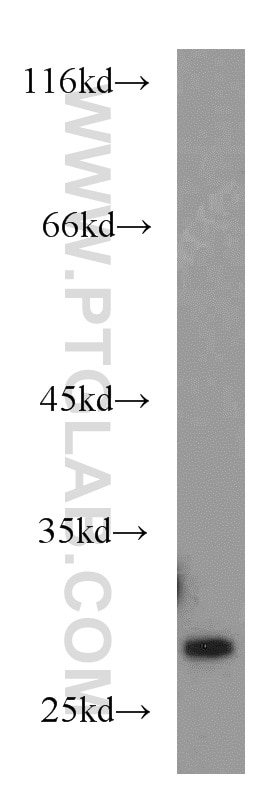
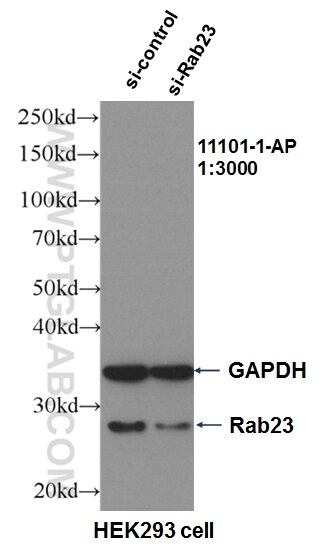
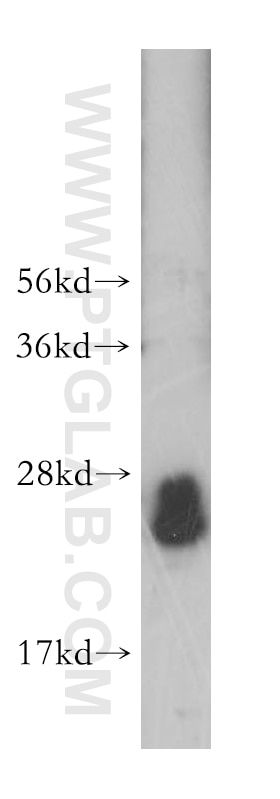
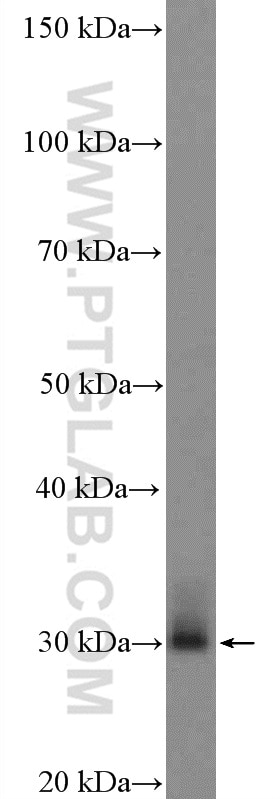
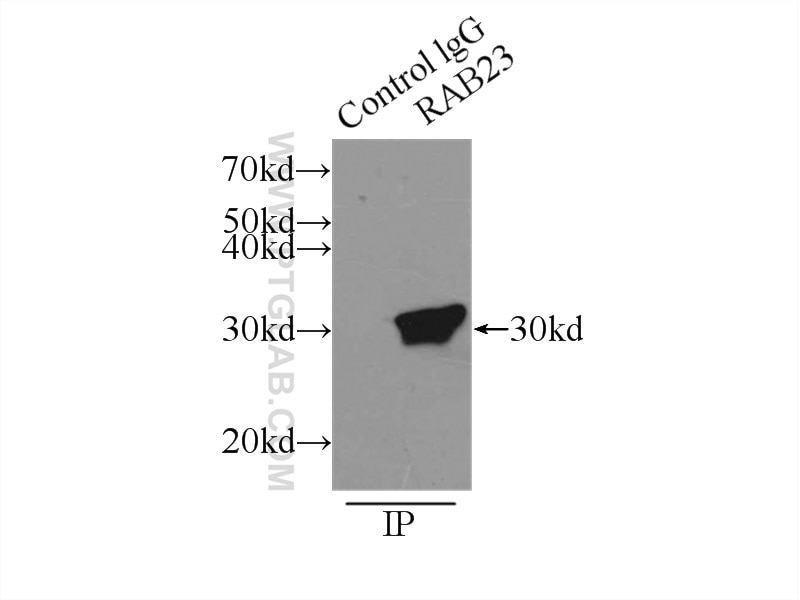
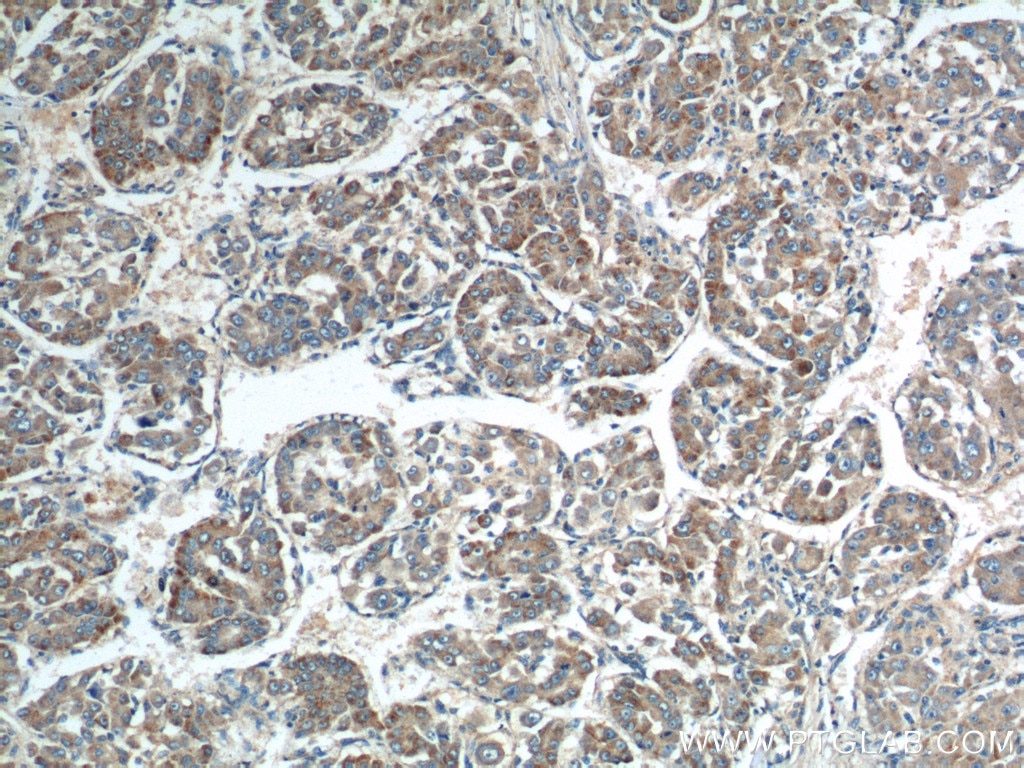
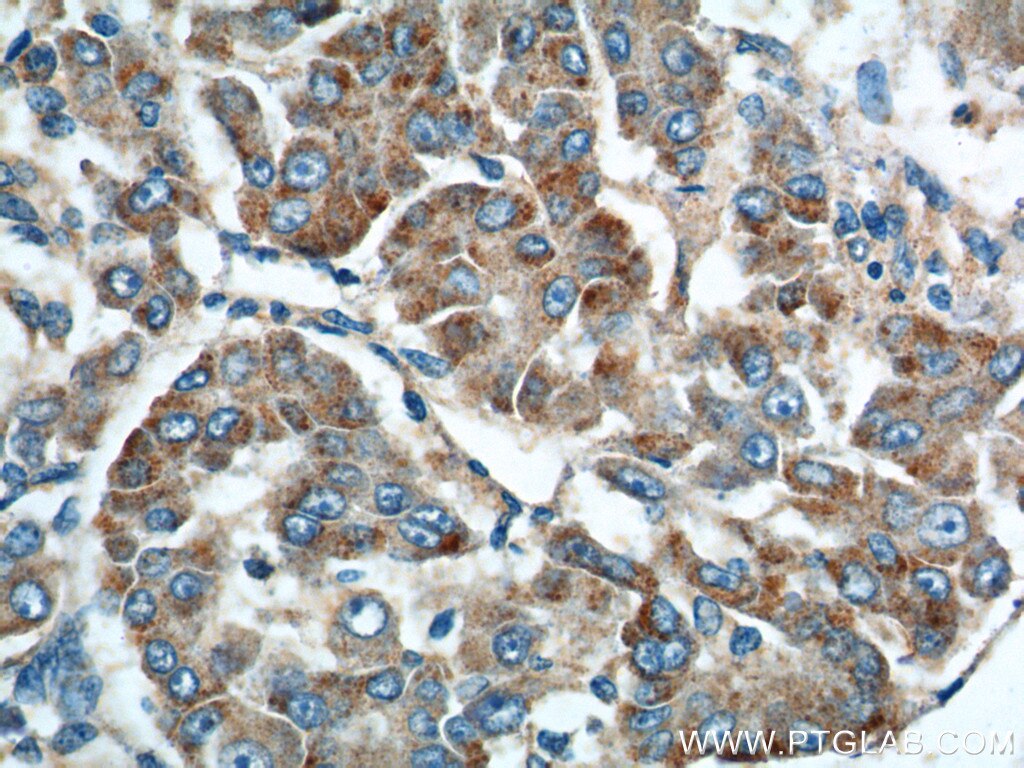
Tested Applications
| Positive WB detected in | mouse brain tissue, rat brain tissue, HEK-293 cells, human brain tissue |
| Positive IP detected in | mouse brain tissue |
| Positive IHC detected in | human liver cancer tissue Note: suggested antigen retrieval with TE buffer pH 9.0; (*) Alternatively, antigen retrieval may be performed with citrate buffer pH 6.0 |
Recommended dilution
| Application | Dilution |
|---|---|
| Western Blot (WB) | WB : 1:500-1:2000 |
| Immunoprecipitation (IP) | IP : 0.5-4.0 ug for 1.0-3.0 mg of total protein lysate |
| Immunohistochemistry (IHC) | IHC : 1:50-1:500 |
| It is recommended that this reagent should be titrated in each testing system to obtain optimal results. | |
| Sample-dependent, Check data in validation data gallery. | |
Product Information
11101-1-AP targets Rab23 in WB, IHC, IF, IP, ELISA applications and shows reactivity with human, mouse, rat samples.
| Tested Reactivity | human, mouse, rat |
| Cited Reactivity | human, mouse, chicken |
| Host / Isotype | Rabbit / IgG |
| Class | Polyclonal |
| Type | Antibody |
| Immunogen |
CatNo: Ag1588 Product name: Recombinant human RAB23 protein Source: e coli.-derived, PGEX-4T Tag: GST Domain: 1-203 aa of BC015021 Sequence: MLEEDMEVAIKMVVVGNGAVGKSSMIQRYCKGIFTKDYKKTIGVDFLERQIQVNDEDVRLMLWDTAGQEEFDAITKAYYRGAQACVLVFSTTDRESFEAVSSWREKVVAEVGDIPTVLVQNKIDLLDDSCIKNEEAEALAKRLKLRFYRTSVKEDLNVNEVFKYLAEKYLQKLKQQIAEDPELTHSSSNKIGVFNTSGGSHSG Predict reactive species |
| Full Name | RAB23, member RAS oncogene family |
| Calculated Molecular Weight | 237 aa, 27 kDa |
| Observed Molecular Weight | 27 kDa |
| GenBank Accession Number | BC015021 |
| Gene Symbol | RAB23 |
| Gene ID (NCBI) | 51715 |
| RRID | AB_2173784 |
| Conjugate | Unconjugated |
| Form | Liquid |
| Purification Method | Antigen affinity purification |
| UNIPROT ID | Q9ULC3 |
| Storage Buffer | PBS with 0.02% sodium azide and 50% glycerol, pH 7.3. |
| Storage Conditions | Store at -20°C. Stable for one year after shipment. Aliquoting is unnecessary for -20oC storage. 20ul sizes contain 0.1% BSA. |
Background Information
Rab23 is a novel member of large Rab small GTPase family. It plays important roles during embryonic development. The brain-enriched Rab23 is the only Rab protein that is known to have a distinct function during central nervous system development, playing an essential role as a negative regulator of the Sonic Hedgehog (Shh) pathway. RAB23 has recently been identified in mesangial cells (MCs), and could serve as a biomarker that indicates the severity of FSGS ( focal segmental glomerulosclerosis). Mutations in RAB23 may result in ACPS2 ( acrocephalopolysyndactyly type 2).
Protocols
| Product Specific Protocols | |
|---|---|
| IHC protocol for Rab23 antibody 11101-1-AP | Download protocol |
| IP protocol for Rab23 antibody 11101-1-AP | Download protocol |
| WB protocol for Rab23 antibody 11101-1-AP | Download protocol |
| Standard Protocols | |
|---|---|
| Click here to view our Standard Protocols |
Publications
What published studies show
| Species | Application | Title |
|---|---|---|
Curr Biol Planar Cell Polarity Effector Proteins Inturned and Fuzzy Form a Rab23 GEF Complex.
| ||
Oncotarget Rab23 promotes squamous cell carcinoma cell migration and invasion via integrin β1/Rac1 pathway.
| ||
J Cell Sci Differential role of Rab proteins in ciliary trafficking: Rab23 regulates smoothened levels.
| ||
J Cancer Res Clin Oncol MicroRNA-367-3p directly targets RAB23 and inhibits proliferation, migration and invasion of bladder cancer cells and increases cisplatin sensitivity
| ||
Exp Dermatol Silencing of Rab23 by siRNA inhibits ultraviolet B-induced melanogenesis via downregulation of PKA/CREB/MITF.
|
Reviews
What customers say
The reviews below have been submitted by verified Proteintech customers who received an incentive for providing their feedback.
Guorong (Verified Customer) (11-22-2022) | Multiple bands distributed at 50 and 75 kDa were observed . Does not represent the performance in other kind of samples
 |








