


Tested Applications
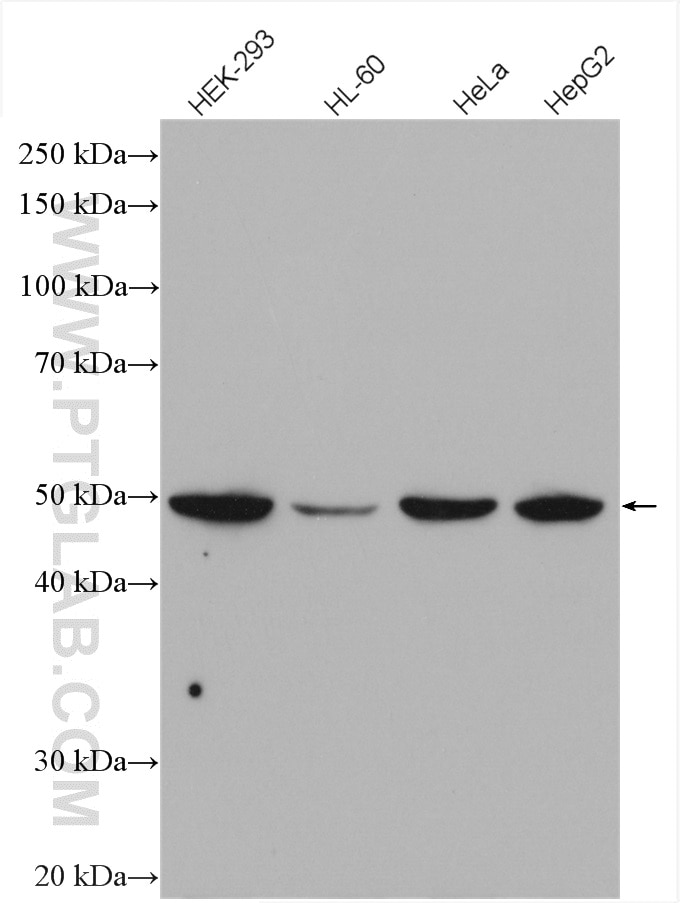
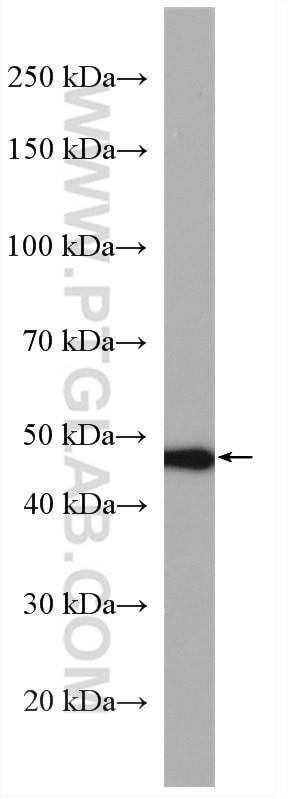
| Positive WB detected in | HEK-293 cells, HeLa cells, HL-60 cells, HepG2 cells |
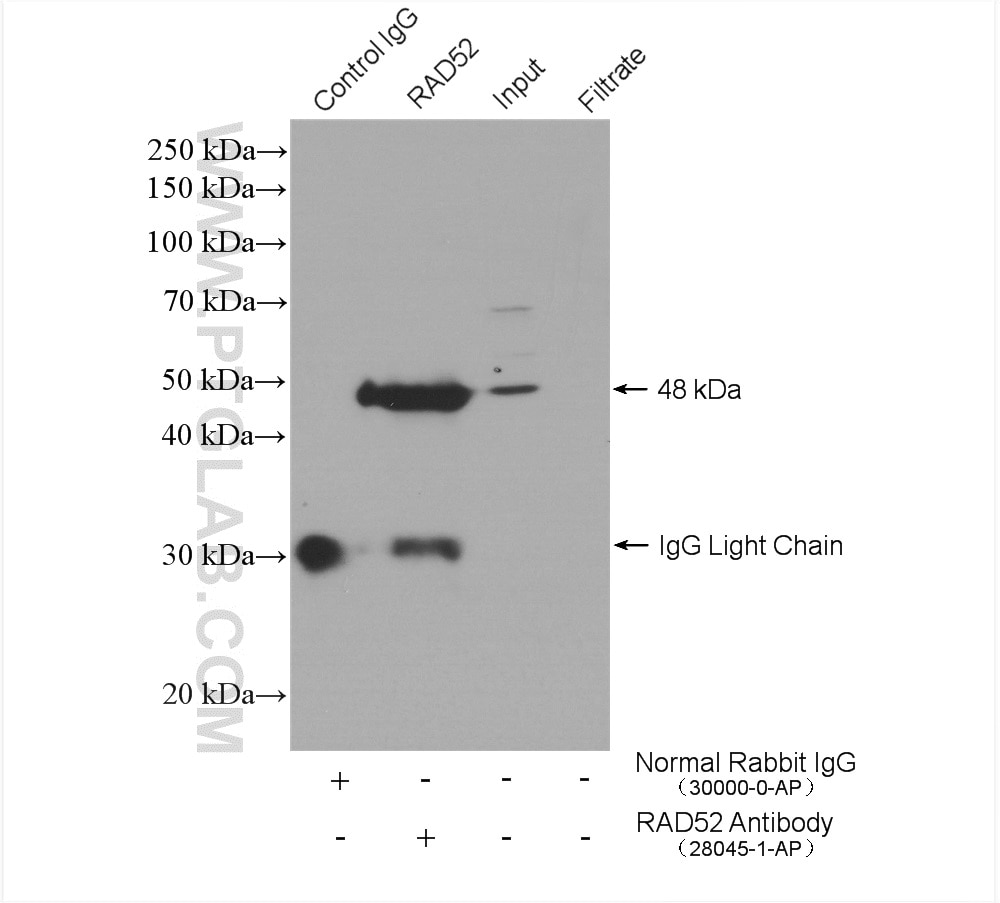
| Positive IP detected in | HEK-293 cells |
Recommended dilution
| Application | Dilution |
|---|---|
| Western Blot (WB) | WB : 1:1000-1:5000 |
| Immunoprecipitation (IP) | IP : 0.5-4.0 ug for 1.0-3.0 mg of total protein lysate |
| It is recommended that this reagent should be titrated in each testing system to obtain optimal results. | |
| Sample-dependent, Check data in validation data gallery. | |
Product Information
28045-1-AP targets RAD52 in WB, IP, CoIP, ELISA applications and shows reactivity with human samples.
| Tested Reactivity | human |
| Cited Reactivity | human, pig |
| Host / Isotype | Rabbit / IgG |
| Class | Polyclonal |
| Type | Antibody |
| Immunogen |
CatNo: Ag27619 Product name: Recombinant human RAD52 protein Source: e coli.-derived, PGEX-4T Tag: GST Domain: 234-418 aa of NM_001297419 Sequence: MADQDCSSRSLSSSAVESEATHQRKLRQKQLQQQFRERMEKQQVRVSTPSAEKSEAAPPAPPVTHSTPVTVSEPLLEKDFLAGVTQELIKTLEDNSEKWAVTPDAGDGVVKPSSRADPAQTSDTLALNNQMVTQNRTPHSVCHQKPQAKSGSWDLQTYSADQRTTGNWESHRKSQDMKKRKYDPS Predict reactive species |
| Full Name | RAD52 homolog (S. cerevisiae) |
| Calculated Molecular Weight | 46 aa |
| Observed Molecular Weight | 46-50 kDa |
| GenBank Accession Number | NM_001297419 |
| Gene Symbol | RAD52 |
| Gene ID (NCBI) | 5893 |
| RRID | AB_2881046 |
| Conjugate | Unconjugated |
| Form | Liquid |
| Purification Method | Antigen affinity purification |
| UNIPROT ID | P43351 |
| Storage Buffer | PBS with 0.02% sodium azide and 50% glycerol, pH 7.3. |
| Storage Conditions | Store at -20°C. Stable for one year after shipment. Aliquoting is unnecessary for -20oC storage. 20ul sizes contain 0.1% BSA. |
Protocols
| Product Specific Protocols | |
|---|---|
| IP protocol for RAD52 antibody 28045-1-AP | Download protocol |
| WB protocol for RAD52 antibody 28045-1-AP | Download protocol |
| Standard Protocols | |
|---|---|
| Click here to view our Standard Protocols |
Publications
What published studies show
The RAD52 Polyclonal antibody (Cat# 28045-1-AP) has 9 citations spanning journals including Signal Transduction and Targeted Therapy, Nature Communications, Molecular Cell, Science Advances, Cell Death & Disease, Cell Reports, Frontiers in Pharmacology, Journal of Cellular and Molecular Medicine, and International Journal of Biochemistry and Cell Biology. Research fields cover DNA repair, homologous recombination, telomere biology, alternative splicing, CRISPR/Cas9-mediated repair, UV-induced DNA damage, and cancer (hepatocellular, colon, ovarian, breast, and small cell lung carcinoma).
| Species | Application | Title |
|---|---|---|
Signal Transduct Target Ther KAT2A-driven succinylation of SRSF11 enforces spliceosome-mediated RAD52 splicing to promote homologous recombination and radioresistance in hepatocellular carcinoma
| ||
Nat Commun Pathway choice in the alternative telomere lengthening in neoplasia is dictated by replication fork processing mediated by EXD2's nuclease activity
| ||
Sci Adv Deficiency in mammalian STN1 promotes colon cancer development via inhibiting DNA repair | ||
Cell Death Dis SF3B4 promotes ovarian cancer progression by regulating alternative splicing of RAD52.
| ||
Cell Rep ABL kinase inactivation induces transcription-replication conflicts and impairs replication fork progression in metastatic small cell lung cancer. |
Reviews
What customers say
The single review reports a 5-star rating for this RAD52 antibody used in Western Blot. The user detected the expected 48 kDa band in wild-type HCT116 and RPE1 cells at a 1:2000 dilution, while no band appeared in RAD52 knockout cells, confirming the antibody specifically recognizes RAD52. Overall, the feedback is positive, highlighting the antibody's specificity and reliable performance in WB applications.
The reviews below have been submitted by verified Proteintech customers who received an incentive for providing their feedback.
Daniel (Verified Customer) (10-15-2024) | I detected the expected band for RAD52 and 48 kDa in WT cells, but not RAD52 KO cells, proving that the antibody is indeed recognizing RAD52.
|





