



Tested Applications
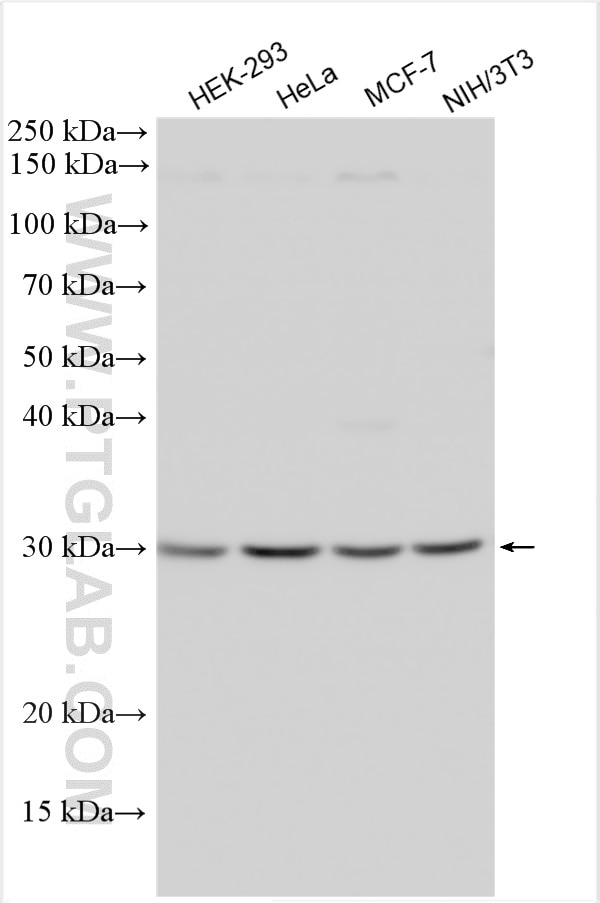
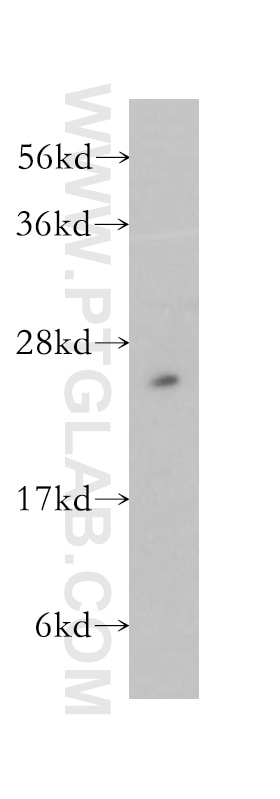
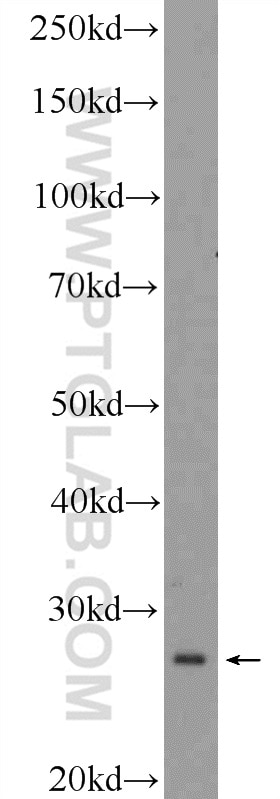
| Positive WB detected in | HEK-293 cells, mouse testis tissue, PC-12 cells, HeLa cells, MCF-7 cells, NIH/3T3 cells |
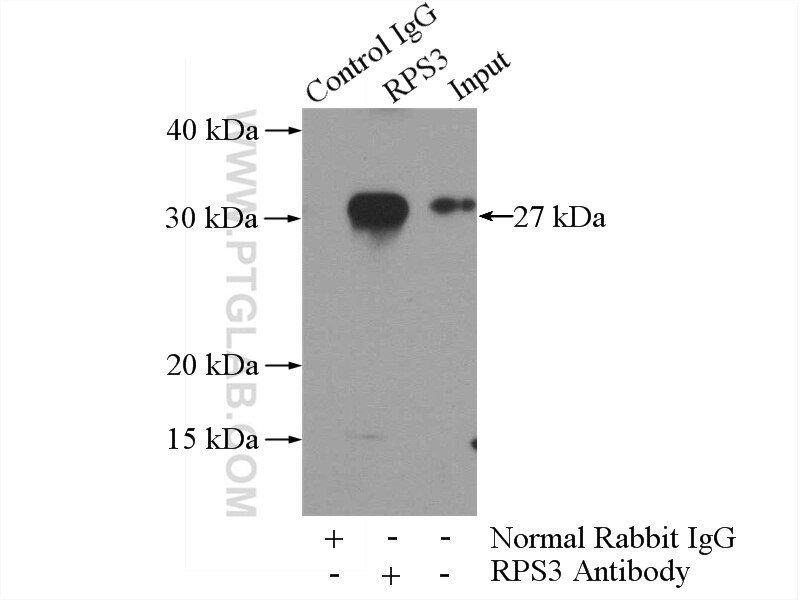
| Positive IP detected in | mouse testis tissue |
| Positive IHC detected in | rat liver tissue Note: suggested antigen retrieval with TE buffer pH 9.0; (*) Alternatively, antigen retrieval may be performed with citrate buffer pH 6.0 |
| Positive IF/ICC detected in | MCF-7 cells |
Recommended dilution
| Application | Dilution |
|---|---|
| Western Blot (WB) | WB : 1:1000-1:6000 |
| Immunoprecipitation (IP) | IP : 0.5-4.0 ug for 1.0-3.0 mg of total protein lysate |
| Immunohistochemistry (IHC) | IHC : 1:500-1:2000 |
| Immunofluorescence (IF)/ICC | IF/ICC : 1:200-1:800 |
| It is recommended that this reagent should be titrated in each testing system to obtain optimal results. | |
| Sample-dependent, Check data in validation data gallery. | |
Product Information
11990-1-AP targets RPS3 in WB, IHC, IF/ICC, IP, ELISA applications and shows reactivity with human, mouse, rat samples.
| Tested Reactivity | human, mouse, rat |
| Cited Reactivity | human, mouse, pig |
| Host / Isotype | Rabbit / IgG |
| Class | Polyclonal |
| Type | Antibody |
| Immunogen |
CatNo: Ag3918 Product name: Recombinant human RPS3 protein Source: e coli.-derived, Unknow Tag: N/A Domain: c16032 of BC034149 Sequence: Predict reactive species |
| Full Name | ribosomal protein S3 |
| Calculated Molecular Weight | 26 aa, 7 kDa |
| Observed Molecular Weight | 26.7 kDa |
| GenBank Accession Number | BC034149 |
| Gene Symbol | RPS3 |
| Gene ID (NCBI) | 6188 |
| RRID | AB_2180758 |
| Conjugate | Unconjugated |
| Form | Liquid |
| Purification Method | Antigen affinity purification |
| UNIPROT ID | P23396 |
| Storage Buffer | PBS with 0.02% sodium azide and 50% glycerol, pH 7.3. |
| Storage Conditions | Store at -20°C. Stable for one year after shipment. Aliquoting is unnecessary for -20oC storage. 20ul sizes contain 0.1% BSA. |
Background Information
40S ribosomal protein S3 (RPS3), also named as SW-cl.26, is a 243 amino acid protein,which contains one KH type-2 domain and belongs to the ribosomal protein S3P family. RPS3 localizes in the cytoplasm. RPS3 is identified in a IGF2BP1-dependent mRNP granule complex, which contains untranslated mRNAs. RPS3 plays a role in repairing various DNA damage acting as a repair UV endonuclease. Nuclear accumulation of RPS3 results in an increase in DNA repair activity to some extent, thereby sustaining neuronal survival.
Protocols
| Product Specific Protocols | |
|---|---|
| IF protocol for RPS3 antibody 11990-1-AP | Download protocol |
| IHC protocol for RPS3 antibody 11990-1-AP | Download protocol |
| IP protocol for RPS3 antibody 11990-1-AP | Download protocol |
| WB protocol for RPS3 antibody 11990-1-AP | Download protocol |
| Standard Protocols | |
|---|---|
| Click here to view our Standard Protocols |
Publications
What published studies show
The RPS3 Polyclonal antibody (catalog #11990-1-AP) has 34 citations. They appear in journals including Nature Communications, Molecular Cell, EMBO Journal, Cell Reports, Current Biology, Autophagy, Acta Pharmaceutica Sinica B, Journal of Biological Chemistry, DNA Repair, Frontiers in Oncology, iScience, and Pathogens. Research fields span ribosomal biogenesis, cancer (metastasis, resistance), viral infection (SARS-CoV-2, KSHV), DNA repair, meiosis, cilia, and inflammation.
| Species | Application | Title |
|---|---|---|
Autophagy Byakangelicin alleviates metabolic dysfunction-associated steatohepatitis by selective inhibition of a non-canonical MTORC1 signaling pathway. | ||
Nat Commun Cilia locally synthesize proteins to sustain their ultrastructure and functions. | ||
Nat Commun Kaposi's sarcoma-associated herpesvirus induces specialised ribosomes to efficiently translate viral lytic mRNAs | ||
Nat Commun DDX41 resolves G-quadruplexes to maintain erythroid genome integrity and prevent cGAS-mediated cell death | ||
Mol Cell A methyltransferase-independent role for METTL1 in tRNA aminoacylation and oncogenic transformation | ||
Acta Pharm Sin B RBM14 enhances transcriptional activity of p23 regulating CXCL1 expression to induce lung cancer metastasis. |
Reviews
What customers say
This product has received 2 reviews, both for Western Blot applications. One reviewer gave it 5 stars, noting that the antibody recognized a clean band at 27 kD. The other reviewer gave it 3 stars and used it on Cl-16 cells at a 1:500 dilution but provided no additional comments. Overall, the feedback suggests the antibody performs well for WB with clear band detection, though results may vary depending on the cell type and conditions used.
The reviews below have been submitted by verified Proteintech customers who received an incentive for providing their feedback.
Boyan (Verified Customer) (12-16-2021) | This antibody recognized a clean band at 27 kd.
|
Huanzhou (Verified Customer) (11-26-2018) |
|








