



Tested Applications
| Positive WB detected in | mouse small intestine tissue, Transfected HEK-293 cells |
| Positive IP detected in | human placenta tissue |
Recommended dilution
| Application | Dilution |
|---|---|
| Western Blot (WB) | WB : 1:500-1:1000 |
| Immunoprecipitation (IP) | IP : 0.5-4.0 ug for 1.0-3.0 mg of total protein lysate |
| It is recommended that this reagent should be titrated in each testing system to obtain optimal results. | |
| Sample-dependent, Check data in validation data gallery. | |
Product Information
17193-1-AP targets RSPO3 in WB, IHC, IF, IP, ELISA applications and shows reactivity with human, mouse, rat samples.
| Tested Reactivity | human, mouse, rat |
| Cited Reactivity | human, mouse, rat |
| Host / Isotype | Rabbit / IgG |
| Class | Polyclonal |
| Type | Antibody |
| Immunogen |
CatNo: Ag9899 Product name: Recombinant human RSPO3 protein Source: e coli.-derived, PET28a Tag: 6*His Domain: 27-272 aa of BC022367 Sequence: GRRQRRMHPNVSQGCQGGCATCSDYNGCLSCKPRLFFALERIGMKQIGVCLSSCPSGYYGTRYPDINKCTKCKADCDTCFNKNFCTKCKSGFYLHLGKCLDNCPEGLEANNHTMECVSIVHCEVSEWNPWSPCTKKGKTCGFKRGTETRVREIIQHPSAKGNLCPPTNETRKCTVQRKKCQKGERGKKGRERKRKKPNKGESKEAIPDSKSLESSKEIPEQRENKQQQKKRKVQDKQKSVSVSTVH Predict reactive species |
| Full Name | R-spondin 3 homolog (Xenopus laevis) |
| Calculated Molecular Weight | 272 aa, 31 kDa |
| Observed Molecular Weight | 30-40 kDa |
| GenBank Accession Number | BC022367 |
| Gene Symbol | RSPO3 |
| Gene ID (NCBI) | 84870 |
| RRID | AB_2878360 |
| Conjugate | Unconjugated |
| Form | Liquid |
| Purification Method | Antigen affinity purification |
| UNIPROT ID | Q9BXY4 |
| Storage Buffer | PBS with 0.02% sodium azide and 50% glycerol, pH 7.3. |
| Storage Conditions | Store at -20°C. Stable for one year after shipment. Aliquoting is unnecessary for -20oC storage. 20ul sizes contain 0.1% BSA. |
Background Information
RSPO3, also named as R-spondin-3, is a 272 amino acid protein, which contains 1 TSP type-1 domain and 2 FU (furin-like) repeats. RSPO3 may be a secreted protein and belongs to the R-spondin family. RSPO3 is expressed at higher level in placenta, small intestine, fetal thymus and lymph node. RSPO3 is an activator of the canonical Wnt signaling pathway by acting as a ligand for LGR4-6 receptors. The four R-spondins (RSPO1-4) and three related leucinerich repeat-containing G-protein coupled receptors, LGR4, LGR5, and LGR6 (LGR4-6), constitute a ligand-receptor system that plays critical roles in development, stem cell survival, and oncogenesis. Ectopic expression of RSPO2/3in mouse mammary epithelial cells led to an increase in invasiveness in vitro and in tumor formation and metastasis in vivo.
Protocols
| Product Specific Protocols | |
|---|---|
| IP protocol for RSPO3 antibody 17193-1-AP | Download protocol |
| WB protocol for RSPO3 antibody 17193-1-AP | Download protocol |
| Standard Protocols | |
|---|---|
| Click here to view our Standard Protocols |
Publications
What published studies show
The RSPO3 Polyclonal antibody (Cat# 17193-1-AP) has 19 citations across journals including Nature, Cancer Discovery, Nature Communications, PNAS, J Exp Clin Cancer Res, Cardiovasc Res, Cell Death & Disease, Phytomedicine, FASEB J, J Cell Sci, Cancer Med, and others. Research fields span Wnt/RSPO signaling, liver biology, tumor microenvironment and cancer (pancreatic, gastric, choriocarcinoma), atherosclerosis, ischemia/reperfusion injury, diabetes vascular complications, wound healing, sepsis, preeclampsia, and muscle regeneration.
| Species | Application | Title |
|---|---|---|
Cancer Discov Tumor Microenvironment-Derived R-spondins Enhance Antitumor Immunity to Suppress Tumor Growth and Sensitize for Immune Checkpoint Blockade Therapy | ||
Nat Commun R-Spondin chromosome rearrangements drive Wnt-dependent tumour initiation and maintenance in the intestine. | ||
J Exp Clin Cancer Res Subtypes in pancreatic ductal adenocarcinoma based on niche factor dependency show distinct drug treatment responses. | ||
Cell Death Dis Endothelial cell-derived RSPO3 activates Gαi1/3-Erk signaling and protects neurons from ischemia/reperfusion injury
|
Reviews
What customers say
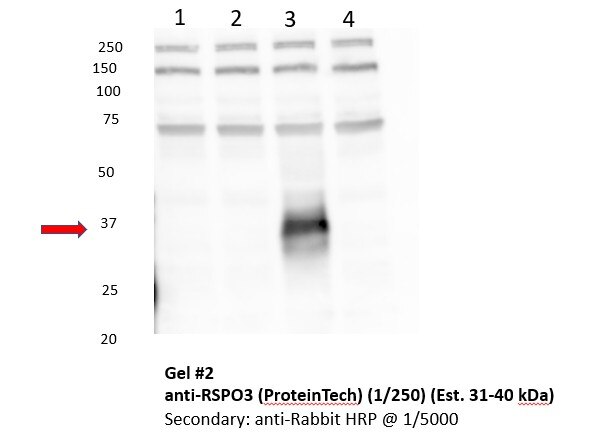
The single review for this product is highly positive, rated 5 out of 5 stars. The reviewer used it for Western Blot at a 1:250 dilution and reported excellent performance, noting a clear band at the expected molecular weight that confirmed successful transfection. Overall, the feedback highlights reliable specificity and strong signal quality for WB applications.
The reviews below have been submitted by verified Proteintech customers who received an incentive for providing their feedback.
Gerald (Verified Customer) (07-23-2025) | Worked very well for Western Blot, showing a clear band at the expected molecular weight size, thereby confirming a successful transfection.
 |


