
Rat TGF-beta1 ELISA Kit
Cat no : KE20010
Synonyms
LAP, Latency-associated peptide, TGF BETA, TGF beta 1, TGF BETA1
Validation Data Gallery
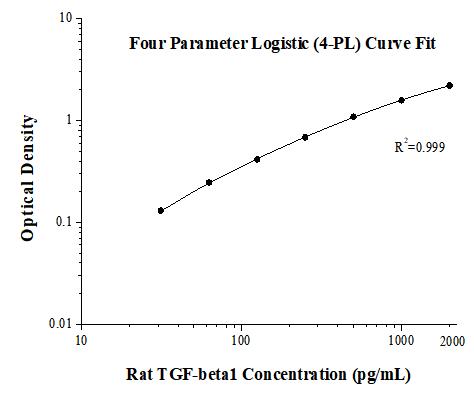
Product Information
KE20010 is a solid phase sandwich Enzyme Linked-Immuno-Sorbent Assay (Sandwich ELISA). The TGF-beta1 ELISA kit is to be used to detect and quantify protein levels of endogenous TGF-beta1. The assay recognizes Rat TGF-beta1. An antibody specific for TGF-beta1 has been pre-coated onto the microwells. The TGF-beta1 protein in samples is captured by the coated antibody after incubation. Following extensive washing, another antibody of biotinylated specific for TGF-beta1 is added to detect the captured TGF-beta1 protein. For signal development, Streptavidin-HRP is added, followed by Tetramethyl-benzidine (TMB) reagent. Solution containing sulfuric acid is used to stop color development and the color intensity which is proportional to the quantity of bound protein is measurable at 450 nm with the correction wavelength set at 630 nm. This ELISA kit is cross-reactive with bovine, porcine, equine, and caprine. Therefore, the culture medium should not contain serum components associated with the above species.
| Product name | Rat TGF-beta1 ELISA Kit |
| Tests | 1 X 96 well plate |
| Sample type | Serum, Plasma, Cell culture supernatants |
| Assay type | Sandwich |
| Sensitivity | 3.4 pg/mL |
| Range | 31.25 - 2000 pg/mL |
| Reactivity | Rat |
| Tested applications | Sandwich ELISA |
| Gene ID (NCBI) | 59086 |
Recovery
| Sample Type | Average | Range |
|---|---|---|
| cell culture supernatants | 100 | 78-126 |
| rat serum | 99 | 81-114 |
IntraAssay
| Sample | n | mean ( pg/mL) | SD | CV% |
|---|---|---|---|---|
| 1 | 20 | 43.6 | 3.3 | 7.5 |
| 2 | 20 | 245.3 | 11.1 | 4.5 |
| 3 | 20 | 1027.5 | 53.2 | 5.2 |
InterAssay
| Sample | n | mean ( pg/mL) | SD | CV% |
|---|---|---|---|---|
| 1 | 24 | 55.5 | 4.5 | 8.1 |
| 2 | 24 | 251.8 | 23.0 | 9.1 |
| 3 | 24 | 1079.7 | 94.4 | 8.7 |
Background Information
TGF-beta is a member of the transforming growth factor beta (TGFB) family of cytokines, which are multifunctional peptides that regulate proliferation, differentiation, adhesion, migration, and other functions in many cell types. TGF-beta is produced by a number of cell types including regulatory T cells, fibroblasts, epithelial cells, and endothelial cells. TGF-beta acts synergistically with TGFA in inducing transformation. It also acts as a negative autocrine growth factor. TGF-beta plays an important role in bone remodeling as it is a potent stimulator of osteoblastic bone formation, causing chemotaxis, proliferation and differentiation in committed osteoblasts. TGF-beta appears to promote late stage progression and metastasis in some cancers.
Properties
| Storage Instructions | All the reagents are stored at 2-8℃ for 6 months or -20℃ for 12 months. Refer to the protocol for further storage instructions. |
| Synonyms | LAP, Latency-associated peptide, TGF BETA, TGF beta 1, TGF BETA1 |
FAQ
1、I have limited sample diluent. How should I handle samples requiring high dilution factors?
Answer: We recommend performing a serial dilution. For example, if human serum requires a 1,000,000-fold dilution, you can use a three-step 100× dilution method as follows:
Step 1: Take 2 uL of human serum and add it to 198 uL of sample diluent, mix thoroughly to obtain a 100-fold diluted sample.
Step 2: Take 2 uL of the 100-fold diluted sample and add it to 198 uL of sample diluent, mix thoroughly to obtain a 10,000-fold diluted sample.
Step 3: Take 2 uL of the 10,000-fold diluted sample and add it to 198 uL of sample diluent, mix thoroughly to obtain a 1,000,000-fold diluted sample.
If further dilution is required, additional serial steps can be used. We do not recommend using any other solutions or water for dilution, except for the sample diluent we suggest. If your sample diluent is still insufficient, please contact our customer service for more sample diluent.
Publications
| Species | Sample Type | Title |
|---|---|---|
Cancer Cell Epithelial cells activate fibroblasts to promote esophageal cancer development | ||
ACS Nano Flowerbed-Inspired Mg-Loaded Scaffold Accelerates Critical-Sized Bone-Defect Repair by Reprogramming the Microenvironment. | ||
Biomaterials A biosilica nanocage-based injectable hydrogel to trap endogenous TGF-β1 for in-situ hyaline cartilage regeneration. | ||
J Control Release Sorbitol-responsive in situ gel improves rat ischemic hearts: Supporting mesenchymal stem cell survival and enhancing paracrine effect | ||
Phytomedicine Shenling Tongqiao powder targets TGF-β1/Smad-Wnt/β-catenin axis to suppress epithelial-mesenchymal transition in chronic rhinosinusitis | ||
Proc Natl Acad Sci U S A An endoscopically compatible fast-gelation powder forms Janus-adhesive hydrogel barrier to prevent postoperative adhesions |