
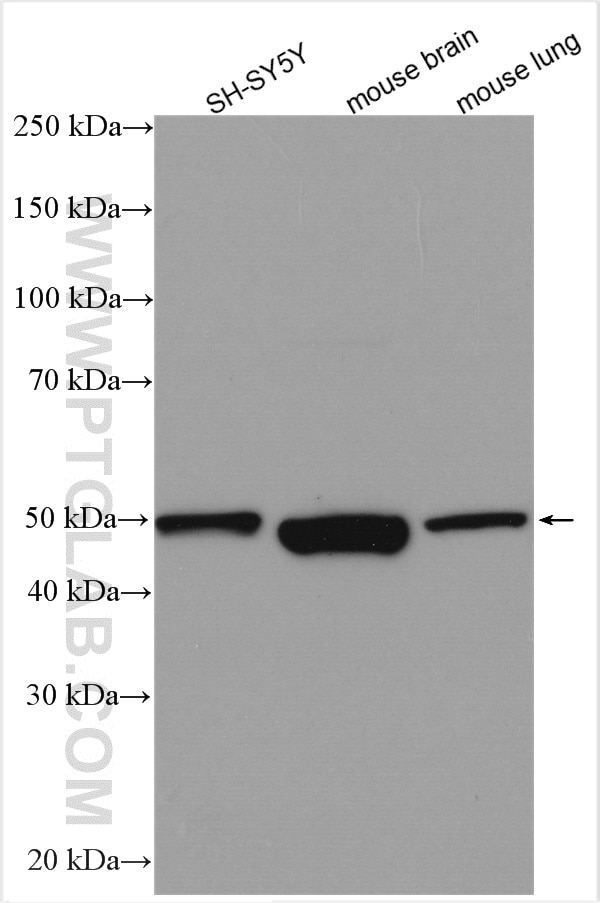

Tested Applications
| Positive WB detected in | SH-SY5Y cells, mouse brain tissue, mouse lung tissue |
Recommended dilution
| Application | Dilution |
|---|---|
| Western Blot (WB) | WB : 1:500-1:2000 |
| It is recommended that this reagent should be titrated in each testing system to obtain optimal results. | |
| Sample-dependent, Check data in validation data gallery. | |
Product Information
29318-1-AP targets S1PR1/EDG1 in WB, ELISA applications and shows reactivity with human, mouse samples.
| Tested Reactivity | human, mouse |
| Cited Reactivity | human, rat |
| Host / Isotype | Rabbit / IgG |
| Class | Polyclonal |
| Type | Antibody |
| Immunogen |
CatNo: Ag28083 Product name: Recombinant human S1PR1 protein Source: e coli.-derived, PET28a Tag: 6*His Domain: 311-382 aa of BC018650 Sequence: YTLTNKEMRRAFIRIMSCCKCPSGDSAGKFKRPIIAGMEFSRSKSDNSSHPQKDEGDNPETIMSSGNVNSSS Predict reactive species |
| Full Name | sphingosine-1-phosphate receptor 1 |
| Calculated Molecular Weight | 43 kDa |
| Observed Molecular Weight | 45-50 kDa |
| GenBank Accession Number | BC018650 |
| Gene Symbol | S1PR1 |
| Gene ID (NCBI) | 1901 |
| RRID | AB_2918281 |
| Conjugate | Unconjugated |
| Form | Liquid |
| Purification Method | Antigen affinity purification |
| UNIPROT ID | P21453 |
| Storage Buffer | PBS with 0.02% sodium azide and 50% glycerol, pH 7.3. |
| Storage Conditions | Store at -20°C. Stable for one year after shipment. Aliquoting is unnecessary for -20oC storage. 20ul sizes contain 0.1% BSA. |
Background Information
S1PR1 (sphingosine-1-phosphate receptor 1), also known as S1P1 or EDG1, is one of five G-protein-coupled receptors for sphingosine-1-phosphate (S1P) (PMID: 18787560). S1P1 and its receptors have important regulatory functions in normal physiology and disease processes, particularly involving the immune, central nervous, and cardiovascular systems (PMID: 21339489). S1PR1 is widely expressed in various cell types, including endothelial cells and lymphocytes (PMID: 14737169). S1P-S1PR1 plays a major role in lymphocyte egress and chemotaxis, cell proliferation and survival, and tumor angiogenesis and metastasis (PMID: 21102457).
Protocols
| Product Specific Protocols | |
|---|---|
| WB protocol for S1PR1/EDG1 antibody 29318-1-AP | Download protocol |
| Standard Protocols | |
|---|---|
| Click here to view our Standard Protocols |
Publications
What published studies show
The S1PR1/EDG1 Polyclonal antibody (Cat# 29318-1-AP) has 5 total citations. These appear in J Transl Med, J Clin Transl Hepatol, Food Sci Nutr, Toxicol In Vitro, and Mechanobiol Med. The cited research spans oncology (oral squamous cell carcinoma), hepatology (liver venous deprivation), cardiovascular disease (atherosclerosis), pulmonary fibrosis, and bone biology (osteogenesis), primarily using WB applications in human and rat samples.
| Species | Application | Title |
|---|---|---|
J Transl Med S1PR3 inhibition impairs cell cycle checkpoint via the AKT/WEE1 pathway in oral squamous cell carcinoma | ||
J Clin Transl Hepatol Establishment of a Rat Model of Liver Venous Deprivation: Simultaneous Portal and Hepatic Vein Ligation | ||
Food Sci Nutr Hydroxysafflor yellow A, a natural food pigment, ameliorates atherosclerosis in ApoE-/- mice by inhibiting the SphK1/S1P/S1PR3 pathway | ||
Toxicol In Vitro SiO(2) dust induces the transformation of lung fibroblasts to myofibroblasts by activating the S1P-RhoA-YAP signaling pathway. | ||
Mechanobiol Med Mechanical stretch promotes osteogenesis in the midpalatal suture by enhancing neutrophil fatty acid oxidation through the S1PR1/STAT3 axis. |


