


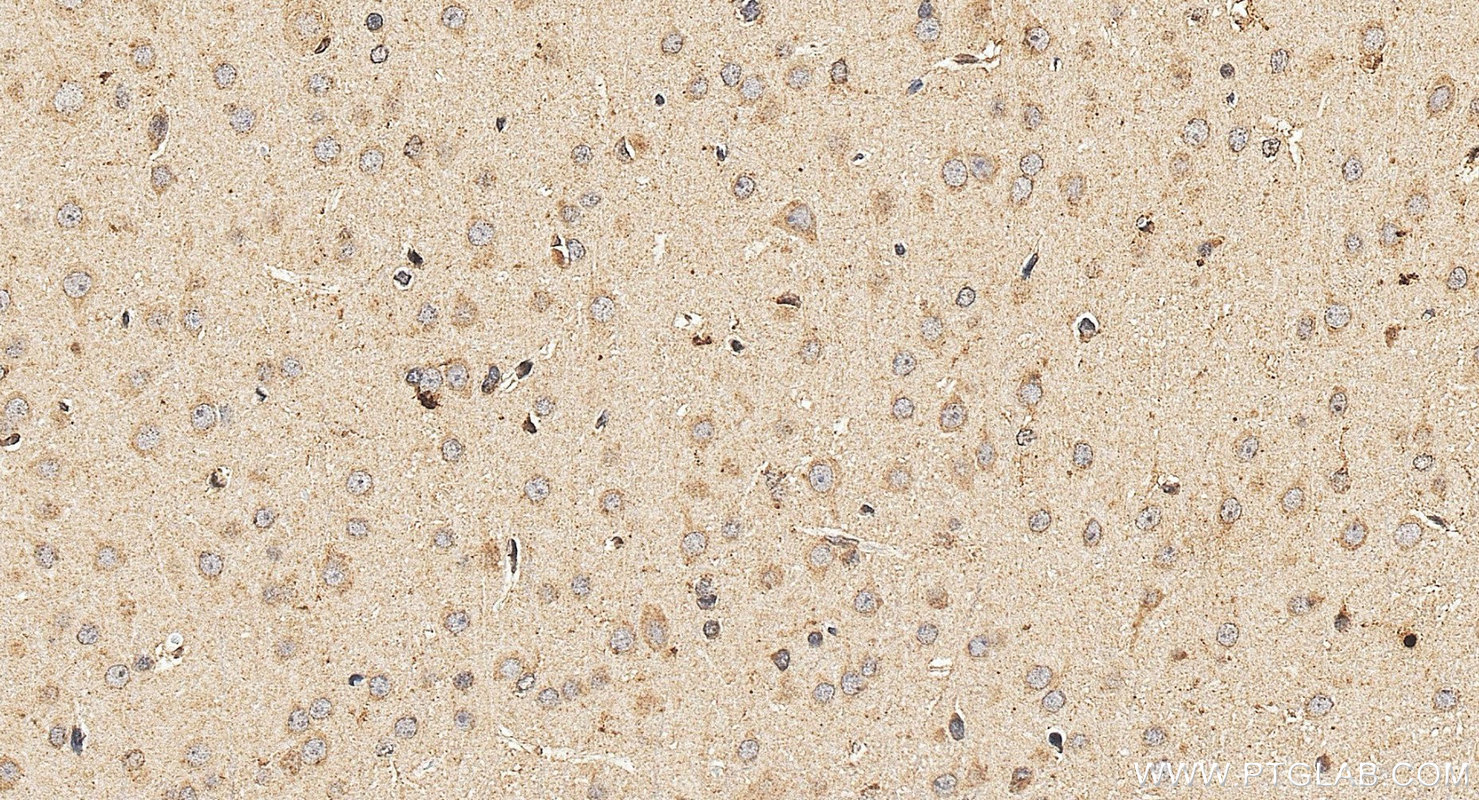

Tested Applications
| Positive WB detected in | mouse brain tissue, HEK-293 cells, HeLa cells, Jurkat cells, K-562 cells |
Recommended dilution
| Application | Dilution |
|---|---|
| Western Blot (WB) | WB : 1:500-1:1000 |
| It is recommended that this reagent should be titrated in each testing system to obtain optimal results. | |
| Sample-dependent, Check data in validation data gallery. | |
Product Information
13874-1-AP targets S1PR5/EDG8 in WB, IHC, ELISA applications and shows reactivity with human, mouse samples.
| Tested Reactivity | human, mouse |
| Cited Reactivity | human, mouse, zebrafish |
| Host / Isotype | Rabbit / IgG |
| Class | Polyclonal |
| Type | Antibody |
| Immunogen |
CatNo: Ag4928 Product name: Recombinant human S1PR5 protein Source: e coli.-derived, PGEX-4T Tag: GST Domain: 214-398 aa of BC034703 Sequence: RIYCQVRANARRLPARPGTAGTTSTRARRKPRSLALLRTLSVVLLAFVACWGPLFLLLLLDVACPARTCPVLLQADPFLGLAMANSLLNPIIYTLTNRDLRHALLRLVCCGRHSCGRDPSGSQQSASAAEASGGLRRCLPPGLDGSFSGSERSSPQRDGLDTSGSTGSPGAPTAARTLVSEPAAD Predict reactive species |
| Full Name | sphingosine-1-phosphate receptor 5 |
| Calculated Molecular Weight | 398 aa, 42 kDa |
| Observed Molecular Weight | 50-55 kDa |
| GenBank Accession Number | BC034703 |
| Gene Symbol | S1PR5 |
| Gene ID (NCBI) | 53637 |
| RRID | AB_2182638 |
| Conjugate | Unconjugated |
| Form | Liquid |
| Purification Method | Antigen affinity purification |
| UNIPROT ID | Q9H228 |
| Storage Buffer | PBS with 0.02% sodium azide and 50% glycerol, pH 7.3. |
| Storage Conditions | Store at -20°C. Stable for one year after shipment. Aliquoting is unnecessary for -20oC storage. 20ul sizes contain 0.1% BSA. |
Background Information
Sphingosine 1-phosphate (S1P) is a biologically active lysophospholipid that elicits diverse physiological effects on most types of cells and tissues via five G protein-coupled receptors, S1PR1 to S1PR5. S1PRs differ in their tissue expression and cell lineage: S1PR1-3 are expressed throughout the immune, central nervous system (CNS), and cardiovascular system; S1PR4 is primarily expressed in lymphoid tissue; and S1PR5 is a predominant receptor in CNS white matter, spleen, and natural killer cells (PMID: 21707490). S1PR5 (also known as EDG8) has been involved in the trafficking of NK cells and monocytes (PMID: 21911833; 23519784).
Protocols
| Product Specific Protocols | |
|---|---|
| WB protocol for S1PR5/EDG8 antibody 13874-1-AP | Download protocol |
| Standard Protocols | |
|---|---|
| Click here to view our Standard Protocols |
Publications
What published studies show
The S1PR5/EDG8 Polyclonal antibody (Cat# 13874-1-AP) has 6 citations across journals including Nature Communications, Journal of Translational Medicine, Drug Design, Development and Therapy, Molecular Neurobiology, Scientific Reports, and PLoS One. Research fields span ocular neovascularization, oral squamous cell carcinoma, lung adenocarcinoma, Alzheimer's disease, NK-cell anti-tumor immunity, and hepatocellular carcinoma, with most studies employing Western blot in zebrafish, mouse, or human samples.
| Species | Application | Title |
|---|---|---|
Nat Commun Sphingosine-1-Phosphate-derived 2-Hexadecenal is a central mediator of ocular neovascularization by inhibiting Sphingosine-1-Phosphate receptor 5. | ||
J Transl Med S1PR3 inhibition impairs cell cycle checkpoint via the AKT/WEE1 pathway in oral squamous cell carcinoma | ||
Drug Des Devel Ther Network Pharmacology and Experimental Verification to Explore the Potential Mechanism of Yin-Huo-Tang for Lung Adenocarcinoma Recurrence. | ||
Mol Neurobiol Dual Mechanisms of Cognitive Function and Pathological Improvements by the Selective S1PR1/5 Modulator Siponimod in 3xTg-AD Mice. | ||
Sci Rep Transcriptional signature of rapidly responding NK cells reveals S1P5 and CXCR4 as anti-tumor response disruptors | ||
PLoS One Sphingosine 1-phosphate (S1P) reduces hepatocyte growth factor-induced migration of hepatocellular carcinoma cells via S1P receptor 2. |




