
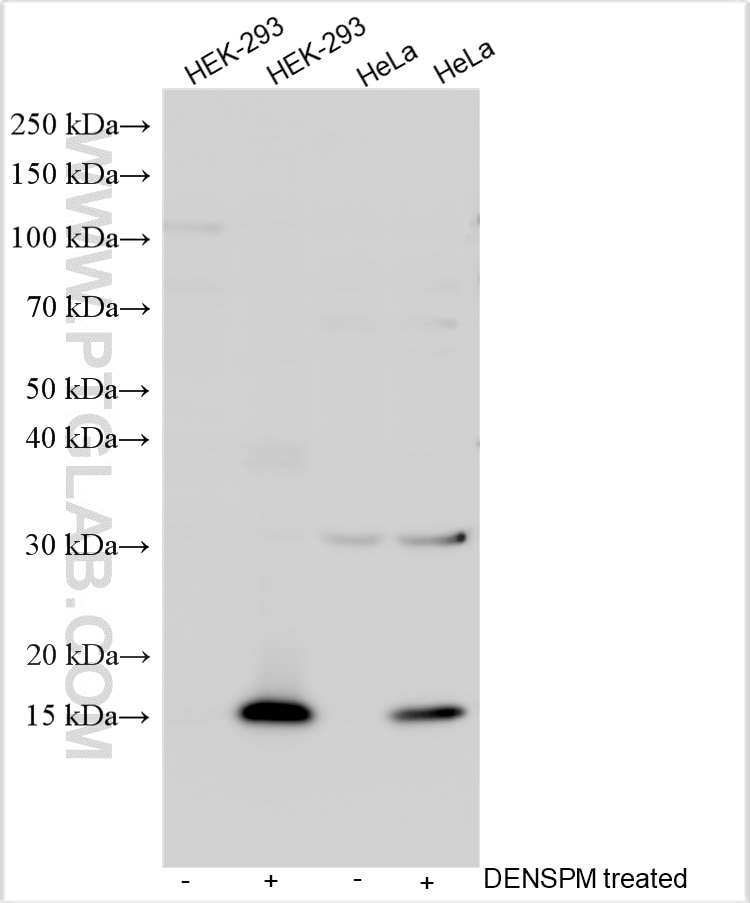
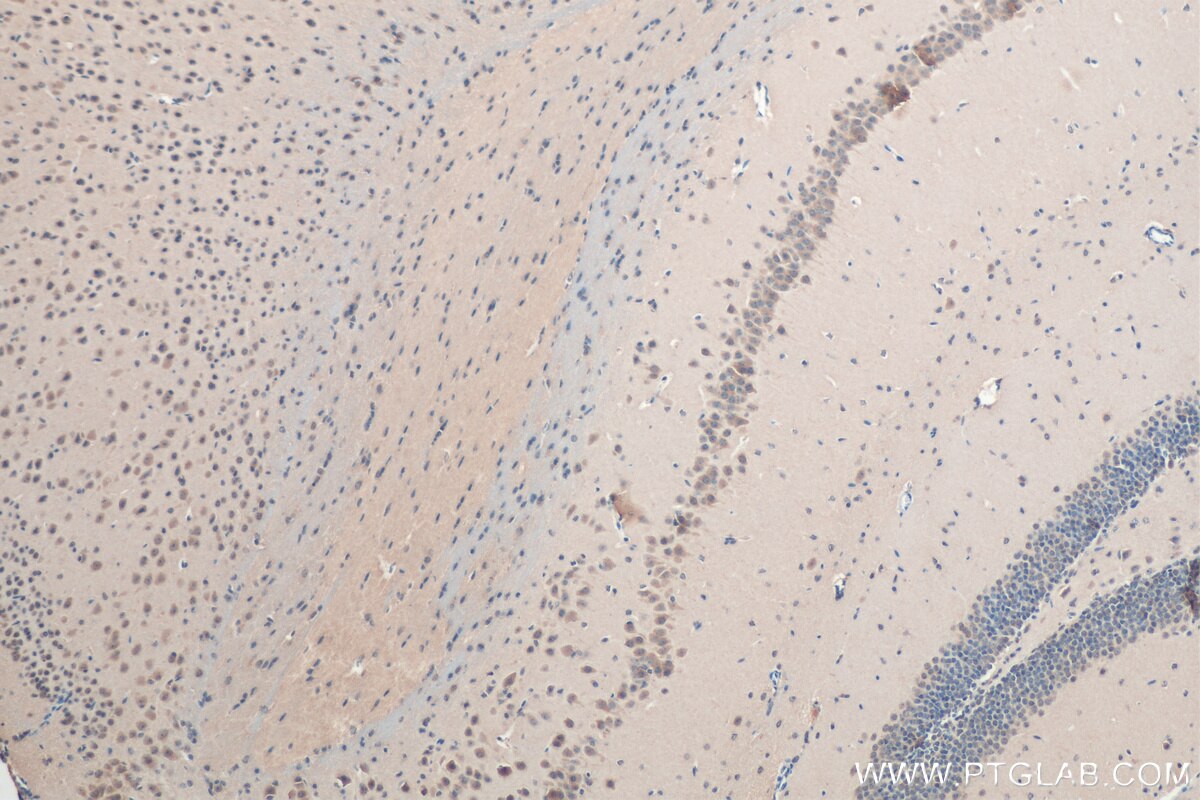

Tested Applications
| Positive WB detected in | HEK-293 cells |
| Positive IHC detected in | mouse brain tissue Note: suggested antigen retrieval with TE buffer pH 9.0; (*) Alternatively, antigen retrieval may be performed with citrate buffer pH 6.0 |
Recommended dilution
| Application | Dilution |
|---|---|
| Western Blot (WB) | WB : 1:500-1:3000 |
| Immunohistochemistry (IHC) | IHC : 1:50-1:500 |
| It is recommended that this reagent should be titrated in each testing system to obtain optimal results. | |
| Sample-dependent, Check data in validation data gallery. | |
Product Information
10708-1-AP targets SAT1 in WB, IHC, IF, ELISA applications and shows reactivity with human, mouse, rat samples.
| Tested Reactivity | human, mouse, rat |
| Cited Reactivity | human, mouse, rat |
| Host / Isotype | Rabbit / IgG |
| Class | Polyclonal |
| Type | Antibody |
| Immunogen |
CatNo: Ag1154 Product name: Recombinant human SAT1 protein Source: e coli.-derived, PGEX-4T Tag: GST Domain: 1-171 aa of BC008424 Sequence: MAKFVIRPATAADCSDILRLIKELAKYEYMEEQVILTEKDLLEDGFGEHPFYHCLVAEVPKEHWTPEGHSIVGFAMYYFTYDPWIGKLLYLEDFFVMSDYRGFGIGSEILKNLSQVAMRCRCSSMHFLVAEWNEPSINFYKRRGASDLSSEEGWRLFKIDKEYLLKMATEE Predict reactive species |
| Full Name | spermidine/spermine N1-acetyltransferase 1 |
| Calculated Molecular Weight | 20 kDa |
| Observed Molecular Weight | 15-25 kDa |
| GenBank Accession Number | BC008424 |
| Gene Symbol | SAT1 |
| Gene ID (NCBI) | 6303 |
| RRID | AB_2877739 |
| Conjugate | Unconjugated |
| Form | Liquid |
| Purification Method | Antigen affinity purification |
| UNIPROT ID | P21673 |
| Storage Buffer | PBS with 0.02% sodium azide and 50% glycerol, pH 7.3. |
| Storage Conditions | Store at -20°C. Stable for one year after shipment. Aliquoting is unnecessary for -20oC storage. 20ul sizes contain 0.1% BSA. |
Background Information
Spermidine/spermine N1-acetyltransferase 1 (SAT1 or SSAT1) is the key regulatory enzyme in the catabolism of polyamines, catalyzing acetylation of spermidine or spermine to generate N1-acetyl spermidine or N1-acetyl spermine, and N1, N12-diacetylspermine. The cellular level of SAT1 is normally extremely low, but it is induced rapidly by a variety of stimuli, including polyamines, polyamine analogs, toxic chemicals, certain drugs, and growth factors. Downregulation of SAT1 has been reported in Epstein-Barr virus positive Burkitt's lymphoma cells.
Protocols
| Product Specific Protocols | |
|---|---|
| IHC protocol for SAT1 antibody 10708-1-AP | Download protocol |
| WB protocol for SAT1 antibody 10708-1-AP | Download protocol |
| Standard Protocols | |
|---|---|
| Click here to view our Standard Protocols |
Publications
What published studies show
The SAT1 Polyclonal antibody (catalog number 10708-1-AP) has 54 citations. These appear in journals including Nature, Cell Metabolism, Neuron, Nature Communications, PNAS, Science Reports, EMBO Molecular Medicine, Advanced Science, Journal of Translational Medicine, Frontiers in Pharmacology, International Journal of Molecular Sciences, and PLoS ONE, among others. Research fields span ferroptosis, polyamine metabolism, cancer (breast, gastric, prostate, lung, melanoma), neurodegeneration (Alzheimer's, Parkinson's), cardiovascular disease, liver injury, and inflammation.
| Species | Application | Title |
|---|---|---|
Signal Transduct Target Ther Chemo-photothermal synergy ignites antitumor immunity via ferroptosis. | ||
Cell Metab Urea cycle activation triggered by host-microbiota maladaptation driving colorectal tumorigenesis | ||
Nat Commun Ferroptosis-activating metabolite acrolein antagonizes necroptosis and anti-cancer therapeutics
| ||
Neuron Spliceosomal GTPase Eftud2 deficiency-triggered ferroptosis leads to Purkinje cell degeneration | ||
Adv Sci (Weinh) Autophagy Deficiency Induced by SAT1 Potentiates Tumor Progression in Triple-Negative Breast Cancer |



