
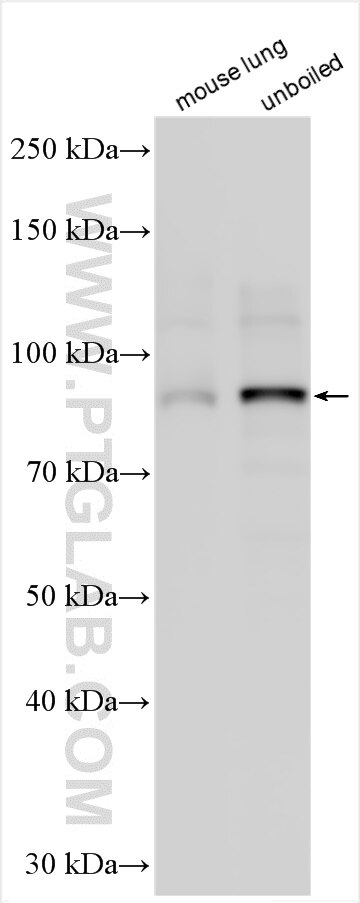

Tested Applications
| Positive WB detected in | mouse lung tissue, unboiled mouse lung tissue |
Recommended dilution
| Application | Dilution |
|---|---|
| Western Blot (WB) | WB : 1:500-1:3000 |
| It is recommended that this reagent should be titrated in each testing system to obtain optimal results. | |
| Sample-dependent, Check data in validation data gallery. | |
Product Information
13702-1-AP targets SCARF1 in WB, IF, ELISA applications and shows reactivity with human, mouse samples.
| Tested Reactivity | human, mouse |
| Cited Reactivity | human, mouse, rat |
| Host / Isotype | Rabbit / IgG |
| Class | Polyclonal |
| Type | Antibody |
| Immunogen |
CatNo: Ag4621 Product name: Recombinant human SCARF1 protein Source: e coli.-derived, PGEX-4T Tag: GST Domain: 438-830 aa of BC039735 Sequence: LACCACCCWAPRSDLKDRPARDGATVSRMKLQVWGTLTSLGSTLPCRSLSSHKLPWVTVSHHDPEVPFNHSFIEPPSAGWATDDSFSSDPESGEADEVPAYCVPPQEGMVPVAQAGSSEASLAAGAFPPPEDASTPFAIPRTSSLARAKRPSVSFAEGTKFAPQSRRSSGELSSPLRKPKRLSRGAQSGPEGREAEESTGPDEAEAPESFPAAASPGDSATGHRRPPLGSRTVAEHVEAIEGSVQESSGPVTTIYMLAGKPRGSEGPVRSVFRHFGSFQKGQAEAKVKRAIPKPPRQALNRKKGSPGLASGSVGQSPNSAPKAGLPGATGPMAVRPEEAVRGLGAGTESSRRAQEPVSGCGSPEQDPQKQAEEERQEEPEYENVVPISRPPEP Predict reactive species |
| Full Name | scavenger receptor class F, member 1 |
| Calculated Molecular Weight | 830 aa, 87 kDa |
| Observed Molecular Weight | 90 kDa |
| GenBank Accession Number | BC039735 |
| Gene Symbol | SCARF1 |
| Gene ID (NCBI) | 8578 |
| RRID | AB_2182983 |
| Conjugate | Unconjugated |
| Form | Liquid |
| Purification Method | Antigen affinity purification |
| UNIPROT ID | Q14162 |
| Storage Buffer | PBS with 0.02% sodium azide and 50% glycerol, pH 7.3. |
| Storage Conditions | Store at -20°C. Stable for one year after shipment. Aliquoting is unnecessary for -20oC storage. 20ul sizes contain 0.1% BSA. |
Background Information
Scavenger receptor class F member 1 (SCARF1), also known as scavenger receptor expressed by endothelial cells (SREC)-I, belongs to the scavenger receptor (SR) superfamily. SCARF1 has been shown to bind modified low density lipoproteins (LDLs), including acetylated (Ac-) and oxidized (ox-) LDLs (PMID: 29725698; PMID: 15145948). In addition to binding and internalizing a diverse range of endogenous proteins, SCARF1 also binds a wide array of viral, fungal, and bacterial antigens (PMID: 29242513). SCARF1 has a calculated molecular weight of 87 kDa, with a molecular weight of 140-160 kDa due to N-glycosylation (PMID: 22279061; PMID: 15145948). SCARF1 can also exist as a dimer (~ 180 kDa) and a truncated soluble form (~ 60 kDa) (PMID: 29242513; PMID: 29725698).
Protocols
| Product Specific Protocols | |
|---|---|
| WB protocol for SCARF1 antibody 13702-1-AP | Download protocol |
| Standard Protocols | |
|---|---|
| Click here to view our Standard Protocols |
Publications
What published studies show
The anti-SCARF1 antibody (Cat# 13702-1-AP) has 6 total citations. These appear in Nature Immunology, Cell Reports, Cell Proliferation, Frontiers in Immunology, Journal of Investigative Dermatology, and Journal of Developmental Biology. Research fields span immunology (apoptotic cell clearance, autoimmunity, complement/sepsis), oncology (tumor-associated macrophages, lung adenocarcinoma), liver transplantation, dermatology (vitiligo/ferroptosis), and developmental biology (haematopoietic progenitors).
| Species | Application | Title |
|---|---|---|
Nat Immunol The scavenger receptor SCARF1 mediates the clearance of apoptotic cells and prevents autoimmunity.
| ||
Cell Rep Fibroblast-Derived STC-1 Modulates Tumor-Associated Macrophages and Lung Adenocarcinoma Development. | ||
Cell Prolif SCARF1 promotes M2 polarization of Kupffer cells via calcium-dependent PI3K-AKT-STAT3 signalling to improve liver transplantation. | ||
J Invest Dermatol Heat shock protein 70/toll-like receptor 2 orchestrates melanocyte ferroptosis in the onset of vitiligo. | ||
Front Immunol Neutrophil heterogeneity in complement C1q expression associated with sepsis mortality | ||
J Dev Biol Discovery of New Markers for Haemogenic Endothelium and Haematopoietic Progenitors in the Mouse Yolk Sac. |


