


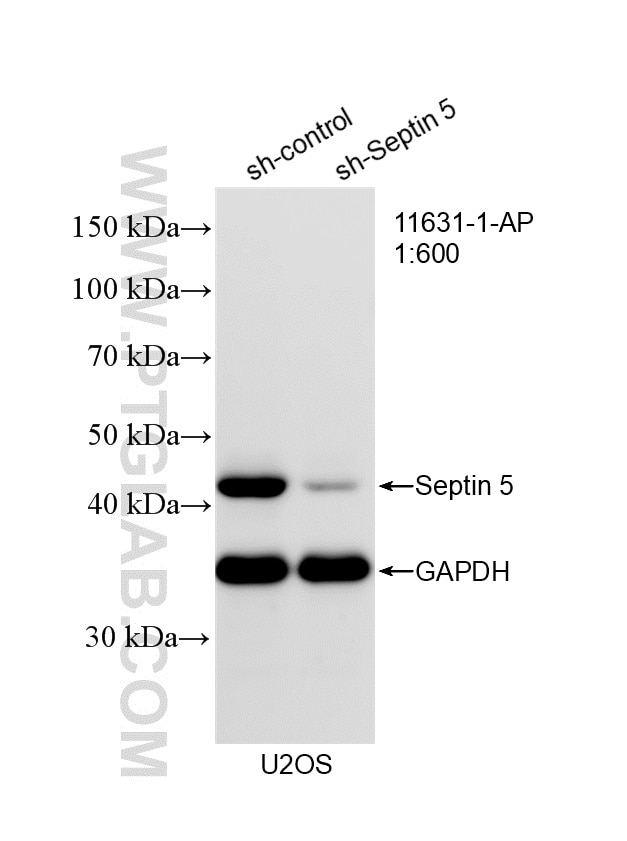



Tested Applications
| Positive WB detected in | Jurkat cells, human brain tissue, NIH/3T3 cells, mouse brain tissue, U2OS cells, rat brain tissue, K-562 cells, LNCaP cells |
| Positive IP detected in | mouse brain tissue |
| Positive IHC detected in | human gliomas tissue, mouse cerebellum tissue, human placenta tissue, rat cerebellum tissue Note: suggested antigen retrieval with TE buffer pH 9.0; (*) Alternatively, antigen retrieval may be performed with citrate buffer pH 6.0 |
Recommended dilution
| Application | Dilution |
|---|---|
| Western Blot (WB) | WB : 1:500-1:2000 |
| Immunoprecipitation (IP) | IP : 0.5-4.0 ug for 1.0-3.0 mg of total protein lysate |
| Immunohistochemistry (IHC) | IHC : 1:50-1:500 |
| It is recommended that this reagent should be titrated in each testing system to obtain optimal results. | |
| Sample-dependent, Check data in validation data gallery. | |
Product Information
11631-1-AP targets Septin 5 in WB, IHC, IF, IP, ELISA applications and shows reactivity with human, mouse, rat samples.
| Tested Reactivity | human, mouse, rat |
| Cited Reactivity | human, mouse, rat |
| Host / Isotype | Rabbit / IgG |
| Class | Polyclonal |
| Type | Antibody |
| Immunogen |
CatNo: Ag2205 Product name: Recombinant human SEPT5 protein Source: e coli.-derived, PGEX-4T Tag: GST Domain: 1-369 aa of BC025261 Sequence: MSTGLRYKSKLATPEDKQDIDKQYVGFATLPNQVHRKSVKKGFDFTLMVAGESGLGKSTLVHSLFLTDLYKDRKLLSAEERISQTVEILKHTVDIEEKGVKLKLTIVDTPGFGDAVNNTECWKPITDYVDQQFEQYFRDESGLNRKNIQDNRVHCCLYFISPFGHGLRPVDVGFMKALHEKVNIVPLIAKADCLVPSEIRKLKERIREEIDKFGIHVYQFPECDSDEDEDFKQQDRELKESAPFAVIGSNTVVEAKGQRVRGRLYPWGIVEVENQAHCDFVKLRNMLIRTHMHDLKDVTCDVHYENYRAHCIQQMTSKLTQDSRMESPIPILPLPTPDAETEKLIRMKDEELRRMQEMLQRMKQQMQDQ Predict reactive species |
| Full Name | septin 5 |
| Calculated Molecular Weight | 369 aa, 43 kDa |
| Observed Molecular Weight | 40-43 kDa |
| GenBank Accession Number | BC025261 |
| Gene Symbol | Septin 5 |
| Gene ID (NCBI) | 5413 |
| RRID | AB_2301692 |
| Conjugate | Unconjugated |
| Form | Liquid |
| Purification Method | Antigen affinity purification |
| UNIPROT ID | Q99719 |
| Storage Buffer | PBS with 0.02% sodium azide and 50% glycerol, pH 7.3. |
| Storage Conditions | Store at -20°C. Stable for one year after shipment. Aliquoting is unnecessary for -20oC storage. 20ul sizes contain 0.1% BSA. |
Background Information
Septin 5, a septin family member formerly called cell division control related protein 1 (CDCrel), is encoded in the 200 kb region and is abundantly expressed in the developing and adult brains of mice and humans. Although its constitutive deletion does not cause detectible structural or developmental abnormalities in the mouse brain, Septin 5 has been implicated in subtle neuronal and behavioral functions. Septin 5 is expressed in presynaptic terminals and exerts negative regulatory control over neurotransmitter release by binding to SNARE-protein, which has been implicated in neuropsychiatric disorders (PMID: 19240081). Septin 5 has 2 isoforms with the molecular mass of 39 and 43 kDa.
Protocols
| Product Specific Protocols | |
|---|---|
| IHC protocol for Septin 5 antibody 11631-1-AP | Download protocol |
| IP protocol for Septin 5 antibody 11631-1-AP | Download protocol |
| WB protocol for Septin 5 antibody 11631-1-AP | Download protocol |
| Standard Protocols | |
|---|---|
| Click here to view our Standard Protocols |
Publications
What published studies show
The anti-SEPT5 antibody (Cat# 11631-1-AP) has 10 citations published in journals including Nature Communications, Journal of Advanced Research, Neurobiology of Disease, Cells, Molecules, Cancers, Cell Signaling, Frontiers in Molecular Neuroscience, Journal of Neuroscience, and Cytoskeleton. Research fields span β-cell exocytosis, thrombus formation, Alzheimer's pathology, APP/Aβ degradation, neuroprotection, endometrial cancer, renal cell carcinoma, hippocampal aging, exocytosis regulation, and kidney fibrosis.
| Species | Application | Title |
|---|---|---|
Nat Commun Septin5 deletion enhances β-cell exocytosis by releasing microtubule-tethered insulin granules onto plasma membrane | ||
J Adv Res Pharmacological inhibition of Septins with Forchlorfenuron attenuates thrombus formation in experimental thrombotic mice models with modulating multiple signaling pathways in platelets | ||
Neurobiol Dis S327 phosphorylation of the presynaptic protein SEPTIN5 increases in the early stages of neurofibrillary pathology and alters the functionality of SEPTIN5. | ||
Cells Presynaptic Vesicle Protein SEPTIN5 Regulates the Degradation of APP C-Terminal Fragments and the Levels of Aβ.
| ||
Molecules Synergistic Neuroprotective Effect of Endogenously-Produced Hydroxytyrosol and Synaptic Vesicle Proteins on Pheochromocytoma Cell Line Against Salsolinol. | ||
Cancers (Basel) Forchlorfenuron-Induced Mitochondrial Respiration Inhibition and Metabolic Shifts in Endometrial Cancer |





