


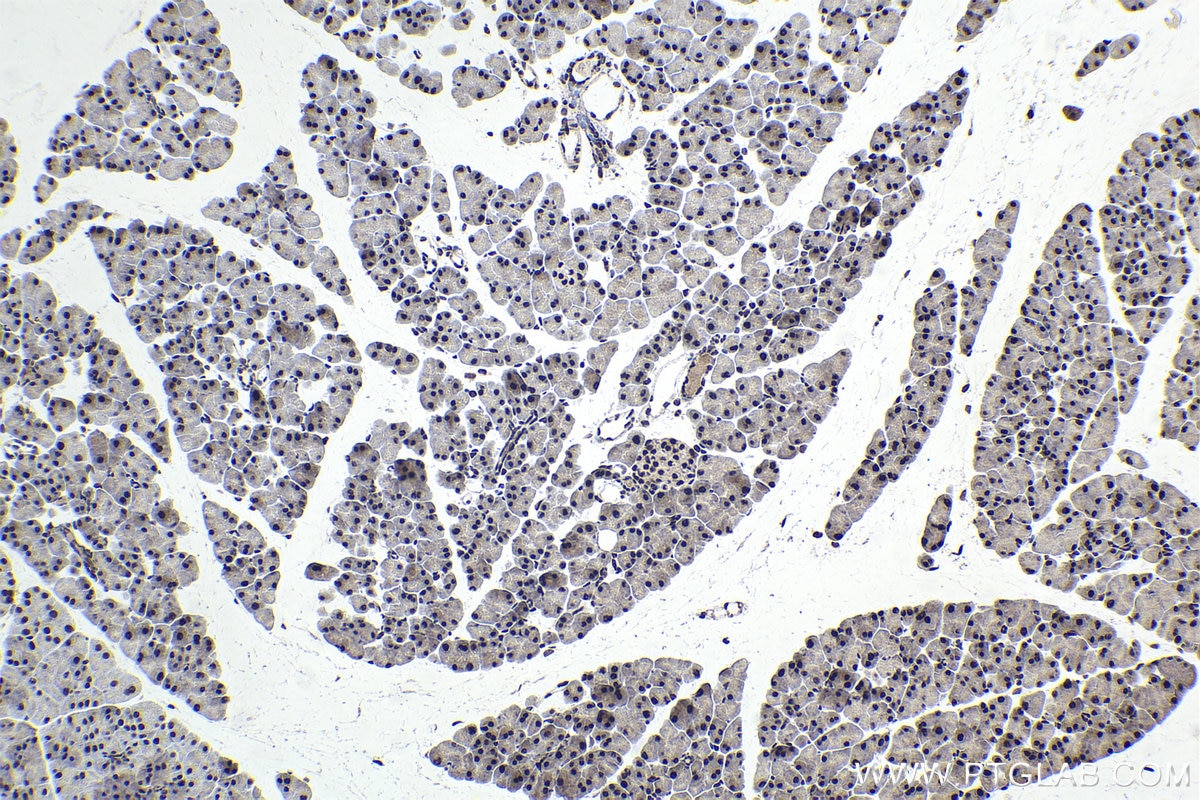
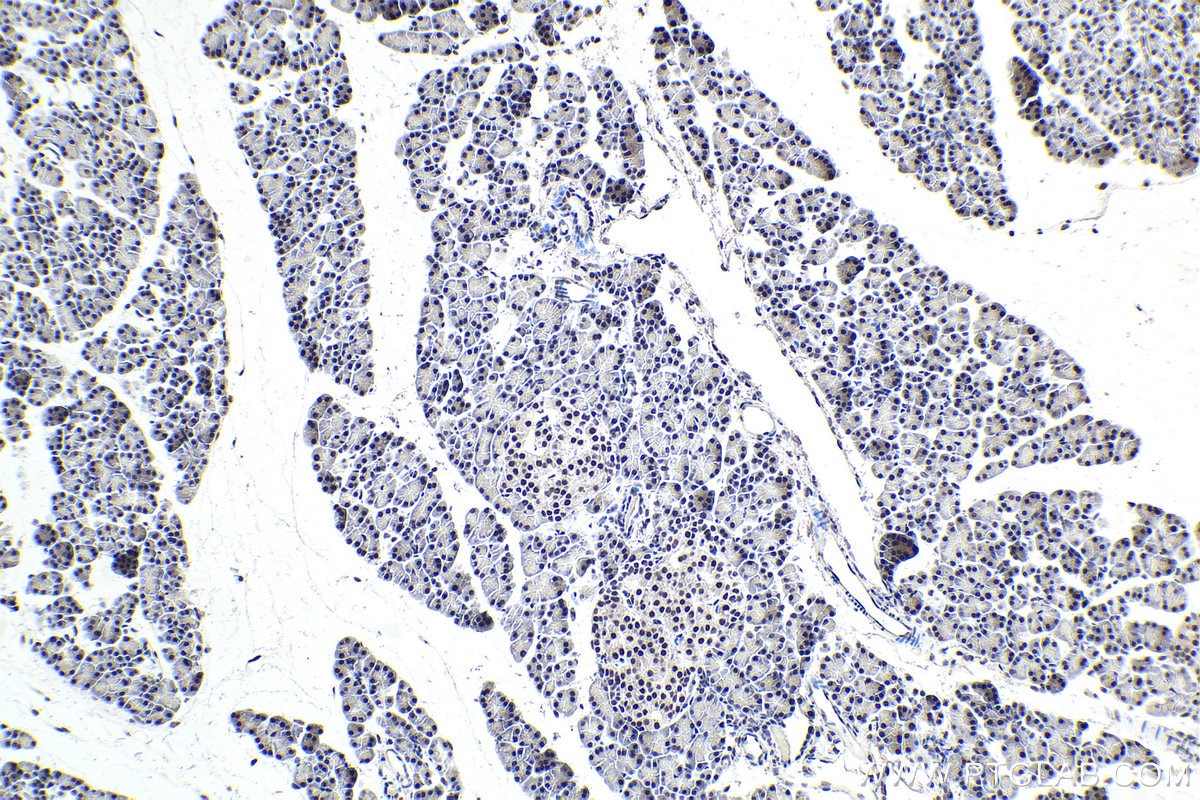

Tested Applications
| Positive WB detected in | mouse testis tissue, A549 cells |
| Positive IHC detected in | mouse pancreas tissue, rat pancreas tissue Note: suggested antigen retrieval with TE buffer pH 9.0; (*) Alternatively, antigen retrieval may be performed with citrate buffer pH 6.0 |
Recommended dilution
| Application | Dilution |
|---|---|
| Western Blot (WB) | WB : 1:500-1:1000 |
| Immunohistochemistry (IHC) | IHC : 1:500-1:2000 |
| It is recommended that this reagent should be titrated in each testing system to obtain optimal results. | |
| Sample-dependent, Check data in validation data gallery. | |
Product Information
16237-1-AP targets SFRS5 in WB, IHC, IF, ELISA applications and shows reactivity with human, mouse, rat samples.
| Tested Reactivity | human, mouse, rat |
| Cited Reactivity | human, mouse |
| Host / Isotype | Rabbit / IgG |
| Class | Polyclonal |
| Type | Antibody |
| Immunogen |
CatNo: Ag8988 Product name: Recombinant human SFRS5 protein Source: e coli.-derived, PET28a Tag: 6*His Domain: 1-272 aa of BC018823 Sequence: MSGCRVFIGRLNPAAREKDVERFFKGYGRIRDIDLKRGFGFVEFEDPRDADDAVYELDGKELCSERVTIEHARARSRGGRGRGRYSDRFSSRRPRNDRRNAPPVRTENRLIVENLSSRVSWQDLKDFMRQAGEVTFADAHRPKLNEGVVEFASYGDLKNAIEKLSGKEINGRKIKLIEGSKRHSRSRSRSRSRTRSSSRSRSRSRSRSRKSYSRSRSRSRSRSRSKSRSVSRSPVPEKSQKRGSSSRSKSPASVDRQRSRSRSRSRSVDSGN Predict reactive species |
| Full Name | splicing factor, arginine/serine-rich 5 |
| Calculated Molecular Weight | 272 aa, 31 kDa |
| Observed Molecular Weight | 40 kDa |
| GenBank Accession Number | BC018823 |
| Gene Symbol | SFRS5 |
| Gene ID (NCBI) | 6430 |
| RRID | AB_2185204 |
| Conjugate | Unconjugated |
| Form | Liquid |
| Purification Method | Antigen affinity purification |
| UNIPROT ID | Q13243 |
| Storage Buffer | PBS with 0.02% sodium azide and 50% glycerol, pH 7.3. |
| Storage Conditions | Store at -20°C. Stable for one year after shipment. Aliquoting is unnecessary for -20oC storage. 20ul sizes contain 0.1% BSA. |
Background Information
SR proteins own a characteristic C-terminal Ser/Arg-rich repeat (RS domain) of variable length and constitute a family of highly conserved nuclear phosphoproteins that can function as both essential and alternative pre-mRNA splicing factors [PMID:7556075]. The binding of SR proteins to pre-mRNA appears to be one of the earliest steps in spliceosome assembly, enhancing the binding of U1 snRNP to the 5' splice site to form a commitment complex [PMID:1577277 ]. Alternative splicing has a major role in the regulation of gene expression. SFRS5 belongs to the serine/arginine (SR) protein family of regulators of alternative pre-mRNA splicing [PMID:9244433].
Protocols
| Product Specific Protocols | |
|---|---|
| IHC protocol for SFRS5 antibody 16237-1-AP | Download protocol |
| WB protocol for SFRS5 antibody 16237-1-AP | Download protocol |
| Standard Protocols | |
|---|---|
| Click here to view our Standard Protocols |
Publications
What published studies show
The SFRS5 (SRSF5) polyclonal antibody (catalog number 16237-1-AP) has 5 total citations. These appear in Cell Metabolism, Cell Reports, JCI Insight, Journal of Dental Research, and Molecules. Associated research fields include breast cancer growth and metastasis, iron-sulfur metabolism in hematopoietic stem cells, pleural fibrosis, X-linked amelogenesis imperfecta, and oral keratinocyte proliferation.
| Species | Application | Title |
|---|---|---|
Cell Metab NEAT1 is essential for metabolic changes that promote breast cancer growth and metastasis. | ||
Cell Rep Aspartyl-tRNA synthetase 2 orchestrates iron-sulfur metabolism in hematopoietic stem cells via fine-tuning alternative RNA splicing | ||
J Dent Res Mutations Causing X-Linked Amelogenesis Imperfecta Alter miRNA Formation from Amelogenin Exon4 | ||
Molecules L-Arginine Enhances Oral Keratinocyte Proliferation under High-Glucose Conditions via Upregulation of CYP1A1, SKP2, and SRSF5 |
Reviews
What customers say
The single review for this antibody reports a 5-star rating from an immunofluorescence experiment on human osteosarcoma epithelial cells. Using a 1:100 dilution, the user observed clear nuclear signal, indicating the antibody performed well for detecting its target in the nucleus. Overall, the feedback is positive, with the reviewer confirming reliable staining and expected subcellular localization in their IF application.
The reviews below have been submitted by verified Proteintech customers who received an incentive for providing their feedback.
Yan (Verified Customer) (04-28-2021) | Signals was observed in the nucleus when I performed immunofluorescence.
|





