





Tested Applications
| Positive WB detected in | COLO 320 cells, mouse kidney tissue, mouse colon tissue, rat colon tissue |
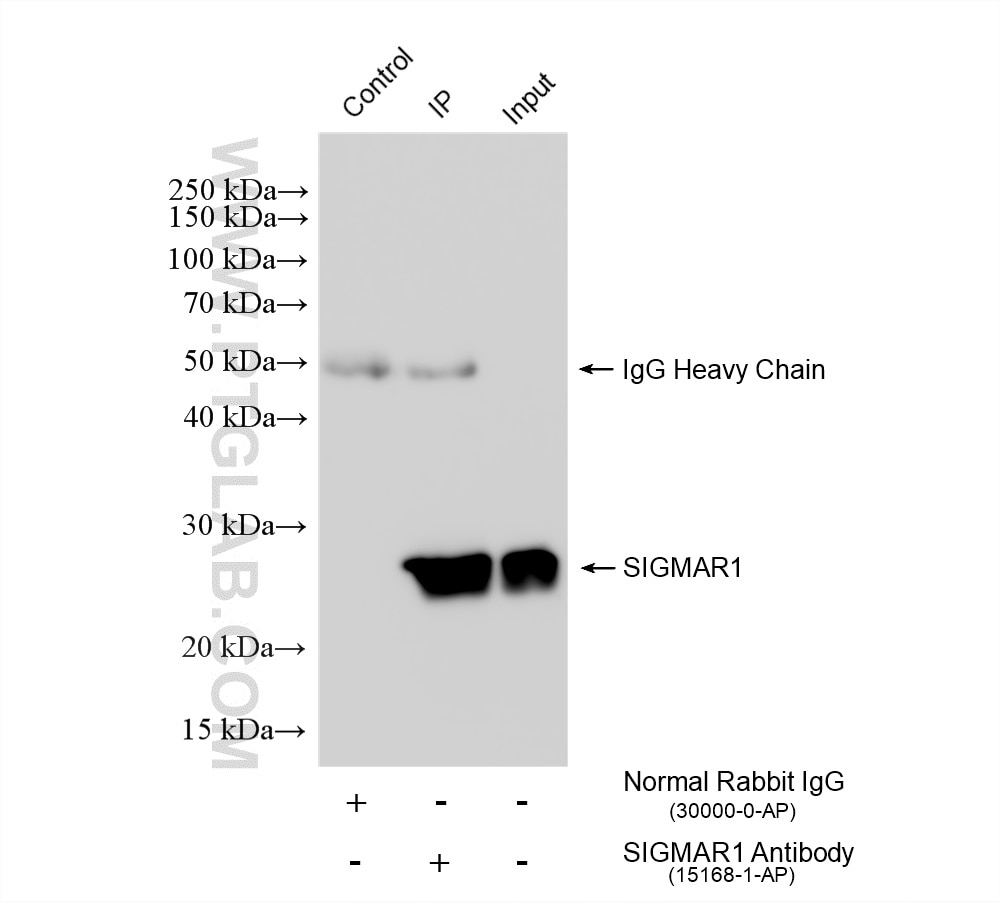
| Positive IP detected in | HEK-293 cells |
| Positive IHC detected in | human liver cancer tissue, rat brain tissue Note: suggested antigen retrieval with TE buffer pH 9.0; (*) Alternatively, antigen retrieval may be performed with citrate buffer pH 6.0 |
Recommended dilution
| Application | Dilution |
|---|---|
| Western Blot (WB) | WB : 1:1000-1:8000 |
| Immunoprecipitation (IP) | IP : 0.5-4.0 ug for 1.0-3.0 mg of total protein lysate |
| Immunohistochemistry (IHC) | IHC : 1:250-1:1000 |
| It is recommended that this reagent should be titrated in each testing system to obtain optimal results. | |
| Sample-dependent, Check data in validation data gallery. | |
Product Information
15168-1-AP targets SIGMAR1 in WB, IHC, IF, IP, CoIP, ELISA applications and shows reactivity with human, mouse, rat, zebrafish samples.
| Tested Reactivity | human, mouse, rat, zebrafish |
| Cited Reactivity | human, mouse, rat, monkey, zebrafish |
| Host / Isotype | Rabbit / IgG |
| Class | Polyclonal |
| Type | Antibody |
| Immunogen |
CatNo: Ag7351 Product name: Recombinant human SIGMAR1 protein Source: e coli.-derived, PGEX-4T Tag: GST Domain: 101-223 aa of BC004899 Sequence: SEYVLLFGTALGSRGHSGRYWAEISDTIISGTFHQWREGTTKSEVFYPGETVVHGPGEATAVEWGPNTWMVEYGRGVIPSTLAFALADTVFSTQDFLTLFYTLRSYARGLRLELTTYLFGQDP Predict reactive species |
| Full Name | sigma non-opioid intracellular receptor 1 |
| Calculated Molecular Weight | 25 kDa |
| Observed Molecular Weight | 27 kDa |
| GenBank Accession Number | BC004899 |
| Gene Symbol | SIGMAR1 |
| Gene ID (NCBI) | 10280 |
| RRID | AB_2301712 |
| Conjugate | Unconjugated |
| Form | Liquid |
| Purification Method | Antigen affinity purification |
| UNIPROT ID | Q99720 |
| Storage Buffer | PBS with 0.02% sodium azide and 50% glycerol, pH 7.3. |
| Storage Conditions | Store at -20°C. Stable for one year after shipment. Aliquoting is unnecessary for -20oC storage. 20ul sizes contain 0.1% BSA. |
Background Information
SIGMAR1, also named as OPRS1, SRBP, SIG-1R and AAG8, belongs to the ERG2 family. It is an endoplasmic reticulum chaperone that binds a wide variety of ligands, including neurosteroids, psychostimulants, and dextrobenzomorphans. SIGMAR1 is ubiquitously expressed, and is enriched in motor neurons of the brain and spinal cord. It plays a role in calcium signaling through modulation together with ANK2 of the ITP3R-dependent calcium efflux at the endoplasmic reticulum. SIGMAR1 plays a role in several other cell functions including proliferation, survival and death. SDS-PAGE and Western blot analysis showed that SIGMAR1 has an apparent molecular mass of 28 kDa. SIGMAR1 has 5 isoforms with MW 21-27kDa and 12kDa.
Protocols
| Product Specific Protocols | |
|---|---|
| IHC protocol for SIGMAR1 antibody 15168-1-AP | Download protocol |
| IP protocol for SIGMAR1 antibody 15168-1-AP | Download protocol |
| WB protocol for SIGMAR1 antibody 15168-1-AP | Download protocol |
| Standard Protocols | |
|---|---|
| Click here to view our Standard Protocols |
Publications
What published studies show
The SIGMAR1 Polyclonal antibody (Cat# 15168-1-AP) has 71 citations. These appear in high-impact journals including Nature, Science, Nature Communications, JCI, PNAS, Cell Reports, Developmental Cell, and journals such as Acta Neuropathologica, Cell Death & Disease, and International Journal of Molecular Sciences. Research fields span neurology (Alzheimer's, stroke, neuropathic pain, neuroinflammation), endoplasmic reticulum–mitochondria contact (MAM) biology, ferroptosis and autophagy, drug addiction, diabetes, nephropathy, and cancer. Applications are predominantly Western blot, with IF, IHC, and IP/Co-IP.
| Species | Application | Title |
|---|---|---|
Science Multiscale photocatalytic proximity labeling reveals cell surface neighbors on and between cells | ||
Nat Commun ATAD3A oligomerization promotes neuropathology and cognitive deficits in Alzheimer's disease models. | ||
Nat Chem Biol CGI1746 targets σ1R to modulate ferroptosis through mitochondria-associated membranes | ||
J Clin Invest Limiting ER-associated degradation capacity triggers acute and chronic effects on insulin biosynthesis.
|
Reviews
What customers say
Both reviews (4/5 and 5/5 stars) report successful use of this antibody for immunofluorescence in zebrafish. One user applied it at 1/200 dilution on frozen zebrafish tissue sections, while the other used a 1:400 dilution for IF in zebrafish embryos with EGFP-labeled ER. Overall, customers found the antibody reliable for zebrafish IF applications at moderate dilutions.
The reviews below have been submitted by verified Proteintech customers who received an incentive for providing their feedback.
Lenie (Verified Customer) (07-15-2025) | Used on frozen section of zebrafish tissue
 |
Anastasia (Verified Customer) (08-07-2024) | SigmaR1 IF in zebrafish embryos with EGFP labeled ER
 |




