
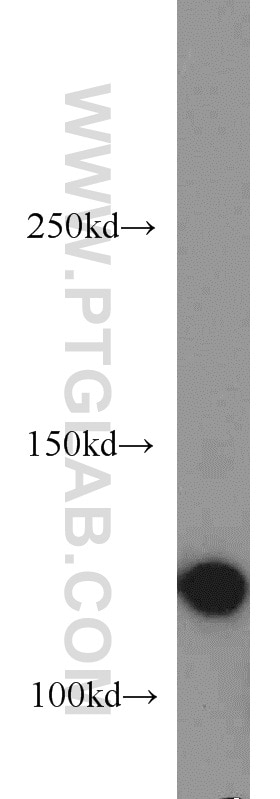
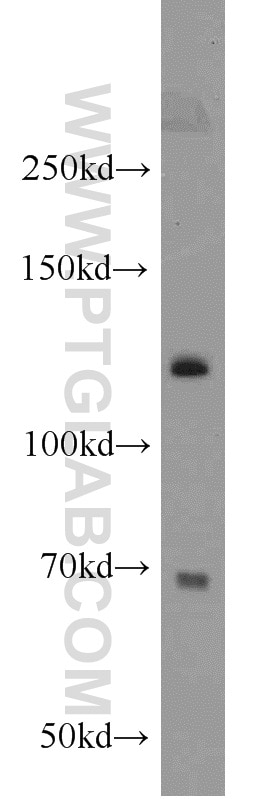

Tested Applications
| Positive WB detected in | HeLa cells |
Recommended dilution
| Application | Dilution |
|---|---|
| Western Blot (WB) | WB : 1:500-1:2000 |
| It is recommended that this reagent should be titrated in each testing system to obtain optimal results. | |
| Sample-dependent, Check data in validation data gallery. | |
Product Information
14178-1-AP targets SMC5 in WB, IF, ELISA applications and shows reactivity with human, mouse, rat samples.
| Tested Reactivity | human, mouse, rat |
| Cited Reactivity | human |
| Host / Isotype | Rabbit / IgG |
| Class | Polyclonal |
| Type | Antibody |
| Immunogen |
CatNo: Ag5385 Product name: Recombinant human SMC5 protein Source: e coli.-derived, PET28a Tag: 6*His Domain: 748-1101 aa of BC038225 Sequence: KLVTELTNLIKICTSLHIQKVDLILQNTTVISEKNKLESDYMAASSQLRLTEQHFIELDENRQRLLQKCKELMKRARQVCNLGAEQTLPQEYQTQVPTIPNGHNSSLPMVFQDLPNTLDEIDALLTEERSRASCFTGLNPTIVQEYTKREEEIEQLTEELKGKKVELDQYRENISQVKERWLNPLKELVEKINEKFSNFFSSMQCAGEVDLHTENEEDYDKYGIRIRVKFRSSTQLHELTPHHQSGGERSVSTMLYLMALQELNRCPFRVVDEINQGMDPINERRVFEMVVNTACKENTSQYFFITPKLLQNLPYSEKMTVLFVYNGPHMLEPNTWNLKAFQRRRRRITFTQPS Predict reactive species |
| Full Name | structural maintenance of chromosomes 5 |
| Calculated Molecular Weight | 1101 aa, 129 kDa |
| Observed Molecular Weight | 120-130 kDa |
| GenBank Accession Number | BC038225 |
| Gene Symbol | SMC5 |
| Gene ID (NCBI) | 23137 |
| RRID | AB_2192775 |
| Conjugate | Unconjugated |
| Form | Liquid |
| Purification Method | Antigen affinity purification |
| UNIPROT ID | Q8IY18 |
| Storage Buffer | PBS with 0.02% sodium azide and 50% glycerol, pH 7.3. |
| Storage Conditions | Store at -20°C. Stable for one year after shipment. Aliquoting is unnecessary for -20oC storage. 20ul sizes contain 0.1% BSA. |
Protocols
| Product Specific Protocols | |
|---|---|
| WB protocol for SMC5 antibody 14178-1-AP | Download protocol |
| Standard Protocols | |
|---|---|
| Click here to view our Standard Protocols |
Publications
What published studies show
The SMC5 Polyclonal antibody (Cat# 14178-1-AP) has 4 citations published in Cell Reports, Stem Cell Reports, mSystems, and Journal of Virology. Research fields span viral replication and host–virus interactions (EBV, adenovirus, DNA viruses), SMC5/6 cohesin complex biology, and cancer-associated copy number variations in human embryonic stem cells.
| Species | Application | Title |
|---|---|---|
Cell Rep Epstein-Barr virus BNRF1 destabilizes SMC5/6 cohesin complexes to evade its restriction of replication compartments. | ||
Stem Cell Reports Early replication fragile sites are associated with cancer-related CNVs and SNVs in human embryonic stem cells. | ||
mSystems Adenovirus Remodeling of the Host Proteome and Host Factors Associated with Viral Genomes
| ||
J Virol PJA1 Coordinates with the SMC5/6 Complex to Restrict DNA Viruses and Episomal Genes through Interferon-independent Manner. |
Reviews
What customers say
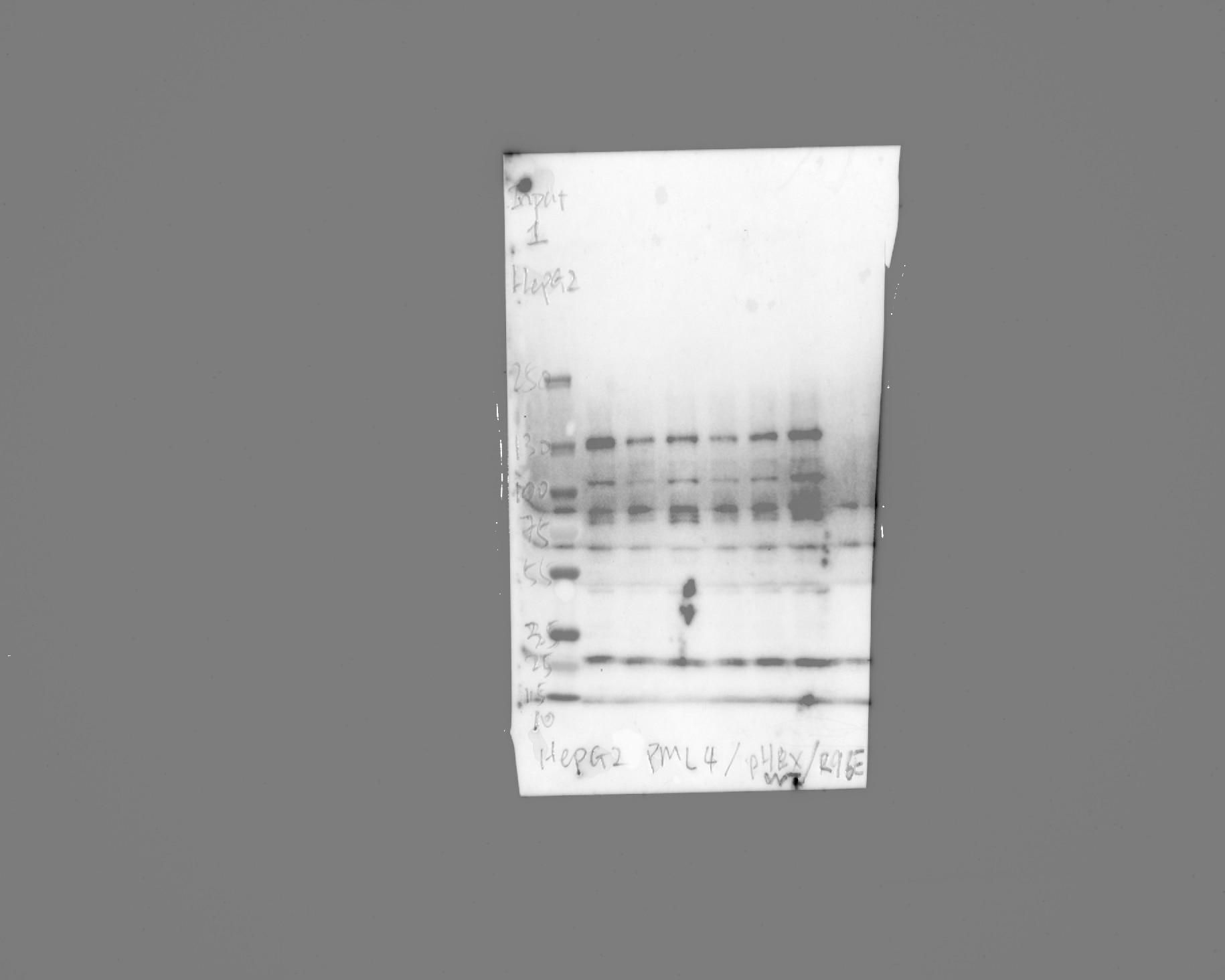
The single review for this antibody reports a fair result for SMC5 detection by Western Blot. The user tested it on HepG2 cells at a 1:1000 dilution and rated it 4 out of 5 stars, describing the performance as acceptable rather than exceptional.
The reviews below have been submitted by verified Proteintech customers who received an incentive for providing their feedback.
James (Verified Customer) (11-30-2022) | The detection of SMC5 by WB is fair with this antibody.
 |



