
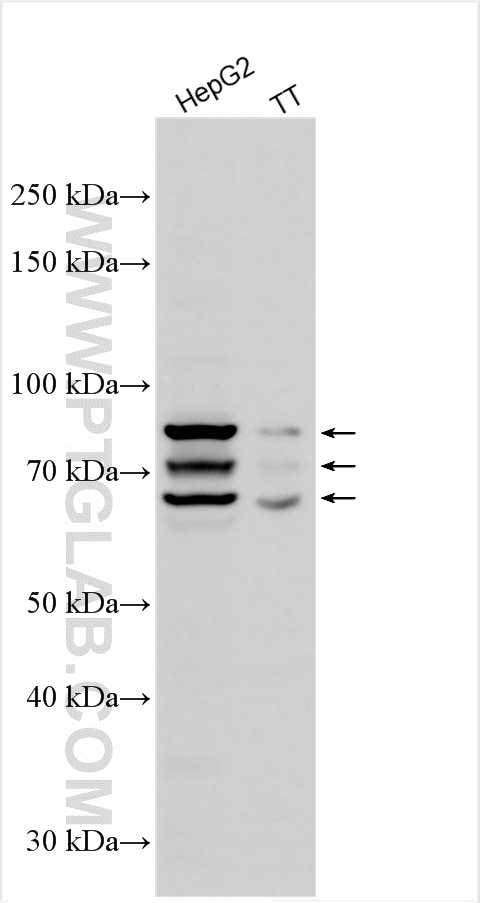
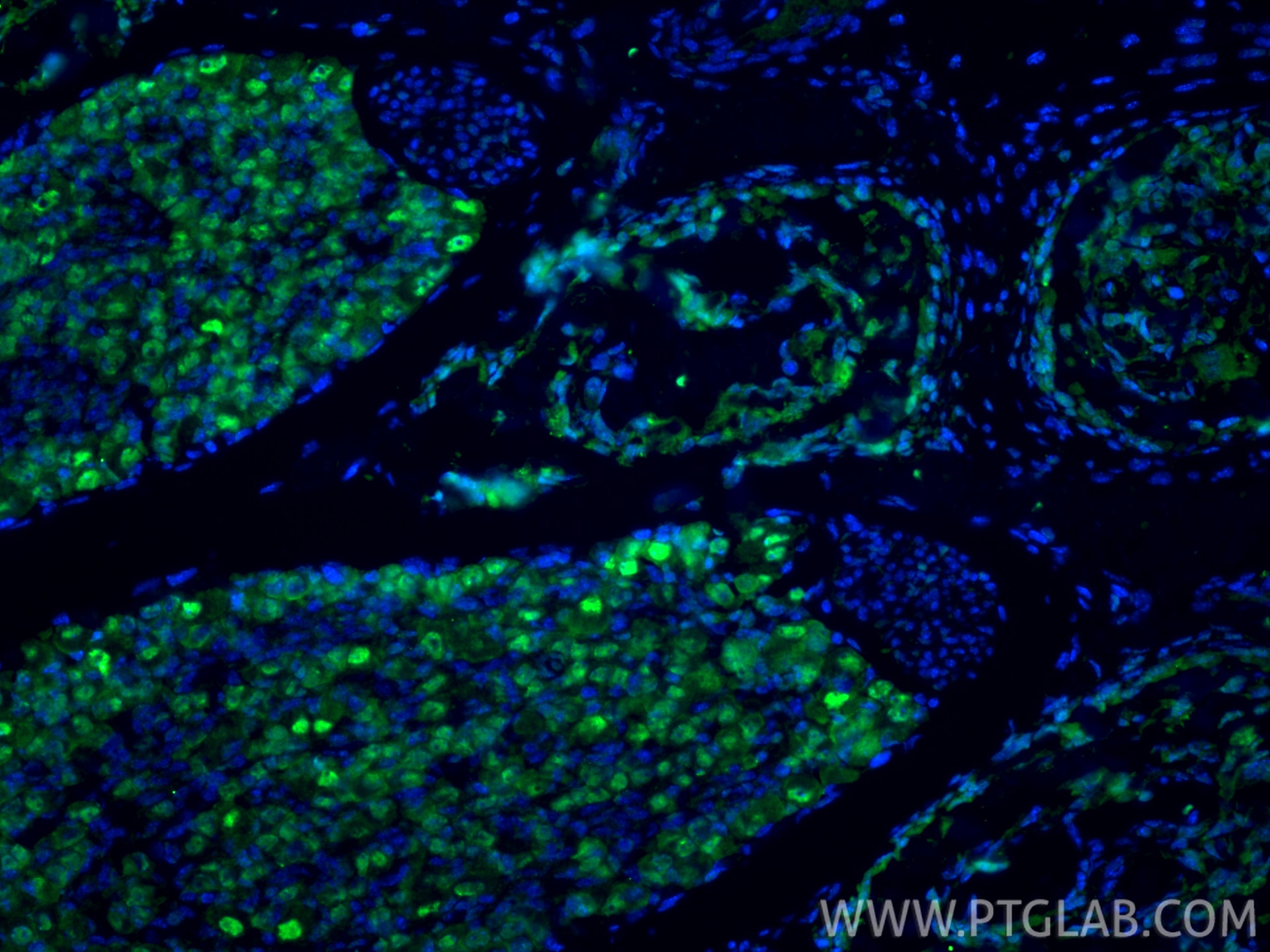

Tested Applications
| Positive WB detected in | HepG2 cells, TT cells |
| Positive IF-P detected in | mouse embryo tissue |
Recommended dilution
| Application | Dilution |
|---|---|
| Western Blot (WB) | WB : 1:1000-1:6000 |
| Immunofluorescence (IF)-P | IF-P : 1:200-1:800 |
| It is recommended that this reagent should be titrated in each testing system to obtain optimal results. | |
| Sample-dependent, Check data in validation data gallery. | |
Product Information
55152-1-AP targets SOX9 in WB, IHC, IF-P, ELISA applications and shows reactivity with human samples.
| Tested Reactivity | human |
| Cited Reactivity | human, mouse, rat, rabbit |
| Host / Isotype | Rabbit / IgG |
| Class | Polyclonal |
| Type | Antibody |
| Immunogen |
Peptide Predict reactive species |
| Full Name | SRY (sex determining region Y)-box 9 |
| Calculated Molecular Weight | 56 kDa |
| Observed Molecular Weight | 56 kDa, 68-75 kDa |
| GenBank Accession Number | NM_000346 |
| Gene Symbol | SOX9 |
| Gene ID (NCBI) | 6662 |
| RRID | AB_3670240 |
| Conjugate | Unconjugated |
| Form | Liquid |
| Purification Method | Antigen affinity purification |
| UNIPROT ID | P48436 |
| Storage Buffer | PBS with 0.02% sodium azide and 50% glycerol, pH 7.3. |
| Storage Conditions | Store at -20°C. Stable for one year after shipment. Aliquoting is unnecessary for -20oC storage. 20ul sizes contain 0.1% BSA. |
Background Information
SOX9, also named as Transcription factor SOX-9, is a 509 amino acid protein. Sex-determining region Y (SRY)-box 9 protein (SOX9) is a member of the SOX family of transcription factors (TFs) which are developmental regulators that possess high mobility group (HMG) box DNA binding and transactivation domains. It participates in a variety of functions, such as lineage restriction and terminal diferentiation, through precise temporal and spatial expression patterns that difer between particular cell types and tissues. SOX9 gene has been implicated in different types of cancer as an oncogene; however, it also may behave as a tumor suppressor. SOX9 can be ubiquitinated or SUMOylated to higher molecular weight (PMID: 24155239; 16307912; 16554309; 32070068)
Protocols
| Product Specific Protocols | |
|---|---|
| IF protocol for SOX9 antibody 55152-1-AP | Download protocol |
| WB protocol for SOX9 antibody 55152-1-AP | Download protocol |
| Standard Protocols | |
|---|---|
| Click here to view our Standard Protocols |
Publications
What published studies show
The SOX9 Polyclonal antibody (catalog no. 55152-1-AP) has 23 citations. These appear in journals including Bioactive Materials, Nature Communications, Journal of Advanced Research, Metabolism, Advanced Science, Carbohydrate Polymers, Journal of Controlled Release, Acta Biomaterialia, Stem Cell Research & Therapy, Cell Signaling, Cartilage, and Bone & Joint Research. Research fields span osteoarthritis, cartilage regeneration, chondrocyte biology, and skeletal development, with additional studies in cancer (gastric, lung, neuroblastoma, hepatocellular), metabolism, and stress/depression.
| Species | Application | Title |
|---|---|---|
Bioact Mater Chondrogenic niche hydrogel microspheres facilitate cartilage regeneration in osteoarthritis. | ||
Bioact Mater Injectable microgels loaded with programmable WELNs based on mendelian randomization macroanalysis alleviate osteoarthritis by restoring the circadian rhythm. | ||
Nat Commun Astrocytic pleiotrophin deficiency in the prefrontal cortex contributes to stress-induced depressive-like responses in male mice | ||
Nat Commun Recapitulation of endochondral ossification by hPSC-derived SOX9+ sclerotomal progenitors | ||
J Adv Res Genomic landscape of paired primary and peritoneal metastatic lesions in gastric cancer highlights evolutionary dynamics and mutational drivers | ||
Metabolism The chemokine CCL20 promotes hepatocyte cholesterol deposition during metabolic dysfunction-associated steatohepatitis by regulating OLR1 expression |
Reviews
What customers say
The single review for this antibody (lot 00115278) is highly positive, rated 5 stars. The user tested it by Western Blot on human iPSC-derived astrocytes at a 1:5000 dilution and described it as a "good antibody for WB." Overall, the feedback indicates reliable performance and strong results for Western Blot applications.
The reviews below have been submitted by verified Proteintech customers who received an incentive for providing their feedback.
Christin (Verified Customer) (02-21-2026) | Good antibody for WB
|



