

Tested Applications
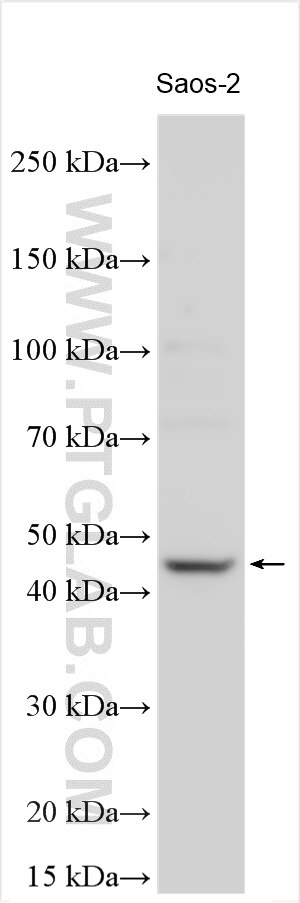
| Positive WB detected in | Saos-2 cells |
Recommended dilution
| Application | Dilution |
|---|---|
| Western Blot (WB) | WB : 1:500-1:2000 |
| It is recommended that this reagent should be titrated in each testing system to obtain optimal results. | |
| Sample-dependent, Check data in validation data gallery. | |
Product Information
28694-1-AP targets SP7 in WB, IHC, IF, ELISA applications and shows reactivity with human samples.
| Tested Reactivity | human |
| Cited Reactivity | human, mouse, rat, rabbit |
| Host / Isotype | Rabbit / IgG |
| Class | Polyclonal |
| Type | Antibody |
| Immunogen |
CatNo: Ag29889 Product name: Recombinant human SP7 protein Source: e coli.-derived, PET28a Tag: 6*His Domain: 1-179 aa of NM_152860 Sequence: MASSLLEEEVHYGSSPLAMLTAACSKFGGSSPLRDSTTLGKAGTKKPYSVGSDLSASKTMGDAYPAPFTSTNGLLSPAGSPPAPTSGYANDYPPFSHSFPGPTGTQDPGLLVPKGHSSSDCLPSVYTSLDMTHPYGSWYKAGIHAGISPGPGNTPTPWWDMHPGGNWLGGGQGQGDGLQ Predict reactive species |
| Full Name | Sp7 transcription factor |
| Calculated Molecular Weight | 45 kDa |
| Observed Molecular Weight | 45 kDa |
| GenBank Accession Number | NM_152860 |
| Gene Symbol | SP7 |
| Gene ID (NCBI) | 121340 |
| RRID | AB_3669667 |
| Conjugate | Unconjugated |
| Form | Liquid |
| Purification Method | Antigen affinity purification |
| UNIPROT ID | Q8TDD2 |
| Storage Buffer | PBS with 0.02% sodium azide and 50% glycerol, pH 7.3. |
| Storage Conditions | Store at -20°C. Stable for one year after shipment. Aliquoting is unnecessary for -20oC storage. 20ul sizes contain 0.1% BSA. |
Background Information
Sp7 is identified in several tissues, including bone, tooth, brain, and the reproductive tract (PMID: 11792318, 33135214, 36881265). In bone, Sp7 is expressed at multiple stages throughout the mesenchymal bone lineage and plays different roles in different osteocytes (PMID: 36881265). SP7 regulates osteoblast differentiation and bone formation through osteoblast target genes by recognizing AT-rich region. In osteocytes, SP7 regulates osteocyte maturation and intracortical remodeling through osteocyte target genes by recognizing TGA(G/T) TCA motif. SP7 also regulates chondrocyte differentiation and endochondral ossification (36881265).
Protocols
| Product Specific Protocols | |
|---|---|
| WB protocol for SP7 antibody 28694-1-AP | Download protocol |
| Standard Protocols | |
|---|---|
| Click here to view our Standard Protocols |
Publications
What published studies show
SP7 Polyclonal antibody (Cat# 28694-1-AP) has 22 citations published across 19 journals, including Nature Communications, Advanced Materials, Advanced Science, Biomaterials, Bioactive Materials, Journal of Advanced Research, and International Journal of Biological Macromolecules. The research fields span osteogenesis and bone biology, osteoporosis, dental and periodontal disease, cartilage repair, tissue engineering with biomaterials/hydrogels, and cardiovascular calcification.
| Species | Application | Title |
|---|---|---|
Bioact Mater Integrated apoptotic extracellular vesicle-recruitment peptide coating reprograms the diabetic bone microenvironment and orchestrates enhanced implant osseointegration. | ||
J Adv Res UHRF1-mediated DNA 5-mC modification drives super-enhancer redistribution and impedes osteogenesis via TGM2-regulated autophagic flux in senile osteoporosis. | ||
J Nanobiotechnology The bone marrow mesenchymal stem cells derived migrasomes induced by Titania nanotubes surface serve as chemotaxis effect for osteogenesis. | ||
Adv Sci (Weinh) Activating the Osteoblastic USP26 Pathway Alleviates Multi-Organ Fibrosis by Decreasing Insulin Resistance. | ||
Adv Sci (Weinh) CGRP Enhances the Regeneration of Bone Defects by Regulating Bone Marrow Mesenchymal Stem Cells Through Promoting ANGPTL4 Secretion by Bone Blood Vessels. | ||
Biomaterials Chaotropic ion-tuned protein/peptide hydrogel with enhanced trans-barrier delivery for effective periodontitis management via pathogen clearance, immunomodulation, and MSC preservation. |


