
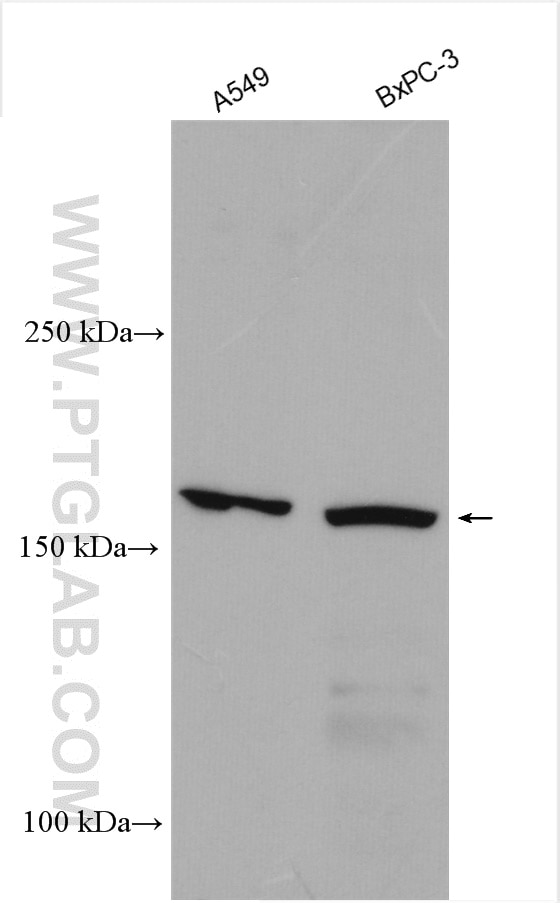
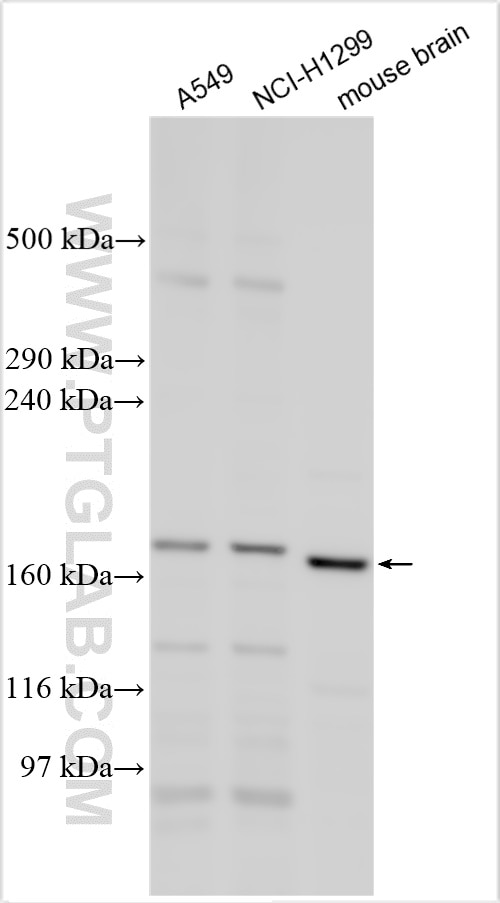

Tested Applications
| Positive WB detected in | A549 cells, NCI-H1299 cells, mouse brain tissue, BxPC-3 cells |
Recommended dilution
| Application | Dilution |
|---|---|
| Western Blot (WB) | WB : 1:500-1:1000 |
| It is recommended that this reagent should be titrated in each testing system to obtain optimal results. | |
| Sample-dependent, Check data in validation data gallery. | |
Product Information
55172-1-AP targets SUR1 in WB, ELISA applications and shows reactivity with human, mouse samples.
| Tested Reactivity | human, mouse |
| Cited Reactivity | mouse |
| Host / Isotype | Rabbit / IgG |
| Class | Polyclonal |
| Type | Antibody |
| Immunogen |
Peptide Predict reactive species |
| Full Name | ATP-binding cassette, sub-family C (CFTR/MRP), member 8 |
| Calculated Molecular Weight | 177 kDa |
| Observed Molecular Weight | 140–177 kDa |
| GenBank Accession Number | NM_000352 |
| Gene Symbol | SUR1 |
| Gene ID (NCBI) | 6833 |
| RRID | AB_3086434 |
| Conjugate | Unconjugated |
| Form | Liquid |
| Purification Method | Antigen affinity purification |
| UNIPROT ID | Q09428 |
| Storage Buffer | PBS with 0.02% sodium azide and 50% glycerol, pH 7.3. |
| Storage Conditions | Store at -20°C. Stable for one year after shipment. Aliquoting is unnecessary for -20oC storage. 20ul sizes contain 0.1% BSA. |
Background Information
SUR1 (Sulfonylurea receptor 1) is a member of the adenosine triphosphate (ATP)-binding cassette (ABC) protein superfamily, which encompasses a large group of membrane proteins that regulate the transport of ions and molecules across lipid bilayers (PMID:34769328). SUR1 regulates ATP-sensitive K+ channels and insulin release. Loss-of-function SUR1 mutations cause congenital hyperinsulinism and gain-of-function SUR1 mutations leading to neonatal diabetes (PMID: 18990670). SUR1 is recognized as a key mediator of central nervous system cellular swelling by the transient receptor potential melastatin 4 (TRPM4) channel. SUR1 (Sulfonylurea receptor 1) is a member of the adenosine triphosphate (ATP)-binding cassette (ABC) protein superfamily, which encompasses a large group of membrane proteins that regulate the transport of ions and molecules across lipid bilayers (PMID:34769328). SUR1 regulates ATP-sensitive K+ channels and insulin release. Loss-of-function SUR1 mutations cause congenital hyperinsulinism and gain-of-function SUR1 mutations leading to neonatal diabetes (PMID: 18990670). SUR1 is recognized as a key mediator of central nervous system cellular swelling by the transient receptor potential melastatin 4 (TRPM4) channel. SUR1 was detected 140-177 kDa in the pancreas, brain, heart (PMID: 34380876).
Protocols
| Product Specific Protocols | |
|---|---|
| WB protocol for SUR1 antibody 55172-1-AP | Download protocol |
| Standard Protocols | |
|---|---|
| Click here to view our Standard Protocols |
Publications
What published studies show
The SUR1 Polyclonal antibody (Cat# 55172-1-AP) has 2 total citations. These appear in ACS Nano (IF 17.3) and Ecotoxicology and Environmental Safety (IF 6.6). The cited research spans cancer nanomedicine—specifically targeted organelle sequestration against breast cancer—and environmental toxicology, focusing on manganese-induced autophagy impairment and oxidative stress injury involving KATP channels.
| Species | Application | Title |
|---|---|---|
ACS Nano Modular Nanoassemblies Mimicking p62 Aggregates for Targeted Organelle Sequestration and Degradation against Breast Cancer | ||
Ecotoxicol Environ Saf Kir6.2-KATP channel: A new target for manganese neurotoxicity induced autophagy impairment and oxidative stress injury. |



