
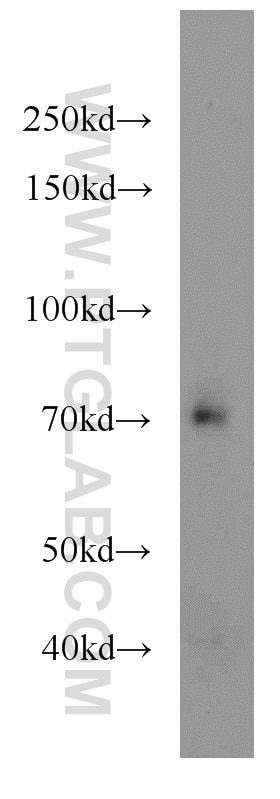



Tested Applications
| Positive WB detected in | mouse liver tissue, human liver tissue, human brain tissue, human heart tissue, HepG2 cells, mouse kidney tissue, mouse heart tissue, mouse placenta tissue, rat liver tissue, HEK-293 cells |
| Positive IP detected in | mouse liver tissue |
Recommended dilution
| Application | Dilution |
|---|---|
| Western Blot (WB) | WB : 1:500-1:1000 |
| Immunoprecipitation (IP) | IP : 0.5-4.0 ug for 1.0-3.0 mg of total protein lysate |
| It is recommended that this reagent should be titrated in each testing system to obtain optimal results. | |
| Sample-dependent, Check data in validation data gallery. | |
Product Information
13838-1-AP targets TCF4/TCF7L2 in WB, IHC, IF, IP, CoIP, ChIP, ELISA applications and shows reactivity with human, mouse, rat samples.
| Tested Reactivity | human, mouse, rat |
| Cited Reactivity | human, mouse, rat, bovine |
| Host / Isotype | Rabbit / IgG |
| Class | Polyclonal |
| Type | Antibody |
| Immunogen |
CatNo: Ag4786 Product name: Recombinant human TCF7L2 protein Source: e coli.-derived, PGEX-4T Tag: GST Domain: 1-355 aa of BC032656 Sequence: MPQLNGGGGDDLGANDELISFKDEGEQEEKSSENSSAERDLADVKSSLVNESETNQNSSSDSEAERRPPPRSESFRDKSRESLEEAAKRQDGGLFKGPPYPGYPFIMIPDLTSPYLPNGSLSPTARTYLQMKWPLLDVQAGSLQSRQALKDARSPSPAHIVSNKVPVVQHPHHVHPLTPLITYSNEHFTPGNPPPHLPADVDPKTGIPRPPHPPDISPYYPLSPGTVGQIPHPLGWQGQPVYPITTGGFRHPYPTALTVNASMSRFPPHMVPPHHTLHTTGIPHPAIVTPTVKQESSQSDVGSLHSSKHQDSKKEEEKKKPHIKKPLNAFMLYMKEMRAKVVAECTLKESAAINQ Predict reactive species |
| Full Name | transcription factor 7-like 2 (T-cell specific, HMG-box) |
| Calculated Molecular Weight | 619 aa, 68 kDa |
| Observed Molecular Weight | 68 kDa |
| GenBank Accession Number | BC032656 |
| Gene Symbol | TCF4 |
| Gene ID (NCBI) | 6934 |
| RRID | AB_2199812 |
| Conjugate | Unconjugated |
| Form | Liquid |
| Purification Method | Antigen affinity purification |
| UNIPROT ID | Q9NQB0 |
| Storage Buffer | PBS with 0.02% sodium azide and 50% glycerol, pH 7.3. |
| Storage Conditions | Store at -20°C. Stable for one year after shipment. Aliquoting is unnecessary for -20oC storage. 20ul sizes contain 0.1% BSA. |
Background Information
TCF7L2 encodes an HMG-box transcription factor and key effector of canonical Wnt/β-catenin signaling, regulating development and tissue homeostasis. It is the strongest genetic susceptibility locus for type 2 diabetes. Alternative splicing produces functionally distinct isoforms, and TCF7L2 variants have also been linked to Crohn's disease and cancer, indicating pleiotropic roles in disease.
Protocols
| Product Specific Protocols | |
|---|---|
| IP protocol for TCF4/TCF7L2 antibody 13838-1-AP | Download protocol |
| WB protocol for TCF4/TCF7L2 antibody 13838-1-AP | Download protocol |
| Standard Protocols | |
|---|---|
| Click here to view our Standard Protocols |
Publications
What published studies show
Anti-TCF7L2 antibody (Cat# 13838-1-AP) has 47 citations published in journals including Nature Microbiology, Oncogene, FASEB Journal, Journal of Biological Chemistry, Cell Death Discovery, International Journal of Biological Sciences, and Biochemical Pharmacology. Research fields cover Wnt/β-catenin signaling, cancer (pancreatic, gastric, breast, ovarian, melanoma), neuroscience (Alzheimer's, depression, epilepsy, stroke), immunology, stem cell biology, metabolic disease, and fibrosis. Applications include WB, IF, IHC, ChIP, CoIP, and IP.
| Species | Application | Title |
|---|---|---|
Cell Mol Immunol TRIM27 maintains gut homeostasis by promoting intestinal stem cell self-renewal | ||
Drug Resist Updat ATP-binding cassette subfamily A member 5 suppresses pancreatic ductal adenocarcinoma progression and chemoresistance by promoting β-catenin ubiquitin-dependent degradation. | ||
Bone Res Single-cell sequencing reveals a senescent immune landscape in bone marrow lesions inducing articular cartilage damage in osteoarthritis. | ||
Nat Microbiol A single-cell transcriptomic atlas reveals senescence and inflammation in the post-tuberculosis human lung | ||
J Control Release Nanoceria drive stem cell hepatic differentiation and microenvironment remodeling for acute liver failure therapy. | ||
Pharmacol Res Targeting aberrant glycosylation to modulate microglial response and improve cognition in models of Alzheimer's disease |



