
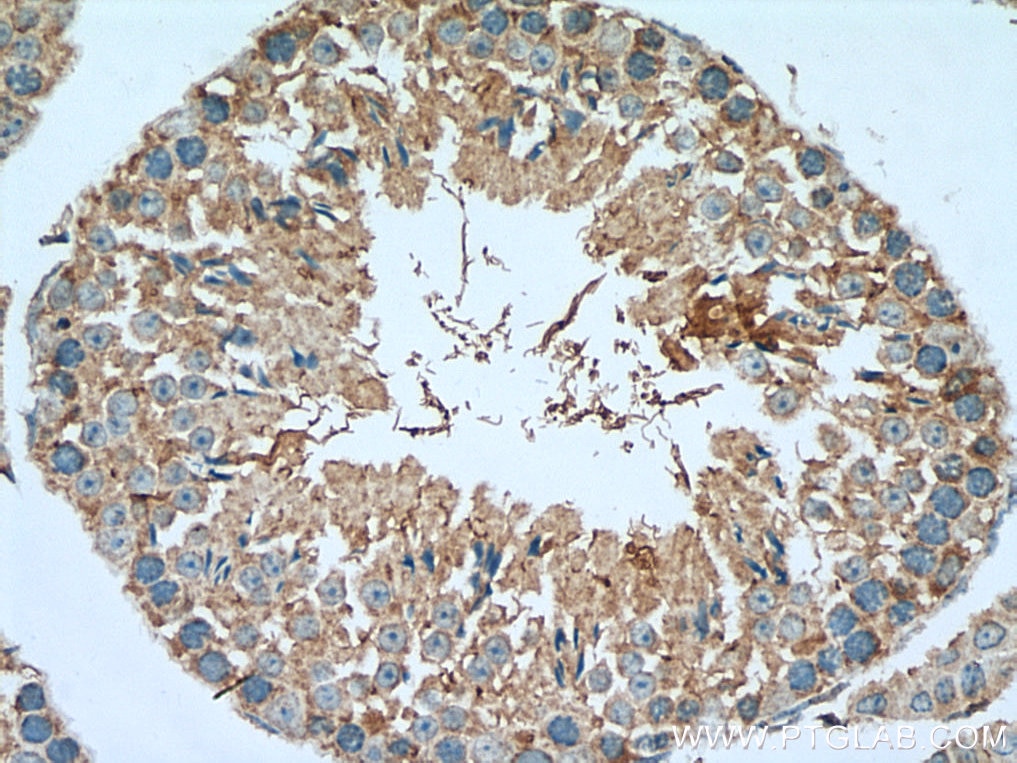

Tested Applications
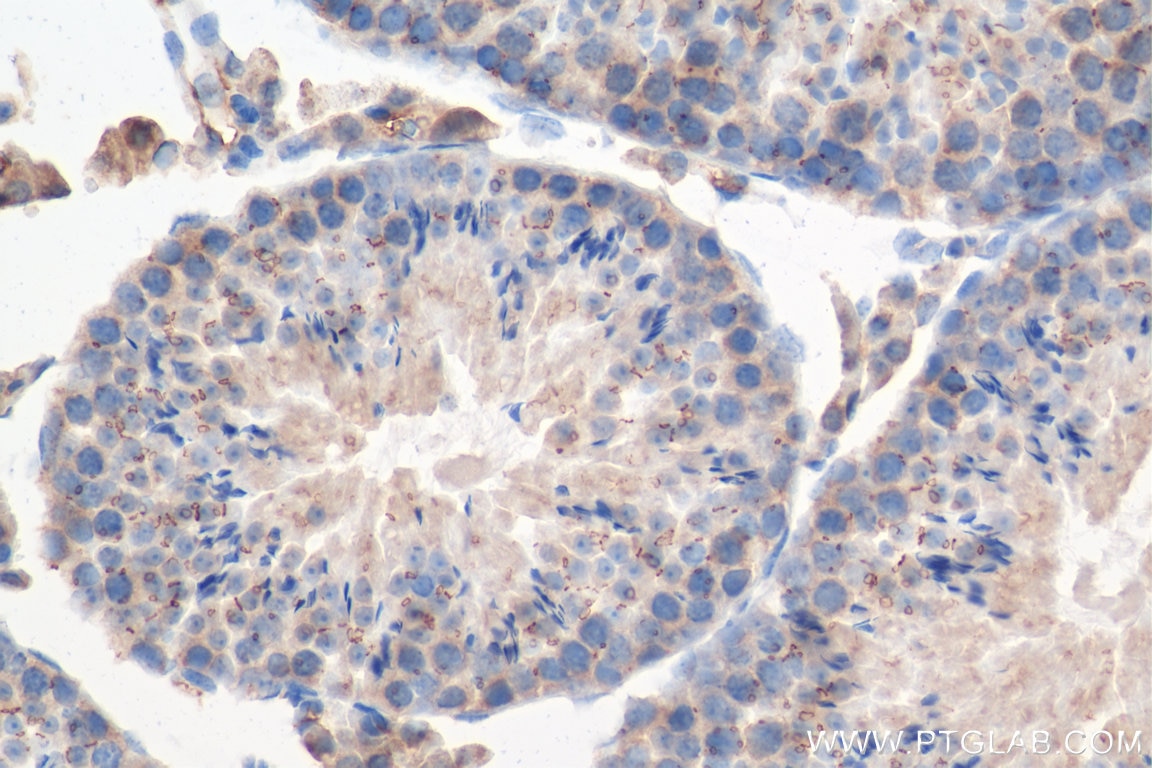
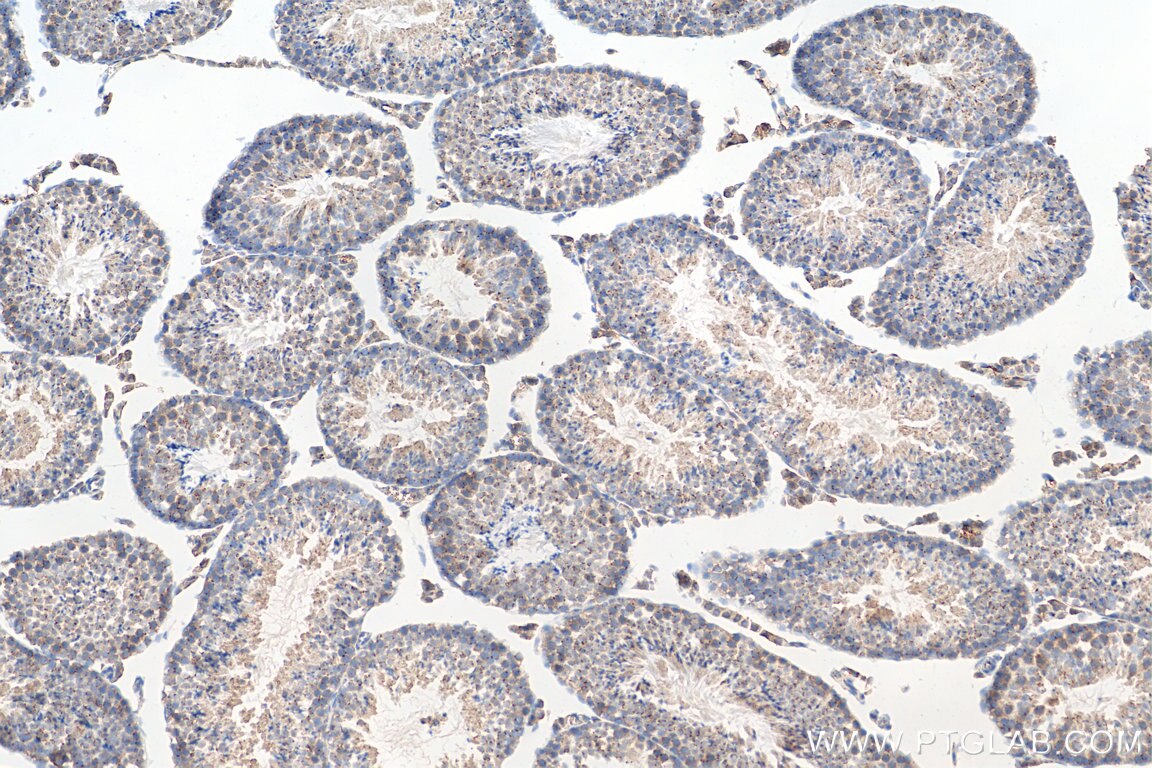
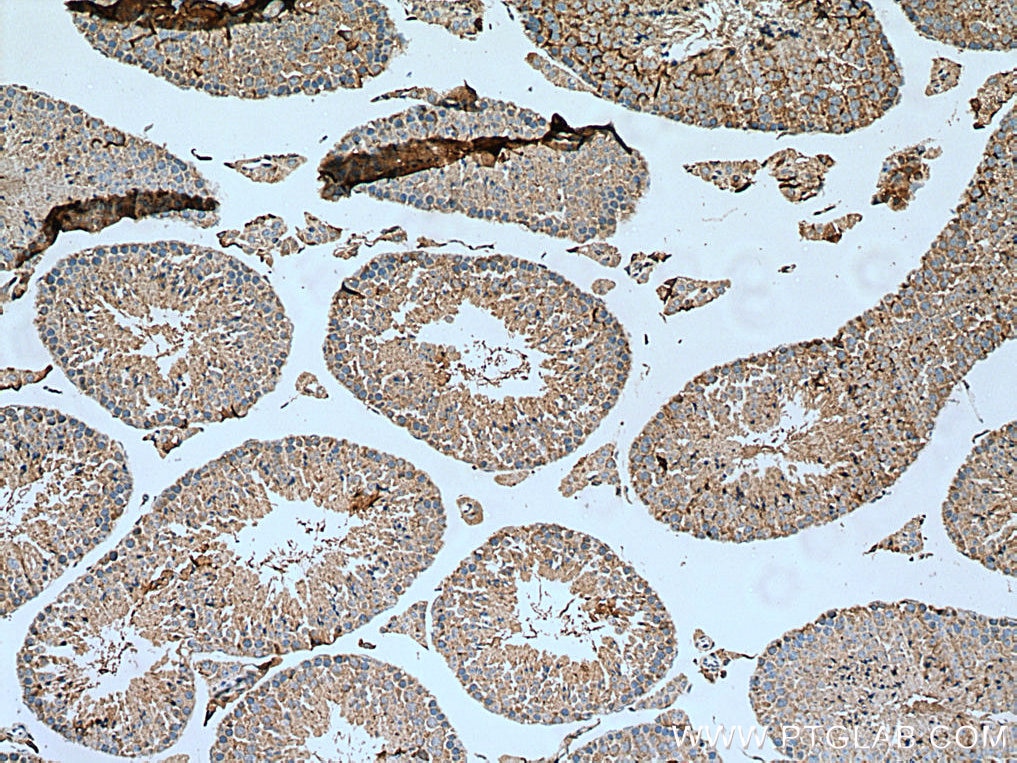
| Positive IHC detected in | mouse testis tissue Note: suggested antigen retrieval with TE buffer pH 9.0; (*) Alternatively, antigen retrieval may be performed with citrate buffer pH 6.0 |
Recommended dilution
| Application | Dilution |
|---|---|
| Immunohistochemistry (IHC) | IHC : 1:400-1:1600 |
| It is recommended that this reagent should be titrated in each testing system to obtain optimal results. | |
| Sample-dependent, Check data in validation data gallery. | |
Product Information
18351-1-AP targets TEX14 in WB, IHC, IF, ELISA applications and shows reactivity with human, mouse samples.
| Tested Reactivity | human, mouse |
| Cited Reactivity | human, mouse |
| Host / Isotype | Rabbit / IgG |
| Class | Polyclonal |
| Type | Antibody |
| Immunogen |
CatNo: Ag13177 Product name: Recombinant human TEX14 protein Source: e coli.-derived, PGEX-4T Tag: GST Domain: 1149-1497 aa of BC040526 Sequence: QPVRSTEDEQEETSKESPKELKEKDISLTDIQDLSSISYEPDSSFKEASCKTPKINHAPTSVSTPLSPGSVSSAASQYKDCLESITFQVKTEFASCWNSQEFIQTLSDDFISVRERAKKLDSLLTSSETPPSRLTGLKRLSSFIGAGSPSLVKACDSSPPHATQRRSLPKVEAFSQHHIDELPPPSQELLDDIELLKQQQGSSTVLHENTASDGGGTANDQRHLEEQETDSKKEDSSMPLSKETEDLGEDTERAHSTLDEDLERWLQPPEESVELQDLPKGSERETNIKDQKVGEEKRKREDSITPERRKSEGVLGTSEEDELKSCFWKRLGWSESSRIIVLDQSDLSD Predict reactive species |
| Full Name | testis expressed 14 |
| Calculated Molecular Weight | 957aa,107 kDa; 1497aa,168 kDa |
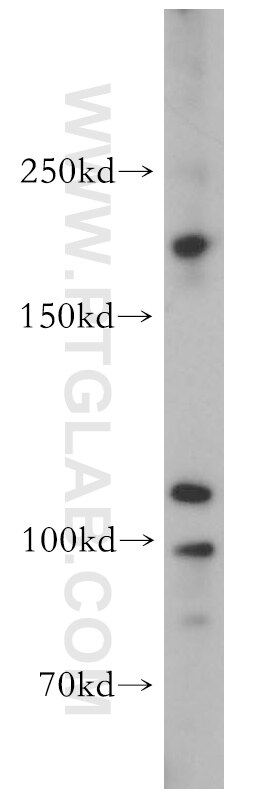
| Observed Molecular Weight | 180-200 kDa, 106 kDa |
| GenBank Accession Number | BC040526 |
| Gene Symbol | TEX14 |
| Gene ID (NCBI) | 56155 |
| RRID | AB_10641992 |
| Conjugate | Unconjugated |
| Form | Liquid |
| Purification Method | Antigen affinity purification |
| UNIPROT ID | Q8IWB6 |
| Storage Buffer | PBS with 0.02% sodium azide and 50% glycerol, pH 7.3. |
| Storage Conditions | Store at -20°C. Stable for one year after shipment. Aliquoting is unnecessary for -20oC storage. 20ul sizes contain 0.1% BSA. |
Background Information
Tex14 is required both for the formation of intercellular bridges during meiosis and for kinetochore-microtubule attachment during mitosis. Intercellular bridges are evolutionarily conserved structures that connect differentiating germ cells and are required for spermatogenesis and male fertility. Tex14 acts by promoting the conversion of midbodies into intercellular bridges via its interaction with CEP55: interaction with CEP55 inhibits the interaction between CEP55 and PDCD6IP/ALIX and TSG101, blocking cell abscission and leading to transform midbodies into intercellular bridges.Tex14 also plays a role during mitosis: recruited to kinetochores by PLK1 during early mitosis and regulates the maturation of the outer kinetochores and microtubule attachment. Tex14 has several variant isoforms with the MW from about 100 kDa to 168 kDa.
Protocols
| Product Specific Protocols | |
|---|---|
| IHC protocol for TEX14 antibody 18351-1-AP | Download protocol |
| WB protocol for TEX14 antibody 18351-1-AP | Download protocol |
| Standard Protocols | |
|---|---|
| Click here to view our Standard Protocols |
Publications
What published studies show
The TEX14 polyclonal antibody (Cat# 18351-1-AP) has 10 citations published in journals including Advanced Science, Cell Death & Disease, Developmental Cell, EMBO Journal, Cell Proliferation, Cells, International Journal of Molecular Sciences, FASEB Journal, eLife, and Methods in Molecular Biology. The research fields span reproductive biology, spermatogenesis, oocyte development, meiosis, cell division, and intercellular bridge formation.
| Species | Application | Title |
|---|---|---|
Adv Sci (Weinh) Microfilament-Myosin II Regulates the Differentiation of Multinucleated Cysts into Oocytes and Influences Oocyte Developmental Potential in Mice. | ||
Cell Death Dis Specific deletion of protein phosphatase 6 catalytic subunit in Sertoli cells leads to disruption of spermatogenesis. | ||
Dev Cell Long-lived cytokinetic bridges coordinate sister-cell elimination in mouse embryos | ||
Cell Prolif YKT6 Is Essential for Male Fertility by Promoting Meiosis Progression During Spermatogenesis of Mice | ||
Cells The Male Mouse Meiotic Cilium Emanates from the Mother Centriole at Zygotene Prior to Centrosome Duplication |






