


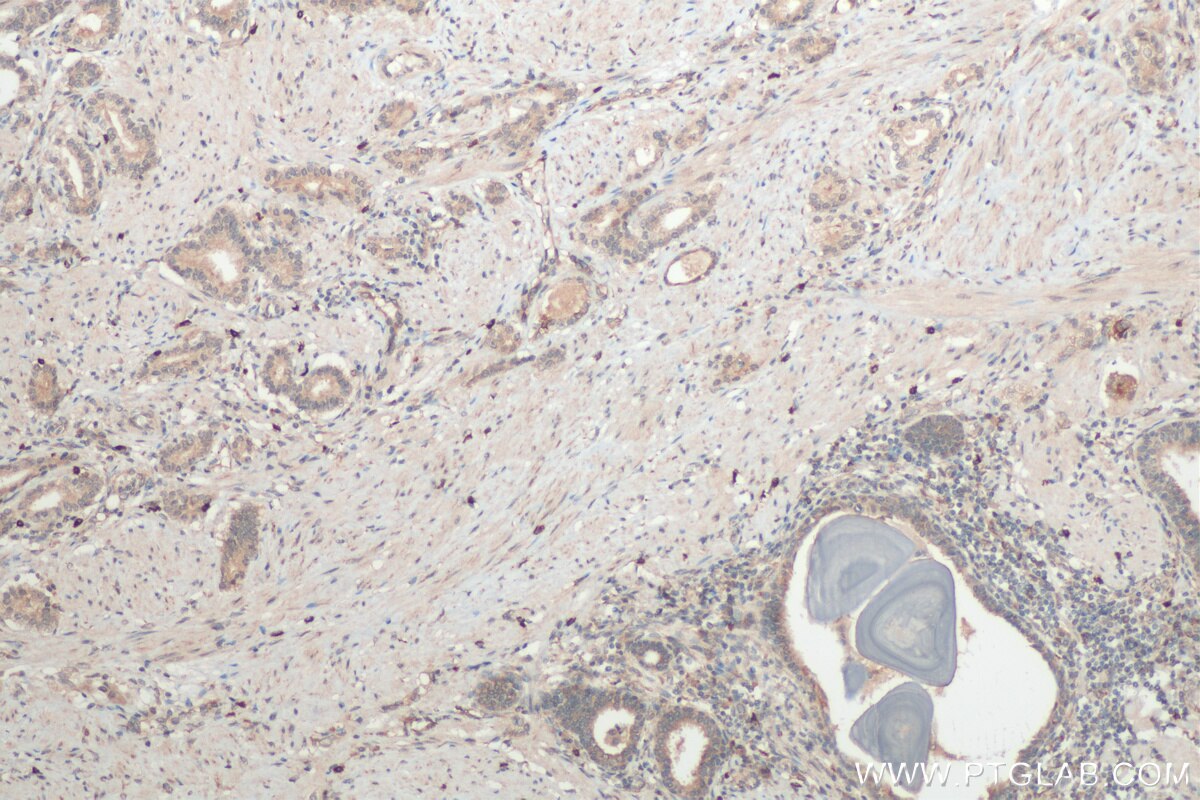


Tested Applications
| Positive WB detected in | A549 cells, U2OS cells, mouse kidney tissue |
| Positive IHC detected in | human prostate cancer tissue Note: suggested antigen retrieval with TE buffer pH 9.0; (*) Alternatively, antigen retrieval may be performed with citrate buffer pH 6.0 |
| Positive IF/ICC detected in | HeLa cells |
Recommended dilution
| Application | Dilution |
|---|---|
| Western Blot (WB) | WB : 1:500-1:2000 |
| Immunohistochemistry (IHC) | IHC : 1:50-1:500 |
| Immunofluorescence (IF)/ICC | IF/ICC : 1:200-1:800 |
| It is recommended that this reagent should be titrated in each testing system to obtain optimal results. | |
| Sample-dependent, Check data in validation data gallery. | |
Product Information
28426-1-AP targets TGFB2/TGF-beta 2 in WB, IHC, IF/ICC, ELISA applications and shows reactivity with human, mouse samples.
| Tested Reactivity | human, mouse |
| Cited Reactivity | human, mouse, rat, rabbit |
| Host / Isotype | Rabbit / IgG |
| Class | Polyclonal |
| Type | Antibody |
| Immunogen |
CatNo: Ag29126 Product name: Recombinant human TGFB2 protein Source: e coli.-derived, PET28a Tag: 6*His Domain: 73-278 aa of NM_001135599 Sequence: STRDLLQEKASRRAAACERERSDEEYYAKEVYKIDMPPFFPSENAIPPTFYRPYFRIVRFDVSAMEKNASNLVKAEFRVFRLQNPKARVPEQRIELYQILKSKDLTSPTQRYIDSKVVKTRAEGEWLSFDVTDAVHEWLHHKDRNLGFKISLHCPCCTFVPSNNYIIPNKSEELEARFAGIDGTSTYTSGDQKTIKSTRKKNSGKT Predict reactive species |
| Full Name | transforming growth factor, beta 2 |
| Calculated Molecular Weight | 48 kDa |
| Observed Molecular Weight | 48 kDa, 51 kDa |
| GenBank Accession Number | NM_001135599 |
| Gene Symbol | TGFB2 |
| Gene ID (NCBI) | 7042 |
| RRID | AB_2918162 |
| Conjugate | Unconjugated |
| Form | Liquid |
| Purification Method | Antigen affinity purification |
| UNIPROT ID | P61812 |
| Storage Buffer | PBS with 0.02% sodium azide and 50% glycerol, pH 7.3. |
| Storage Conditions | Store at -20°C. Stable for one year after shipment. Aliquoting is unnecessary for -20oC storage. 20ul sizes contain 0.1% BSA. |
Background Information
Tranforming growth factor beta-2 (TGFB2), also named G-TSF, BSC-1 cell growth inhibitor, Polyergin and Cetermin, belongs to the TGF-beta family. TGFB2 is a secreted protein and contains a 19aa signal peptides at its N-terminal. Heterodimers with TGFB1 and with TGFB2 have been found in bone. It was proved to have suppressive effects on interleukin-2 dependent T-cell growth.
Protocols
| Product Specific Protocols | |
|---|---|
| IF protocol for TGFB2/TGF-beta 2 antibody 28426-1-AP | Download protocol |
| IHC protocol for TGFB2/TGF-beta 2 antibody 28426-1-AP | Download protocol |
| WB protocol for TGFB2/TGF-beta 2 antibody 28426-1-AP | Download protocol |
| Standard Protocols | |
|---|---|
| Click here to view our Standard Protocols |
Publications
What published studies show
The TGFB2/TGF-β2 Polyclonal antibody (Cat# 28426-1-AP) has 12 citations spanning journals including Advanced Materials, Small, Frontiers in Microbiology, Frontiers in Pharmacology, Cancers, Molecular Carcinogenesis, and Heliyon. Research fields cover oncology (renal, breast, esophageal, colon, and gastric cancers), fibrosis, inflammation, tendon injury, ocular pharmacology, intervertebral disc degeneration, and biomaterials/tissue engineering.
| Species | Application | Title |
|---|---|---|
Adv Mater Multifunctional Injectable Hydrogel as a Biomimic Lens: Optical-Mechanical Restoration and Dynamic Postoperative Microenvironment Regulation. | ||
Small MiR-141-3p-Functionalized Exosomes Loaded in Dissolvable Microneedle Arrays for Hypertrophic Scar Treatment | ||
Front Microbiol Characteristics of Gut Microbiota in Patients With Clear Cell Renal Cell Carcinoma. | ||
Front Cell Infect Microbiol M2-type macrophage nanovesicles regulate the inflammatory response after necrotizing enterocolitis by inducing M1 to M2-like macrophage polarization. | ||
Front Pharmacol 2-Dodecyl-6-methoxycyclohexa-2,5-dien-1,4-dione alleviates liver fibrosis and improves intestinal flora and bile acid metabolism | ||
Front Chem ADSCs Promote Tenocyte Proliferation by Reducing the Methylation Level of lncRNA Morf4l1 in Tendon Injury. |
Reviews
What customers say
The single available review reports a negative experience with this antibody. The user attempted Western Blot at a 1:500 dilution on mouse anterior segment tissue (eyes injected with a vector expressing TGFβ2) and found that the antibody did not produce a usable result. Overall, the feedback indicates the product failed to perform as expected in this specific application and tissue context.
The reviews below have been submitted by verified Proteintech customers who received an incentive for providing their feedback.
Rebecca (Verified Customer) (08-14-2025) | Unfortunately, this antibody did not work in our hands. We attempted to use it for western blot on mouse anterior segment tissue (eyes injected with vector expressing TGFb2).
|





